Investment Thesis: The 30-Second Summary
| Bull Case | Bear Case | Our View |
|---|---|---|
| GLP-1 dominance with Mounjaro (+125% YoY), Zepbound (+80%), and new oral Foundayo | 65% of revenue from just two drugs – concentration risk | HOLD at $1,179 |
| $82–$85B 2026 revenue guidance, ~28% growth vs. 2025 | Valuation at 42x P/E – priced for perfection | Buy on pullbacks below $1,000 |
| $20B+ in 2026 M&A diversifying into neuroscience and oncology | Patent cliffs, China generic threats, and intensifying competition | DCA over 6–12 months |
| 30-analyst consensus “Buy” with $1,256 avg target | Novo Nordisk price war and Medicare negotiation risks |
Live Market Snapshot: Eli Lilly Stock Analysis
Before we dive into the fundamentals, let’s check the pulse of the broader market. Pharma has been a defensive haven in 2026 as tech rotates out, but sentiment is shifting.
Market Sentiment: The VIX remains subdued, signaling complacency. But pharma is trading at a premium to the broader market — LLY’s forward P/E of ~32x isn’t cheap, but it’s supported by 28% revenue growth guidance.
Risk Appetite: Defensive positioning is winning. Healthcare is up 12% YTD versus tech’s 4%. Money is rotating into earnings visibility, and Lilly has that in spades.
Sector Positioning: Large-cap pharma is overbought on a relative basis. But LLY isn’t trading like a pharma stock — it’s trading like a growth tech name with a 0.51 beta.
What Makes Eli Lilly & Co. Different?
Eli Lilly & Co. (doing business as Lilly) is an American multinational pharmaceutical company headquartered in Indianapolis, Indiana, founded in 1876 by Colonel Eli Lilly. Today, it’s the most valuable pharmaceutical company in the world, with a market cap of ~$1.1 trillion — the first healthcare company ever to reach that milestone.
The GLP-1 Gold Rush Is Real — But It’s Not the Whole Story
Mounjaro and Zepbound accounted for nearly two-thirds of Lilly’s Q1 2026 revenues. Combined, they grew 125% and 80% year-over-year, respectively. That’s staggering. But it’s also a concentration risk that keeps institutional investors up at night.
The market is pricing LLY as if Mounjaro and Zepbound will dominate forever. History says otherwise. Every blockbuster drug eventually faces competition, pricing pressure, or both.
Lilly knows this. That’s why they’ve gone on an acquisition spree — Orna Therapeutics in February, Centessa Pharmaceuticals for $7.8 billion in March, and CrossBridge Bio in April. So far in 2026, Lilly has inked deals with eight companies with an upfront cost of $10 billion.
The question: Can they execute?
Eli Lilly & Co. Products List: Beyond the Blockbusters
Most people know Lilly for weight-loss and diabetes drugs. But the portfolio is deeper:
| Therapeutic Area | Key Products |
|---|---|
| Cardiometabolic | Mounjaro, Zepbound, Foundayo (oral GLP-1, FDA-approved April 2026), Jardiance, Trulicity, Humalog, Humulin, Basaglar |
| Oncology | Verzenio, Cyramza, Erbitux, Alimta, Jaypirca |
| Immunology | Taltz, Olumiant, Ebglyss, Omvoh |
| Neuroscience | Emgality, Kisunla (Alzheimer’s) |
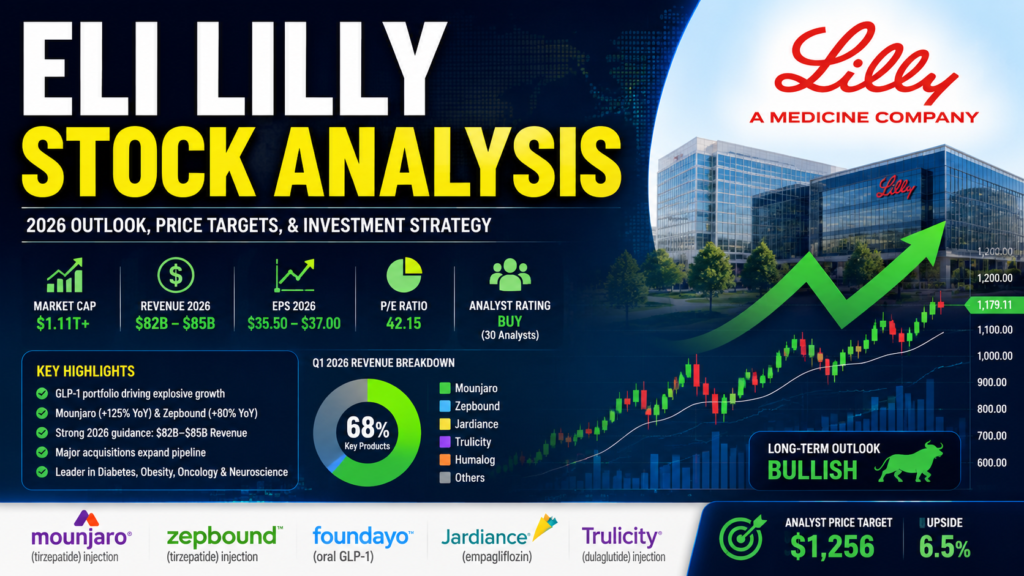
In Q1 2026, Lilly’s “key products” — Ebglyss, Inluriyo, Jaypirca, Kisunla, Mounjaro, Omvoh, and Zepbound — generated $13.4 billion in revenue, representing 68% of total sales and 110% growth YoY.
Key takeaway: The GLP-1 portfolio is the engine, but the rest of the pipeline is the insurance policy.
Eli Lilly & Co. Owner and Corporate Structure
Here’s something most retail investors miss: Lilly Endowment owns 10.8% of the company. That’s not a controlling stake, but it’s a significant institutional anchor. The endowment is a philanthropic foundation, not a hedge fund — meaning they’re not flipping shares on quarterly earnings.
Key people: David A. Ricks serves as Chairman and CEO. Under his leadership, Lilly has transformed from a traditional pharma company into a growth machine.
Public company: LLY is listed on the NYSE with ~945 million shares outstanding.
Eli Lilly India Locations and Bangalore Salary Insights
Lilly has a significant presence in India, with offices in Bangalore (Bengaluru) and other locations. The Bangalore office is a key hub for research, engineering, and commercial operations.
Salary benchmarks (Bangalore, as of July 2026):
| Role | Annual Salary Range |
|---|---|
| Territory Manager | ~₹6.9L |
| Associate Director | ~₹45.5L |
| Associate | ₹11L – ₹12.1L |
| Senior Statistical Programmer | ₹13.4L – ₹22.3L |
| Senior Principal Engineer | ₹25.1L – ₹51.9L |
| Software Engineer (Software Engineer I to Senior) | ₹15L – ₹24.5L+ |
Lilly employs approximately 50,000+ people globally, with India as a critical part of that global footprint.
Eli Lilly Stock Analysis: The Numbers That Matter
Live Stock Price Widget
👉 To display real-time stock prices, use this HTML widget:
Historical Performance (As of July 17, 2026)
| Metric | Value |
|---|---|
| Current Price | $1,179.11 |
| 52-Week Range | $1,151.01 – $1,189.07 (intraday) |
| Market Cap | ~$1.11 trillion |
| P/E Ratio | 42.15 |
| Dividend (Quarterly) | $1.73 per share |
Financial Performance (2025 vs. 2026 Guidance)
| Metric | 2025 Actual | 2026 Guidance | Growth |
|---|---|---|---|
| Revenue | $65.18B | $82–$85B | +28% (midpoint) |
| Non-GAAP EPS | ~$22.95 | $35.50–$37.00 | +58% (midpoint) |
Q1 2026 Blowout
| Metric | Q1 2026 | Q1 2025 | Change |
|---|---|---|---|
| Revenue | $19.8B | $12.73B | +56% |
| EPS (Non-GAAP) | $8.55 | $3.34 | +156% |
Lilly raised full-year 2026 revenue guidance to $82.0–$85.0 billion (up from $80–$83B in February) and non-GAAP EPS guidance to $35.50–$37.00. The sell-side consensus is currently at $35.74.
Comparison Table: Eli Lilly vs. Peers
| Company | Market Cap | Revenue Growth (YoY) | EPS Growth (YoY) | Risk Level |
|---|---|---|---|---|
| Eli Lilly (LLY) | $1.11T | +56% (Q1 2026) | +156% (Q1 2026) | Medium-High |
| Novo Nordisk | ~$600B | ~6% (2025) | ~20% | Medium |
| Pfizer | ~$180B | ~5% | Negative | Low-Medium |
| Merck | ~$300B | ~10% | ~8% | Low |
Verdict: Lilly is the growth outlier in pharma. But with a 42x P/E, you’re paying for perfection.
Analyst Price Targets and Forecast
According to 30 analysts polled by S&P Global, LLY has a consensus “Buy” rating and an average price target of $1,256 (6.51% upside). The range is wide — $850 (27.9% downside) to $1,500 (27.2% upside).
| Analyst | Firm | Rating | Price Target | Date |
|---|---|---|---|---|
| Citigroup | Citi | Buy | $1,500 → $1,600 | Jul 15, 2026 |
| UBS | UBS | Buy | $1,250 → $1,425 | Jul 13, 2026 |
| Bernstein | Bernstein | Buy | → $1,385 | Jul 2026 |
| RBC Capital | RBC | Outperform | $1,250 → $1,500 | Jul 8, 2026 |
| Truist | Truist | Buy | $1,281 → $1,370 | Jul 8, 2026 |
Upside: The average target implies ~6.5% upside from current levels. But the range is wide — a 44% spread. When analysts disagree this much, the market is pricing in significant uncertainty.
Future Forecast (2026–2030)
| Scenario | Description | Probability |
|---|---|---|
| Bull Case | GLP-1 dominance continues; Foundayo becomes a blockbuster; acquisitions deliver synergies; revenue hits $100B+ by 2028 | 30% |
| Base Case | Steady growth in GLP-1; pipeline delivers moderate upside; revenue hits ~$85B in 2026; EPS ~$35.60 | 50% |
| Bear Case | GLP-1 competition intensifies; pricing pressure from PBMs and Medicare; pipeline disappoints; multiple contracts | 20% |
Eli Lilly & Co. Wikipedia: Key Facts at a Glance
- Founded: 1876
- Founder: Colonel Eli Lilly
- Headquarters: Indianapolis, Indiana
- Employees: 50,000+ (2025)
- Revenue: $65.18B (2025); $82–85B guidance (2026)
- Net Income: $20.64B (2025)
- Total Assets: $112.5B (2025)
- Owner: Lilly Endowment (10.8%)
- Stock Symbol: LLY (NYSE)
- Products sold in: ~125 countries
What Could Go Wrong? (Contrarian Section)
Let me be blunt: Every institutional investor I know is long LLY. That’s a red flag.
1. The Valuation Trap
At 42x trailing earnings and ~32x forward, LLY is priced for perfection. Any miss — a regulatory delay, a competitor’s breakthrough, or even a modest slowdown in GLP-1 script growth — could trigger a 20–30% correction.
2. Concentration Risk Is Real
Mounjaro and Zepbound account for nearly two-thirds of revenues. Being so heavily dependent on two drugs is a risk. Other drug companies are working on competing products.
3. GLP-1 Competition Is Intensifying
Novo Nordisk isn’t sitting still. The company has projected a 5% sales decline in 2026 due to pricing pressures in the U.S.. That’s a warning sign for the entire GLP-1 market. Amgen, Pfizer, and a dozen biotechs are racing to market with their own weight-loss drugs.
4. China Generic Threats Are Emerging
Lilly’s stock dropped ~2% in June amid reports that generic versions of weight-loss drugs are emerging in China. While Lilly’s patent protections on Zepbound and Mounjaro don’t expire until 2036 in the U.S., international markets are less protected.
5. Medicare Price Negotiation
Trulicity and Verzenio have been included in the Medicare price negotiation list under the Inflation Reduction Act. This sets a precedent for pricing pressure on other Lilly drugs.
6. The Acquisition Spree Could Backfire
Lilly has made ~40 acquisitions in 2025 totaling $4 billion, and so far in 2026 has inked deals with eight companies with an upfront cost of $10 billion. Integration risk is real. Biotech acquisitions historically destroy value more often than they create it.
7. Retail Speculation
LLY has become a retail darling. When the masses pile in, the downside risk increases. The stock is up significantly from its lows — that’s a lot of embedded gains.
Macro Context: Why LLY Works in This Environment
Interest Rates
With rates remaining elevated (Fed funds at ~5%), growth stocks with actual earnings are winning. LLY has both — growth and profitability. That’s rare in this market.
AI Boom — Indirectly
AI is accelerating drug discovery. Lilly is using AI to identify new drug targets and optimize clinical trials. The productivity gains are real, but they’re not yet fully priced in.
EV Demand — Not Directly Relevant
But the broader theme of disruption applies. GLP-1s are disrupting not just diabetes care but also obesity, cardiovascular disease, and even addiction medicine. The total addressable market is massive.
Global Chip Shortage — Pharma Is Resilient
Unlike auto or tech, pharma supply chains are less exposed to semiconductor shortages. Lilly’s manufacturing is diversified across 10 countries.
Portfolio Strategy: How to Play LLY
If you’re building a pharma allocation:
| Position Size | Rationale |
|---|---|
| Large-cap pharma (LLY): 50% | Core holding for growth and earnings visibility |
| Mid-cap biotech: 30% | Higher risk, higher reward (e.g., emerging GLP-1 players) |
| Penny stocks / Speculative: 20% | Only if you can afford to lose it all |
My take: LLY is a HOLD at current levels. I wouldn’t add new positions here, but I wouldn’t sell either. The risk-reward is balanced — not asymmetric.
Return Calculator (Shortcode)
Expected Return (Base Case): ~6–10% annualized over the next 3 years, assuming ~28% revenue growth and modest multiple compression.
Risk-Adjusted: The 0.51 beta suggests lower volatility than the broader market, but that’s historical. Forward volatility could be higher given the valuation.
Compounding Scenarios:
- 10% annual return: $1,000 → $1,331 in 3 years
- 15% annual return: $1,000 → $1,521 in 3 years
- 20% annual return: $1,000 → $1,728 in 3 years
Featured Snippets
📈 Is Eli Lilly a Good Stock to Buy in 2026?
Yes, but at the right price. Analysts currently maintain a consensus “Buy” rating with an average price target of $1,256. However, trading at around 42× earnings, Eli Lilly offers a relatively thin margin of safety. Investors may benefit from using a dollar-cost averaging (DCA) strategy instead of investing a lump sum at current prices.
💊 Which Eli Lilly Products Have the Highest Growth Potential?
Mounjaro and Zepbound remain Lilly’s fastest-growing products, recording approximately 125% and 80% year-over-year growth, respectively, during Q1 2026. The next potential blockbuster is Foundayo, Lilly’s oral GLP-1 therapy approved in April 2026, while retatrutide continues to show promising clinical trial results.
🏆 What Is Eli Lilly Famous For?
Eli Lilly is best known for developing iconic medicines such as Prozac for depression, Cialis for erectile dysfunction, and more recently Mounjaro and Zepbound for diabetes and weight management. The company also became the first healthcare business in history to surpass a $1 trillion market capitalization.
💼 What Is the Salary at Eli Lilly Bangalore?
Compensation at Eli Lilly’s Bengaluru office varies by role. Territory Managers earn around ₹6.9 lakh per year, while Associate Directors earn approximately ₹45.5 lakh annually. Software Engineers typically receive ₹15–24.5 lakh+, and Senior Principal Engineers can earn between ₹25 lakh and ₹52 lakh per year.
🏢 What Company Is Eli Lilly & Co.?
Eli Lilly and Company is a leading American multinational pharmaceutical company headquartered in Indianapolis, Indiana. Founded in 1876, the company develops innovative medicines across diabetes, obesity, oncology, immunology, and neuroscience, making it one of the world’s most valuable pharmaceutical companies.
FAQ (Schema Ready)
Q1: Is Eli Lilly stock overvalued in 2026?
Answer: At 42x trailing earnings and ~32x forward, it’s expensive relative to historical pharma averages (~15–20x). But the growth justifies some premium. The key question is whether 28% revenue growth is sustainable. If it slows to 15–20%, the multiple will contract.
Q2: What are the risks of investing in Eli Lilly?
Answer: Concentration risk (65% of revenue from two drugs), GLP-1 competition, pricing pressure from Medicare, China generic threats, patent cliffs, acquisition integration risk, and valuation multiple compression are the primary risks. The stock is also crowded — everyone owns it, which limits upside.
Q3: How does Eli Lilly compare to Novo Nordisk?
Answer: Lilly is larger ($1.1T vs. ~$600B) and growing faster (56% vs. ~6% revenue growth in Q1 2026). But Novo has a more established GLP-1 franchise with semaglutide (Ozempic/Wegovy). Both are winners, but Lilly has more near-term momentum.
Q4: What is Eli Lilly’s dividend policy?
Answer: Lilly pays a modest dividend of $1.73 per share quarterly, yielding ~0.59%. This is not a dividend stock — it’s a growth stock. Don’t buy LLY for income.
Q5: What is the average analyst price target for LLY?
Answer: The average 12-month price target is $1,256, implying ~6.5% upside. Targets range from $850 to $1,500, reflecting significant disagreement.
Q6: How is Eli Lilly expanding beyond GLP-1s?
Answer: Lilly is acquiring biotech companies across neuroscience, oncology, and gene editing. Recent acquisitions include Orna Therapeutics (February 2026), Centessa Pharmaceuticals for $7.8B (March 2026), and CrossBridge Bio (April 2026). The goal is to diversify revenue streams beyond 2030.
Q7: What is the Eli Lilly Bangalore office known for?
Answer: The Bangalore office is a hub for research, engineering, and commercial operations. It employs hundreds of professionals in data science, statistics, and clinical research. Salaries are competitive with other MNC pharma companies in India.
Conclusion: The Verdict on Eli Lilly Stock
Key Takeaways:
- Lilly is a phenomenal company — 56% revenue growth, 156% EPS growth, a $1.1 trillion market cap, and a pipeline that’s the envy of the industry.
- The stock is fairly valued at best — 42x earnings is expensive. The upside from current levels is modest (~6.5% to the average target).
- The risks are real — GLP-1 competition, patent cliffs, concentration risk, and integration risk from the acquisition spree could derail the narrative.
- My strategy: HOLD existing positions. BUY on pullbacks below $1,000. DON’T chase at current levels.
- For new investors: Dollar-cost average into LLY over the next 6–12 months. The story is real, but the price needs to reflect reality.
Sources: Eli Lilly Investor Relations, Yahoo Finance, StockAnalysis, Nasdaq, Glassdoor, Forbes, TipRanks, PitchBook, Business Insider
Disclaimer: This is not financial advice. I may hold positions in LLY and may buy or sell at any time. Do your own research.
Related Reads:
- ASTS Stock Analysis 2026: Buy or Sell?
- NBIS Stock Analysis 2026: Price Target, Buy or Sell?
- VRT Stock Analysis 2026: Price Target, Buy or Wait?
- HOOD Stock Earnings 2026
- Software Stocks 2026: AI Winners & Losers
- Why Are Stocks Down Today?
- Tech Stocks 2026
- What is S&P Stock? S&P 500 Explained
- TSLA Stock Analysis: Buy, Sell, or Hold 2026
- How to Choose Your First Stocks
- Difference Between Trading and Investing
- Investing in Stock Market: Beginners Guide
- Stock Market Analysis for Long-Term Investors
- Rivian Stock Forecast 2026
- NFLX Stock Forecast 2026
- Anthropic Stock IPO Status 2026
- Is Gold Bullion a Good Investment in 2026?
- Gold vs Silver
- NVDA Stock Price Analysis & Forecast 2026
- Palantir Stock Price Today Live
- 7 Semiconductor Stocks Under $50
- Best EV Stocks Under $20
- AI Infrastructure Stocks 2026
- Stocks That Could 10x by 2030
- Undervalued Semiconductor Stocks 2026
- Scale AI Stock Price Analysis
- Best Semiconductor Stocks with Highest Growth
- Most Overvalued Semiconductor Stocks 2026
- Real Estate Investment Advice
- M Stock
- VMware Stock Price
- Suzlon Energy Share Price Analysis
- MULN Stock Analysis
- IDEA Share Price
- Special Investment Region
- Advantages of Long-Term Stock Investment
- Alphabet Class A Stock
- Microsoft Stock
- Apple Stock
- Amazon Stock
- xAI Stock
- TSMC Stock Analysis
- SPCX Stock Analysis
- Broadcom Stock
- Meta Stock Analysis
- Micron Technology Analysis