
Written by:
Shourya Singh
Technology & Equity Research Analyst
Coverage: Semiconductors, AI infrastructure, global technology stocks.
Experience: 10+ years analyzing public companies and technology markets.
Reviewed by:
Ashish Pal
Senior Investment Analyst
Former quantitative researcher with 15 years of experience in Asia-Pacific equity markets.
Editorial Disclaimer: Our research team independently analyzes companies using financial reports, earnings calls, SEC filings, and industry data. This article does not constitute financial advice. Data as of July 14, 2026.
TSMC Stock Analysis 2026: Quick Summary
| Aspect | Assessment |
|---|---|
| Current View | Neutral / Long-term bullish |
| Strength | AI chip manufacturing dominance (73% foundry market share) |
| Biggest Risk | Taiwan geopolitical uncertainty + semiconductor cycle turning |
| Valuation | Premium priced (32.95x trailing P/E) |
| Long-term Outlook | Positive, but pullbacks expected |
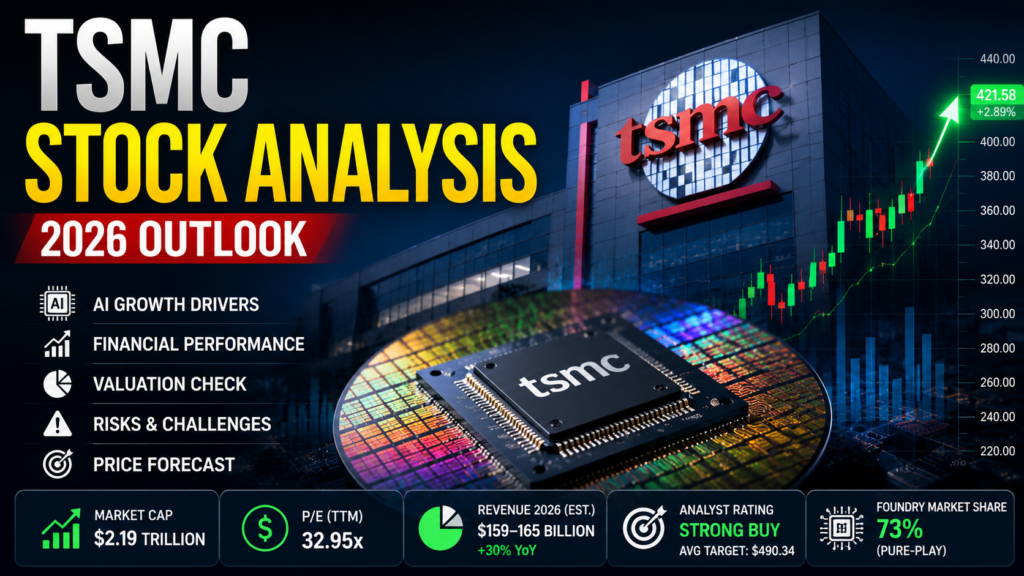
| Analyst Consensus | Strong Buy (19 analysts, avg target $490.34) |
Live Market Snapshot
Market Sentiment: Cautiously bullish but fraying. TSMC shares closed at $421.58 on July 13, 2026, down 2.89% on the day, with a session high of $437.99 and low of $420.29. The stock recently sat approximately 20% off its 52-week high of $479.00. Volume was elevated at 14.2 million shares.
Risk Appetite: Institutional investors are closely watching concentration risks. TSMC’s market capitalization stood at approximately $2.19 trillion as of July 13, 2026.
Sector Positioning: The global semiconductor industry is projected to surpass $1.29 trillion in 2026, up 52.8% from $842.8 billion in 2025, according to IDC. Gartner forecasts semiconductor revenue will grow 64% in 2026, the highest growth in two decades.
Introduction: The Most Important Company You Can’t Ignore
Here’s the thing about TSMC that most retail investors miss: it’s not a chip company. It’s a bottleneck. Every advanced AI processor—Nvidia’s Blackwell, AMD’s MI series, Apple’s silicon, every custom accelerator from Meta to Google—runs through the same foundry in Taiwan’s Hsinchu Science Park.
That’s not a business model. That’s a single point of failure for the entire global AI economy.
Taiwan Semiconductor Manufacturing Company Ltd. (NYSE: TSM) has become the most critical piece of infrastructure in the technology world. At approximately $2.19 trillion market cap, it’s Asia’s most valuable company. But at 32.95x trailing earnings and 22.48x forward, you’re not paying for what it is today. You’re paying for what it might become—and betting that nothing goes wrong along the way.
Let’s be clear: semiconductor investing requires navigating extreme cycles. I’ve experienced both the euphoria of riding AI-driven rallies and the pain of watching “can’t miss” semi stocks miss spectacularly when cycles turned. TSMC is different—but it’s not immune.
What Is Taiwan Semiconductor Manufacturing Company Ltd.?
Short answer: The world’s largest dedicated independent semiconductor foundry. It doesn’t design chips—it manufactures them for everyone else.
Founded in 1987 by Morris Chang as a joint venture between Taiwan’s government, the Industrial Technology Research Institute (ITRI), and private investors, TSMC pioneered the “pure-play” foundry model. Before TSMC, chip companies designed and manufactured their own products. TSMC said: you design, we manufacture. That model enabled the rise of fabless giants like Nvidia, AMD, and Qualcomm.
Products: TSMC manufactures integrated circuits and wafer semiconductor devices for high-performance computing, smartphones, IoT, automotive, and digital consumer electronics. Its advanced process technologies include 3nm, 2nm (N2), and the upcoming A16 (1.6nm) node. In Q1 2026, 3nm accounted for 25% of total wafer revenue; 5nm for 36%; and 7nm for 13%. Advanced technologies (7nm and more advanced) accounted for 74% of total wafer revenue.
Headquarters: No. 8, Li-Hsin Road 6, Hsinchu Science Park, Hsinchu, Taiwan. Contact: +886-3-5636688.
Ownership: Widely held. Major institutional holders include Vanguard Fiduciary Trust Company (~0.81%, 209.5 million shares) and Fidelity Contrafund (~5.56 million shares). Institutional ownership is approximately 47.20%. No single entity has majority control.
The Numbers That Matter: TSMC by the Data
Taiwan Semiconductor Manufacturing Company Ltd. Share Price & Valuation (As of July 13, 2026)
| Metric | Value |
|---|---|
| Market Cap | ~$2.19T |
| Share Price (TSM ADR) | $421.58 |
| 52-Week High | $479.00 |
| 52-Week Low | $223.70 |
| Trailing P/E | 32.95x |
| Forward P/E | 22.48x |
| Price/Sales | 15.32x |
| P/B Ratio | 10.60x |
| Dividend Yield | ~0.73% |
| Beta | 1.25 |
| Analyst Consensus | Strong Buy |
| Average Price Target | $490.34 |
| Shares Outstanding | 5.19B |
Sources: StockAnalysis.com, Yahoo Finance, Morningstar
The takeaway: A 32.95x trailing P/E for a cyclical semiconductor company is not cheap. The forward P/E of 22.48x is more reasonable but still assumes flawless execution.
Historical Performance
| Stock | 3-Year Return | 5-Year Return | Volatility (Beta) |
|---|---|---|---|
| TSMC (TSM) | ~351.91% | ~290.63% | 1.25 |
Source: Motley Fool
The pattern: TSMC has massively outperformed over 3 and 5 years. But the stock recently sat ~20% off its highs—a potential warning sign.
Why TSMC Matters: The AI Monopoly Nobody Talks About
Taiwan Semiconductor Manufacturing Company Ltd. Products: The AI Engine
TSMC’s product portfolio spans the entire semiconductor value chain, but the real story is advanced nodes. The company commands roughly 73% of the global pure-play foundry market in Q1 2026, according to Counterpoint Research. In advanced chips (sub-7nm), that share exceeds 90%. In the broader “Foundry 2.0” market (including IDMs and OSATs), TSMC leads with 38% share—more than the next ten competitors combined.
Revenue breakdown by platform (Q1 2026):
- High-Performance Computing (HPC): 61%
- Smartphone: 26%
- IoT: 6%
- Automotive: 4%
Source: TSMC Q1 2026 Earnings Report
Key products and technologies:
| Technology | Status | Significance |
|---|---|---|
| 3nm (N3) | Volume production | 25% of Q1 wafer revenue; price hikes of 5-15% planned |
| 2nm (N2) | Volume production H2 2026 | 70% capacity CAGR; Apple secured 50%+ of output |
| A16 (1.6nm) | Volume production late 2026 | “Super Power Rail” backside power |
| CoWoS Packaging | Critical bottleneck | 115,000-140,000 wafers/month by end 2026 |
The AI revenue number: TSMC is on track to generate over $40 billion from AI chips in 2026—close to 25% of total revenue.
The overlooked detail: That 25% AI revenue share means 75% of TSMC’s revenue still comes from non-AI sources—smartphones, automotive, IoT, consumer electronics. Those markets are not growing at 60% annually. The AI boom is masking cyclical weakness elsewhere.
The Bull Case: Why TSMC Could Keep Going
1. Unassailable Market Position
TSMC’s 73% pure-play foundry market share isn’t just dominance—it’s a moat. Samsung Foundry (6.5%) and SMIC (5.0%) aren’t catching up. Counterpoint Research data confirms TSMC’s revenue grew by 40.5%, outpacing the average market growth rate.
2. Pricing Power
TSMC has notified core customers including Nvidia, Apple, and AMD of planned 5-10% price hikes on 3nm, 5nm, and 7nm processes—covering over 70% of wafer revenue. For 3nm wafers specifically, increases could reach 15% in the second half of 2026. When you control 90%+ of the advanced chip market and can’t meet demand, you set prices.
3. Massive Capacity Expansion
TSMC is investing $165 billion in Arizona—five new fabrication facilities and two advanced packaging plants. The company received official clearance to inject an additional $20 billion into its U.S. subsidiary, bringing total approved U.S. investment to $44 billion. Global capex for 2026 is guided at $52-56 billion. Morgan Stanley estimates TSMC’s 2026-2028 capital expenditure could reach $200 billion.
4. Record Financial Performance
- Q1 2026 revenue: NT$1,134.10 billion ($35.90 billion), up 40.6% YoY
- Q1 2026 net income: NT$572.48 billion ($18.16 billion), up 58.3% YoY
- Q1 2026 gross margin: 66.2%—a two-decade high
- Q1 2026 EPS: NT$22.08 ($3.49 per ADR unit)
- June 2026 revenue: NT$442.68 billion ($14.6 billion), up 67.9% YoY
- H1 2026 revenue: NT$2,404.48 billion ($74.99 billion), up 35.6% YoY
- Full-year 2026 guidance: Revenue growth more than 30% in U.S. dollar terms
5. Analyst Optimism
According to 19 analysts polled by S&P Global, TSMC stock has a consensus rating of “Strong Buy” and an average price target of $490.34—16.31% upside from current levels. Estimates range from $354 (bear) to $700 (bull).
Recent analyst actions:
- Goldman Sachs: Raised target to $600; raised 2026-2027 EPS forecasts by 4-6%
- HSBC: Raised target to NT$3,350; raised 2026/27 EPS forecasts by 5% and 14%
- Bank of America: Raised 2026-2028 EPS forecasts
- UBS: Hiked price target to T$3,400 from T$3,000
- Barclays: Raised target from $470 to $625
6. The Trillion-Dollar Industry Tailwind
The global semiconductor market is projected to surpass $1.29 trillion in 2026, up 52.8% year-over-year. Gartner forecasts semiconductor revenue will grow 64% in 2026, the highest growth in two decades.
The Bear Case: What Could Go Wrong
This is the section most retail investors skip. Don’t be that investor.
1. Semiconductor Cycles Don’t Disappear
The semiconductor industry is inherently cyclical. The current upturn has been extraordinary—the industry grew more than 20% in 2025 and is expected to grow significantly in 2026. Two consecutive years of exceptional growth is historically rare. Mean reversion is real.
The warning signs:
- TSMC shares have gained more than 52% YTD in 2026—priced for perfection
- The stock recently sat ~20% off its 52-week high
- Wedbush flagged potential headwinds later in 2026, including costs associated with ramping 2nm production, expansion of U.S.-based fabrication capacity, and broader geopolitical risks
2. Overvaluation Risk
| Metric | TSMC | Notes |
|---|---|---|
| P/E (TTM) | 32.95x | Above historical averages for cyclicals |
| P/B | 10.60x | Reflects premium pricing |
| P/S | 15.32x | Elevated |
| EV/EBITDA | 21.24x |
Source: StockAnalysis.com
The real risk: The forward P/E of 22.48x assumes 2026 earnings growth of ~50%. If that growth disappoints, the multiple compresses and earnings fall—a classic double whammy.
3. Geopolitical Gunpowder
TSMC is headquartered in Taiwan. China claims Taiwan as its territory. The U.S. is increasingly reliant on TSMC for critical AI and defense chips. This is the single largest geopolitical risk in the global economy.
TSMC CEO C.C. Wei acknowledged that the company won’t be able to fulfill demand led by American customers even as more manufacturing capacity comes online in the U.S. The main risk is not demand—it is geographic concentration in Taiwan and the speed at which it can expand in the U.S..
4. Energy Constraints
Semiconductor leaders fear they may not be able to procure enough energy to power advanced manufacturing facilities. TSMC’s fabs are among the most energy-intensive facilities on Earth. Taiwan’s grid stability remains a concern.
5. The AI Spending Slowdown
Most of the demand TSMC is preparing for ultimately flows from a handful of U.S. hyperscalers that are collectively projected to spend more than $700 billion on AI infrastructure in 2026 alone. If that spending decelerates—and it will eventually—TSMC feels the pain.
The key question for July 16 earnings: Will TSMC raise its 2026 revenue guidance again? Some analysts expect TSMC to raise its forecast again. If not, the AI trade cracks.
6. Margin Pressure from Global Expansion
TSMC’s U.S. fabs are expensive. Labor costs are higher. Construction costs are higher. Regulatory costs are higher. Management expects overseas fab dilution to be “mild”—but Goldman now estimates margins will be supported by better pricing and product mix, with 2026-2028 gross margins forecast at 66.9%/66.8%/67.3%.
The Contrarian View: Why Caution Is Warranted at These Levels
Having navigated semiconductor cycles for over a decade, here’s what keeps me up at night:
The concentration risk is unprecedented. TSMC, Samsung, and SK Hynix now dominate the MSCI Emerging Markets index. That’s not diversification—that’s a leveraged bet on one sector.
The narrative is too clean. “AI is the future. TSMC makes AI chips. Buy TSMC.” That’s the thesis retail investors are buying. Institutional investors are watching the cycle closely. When Fidelity and BlackRock trim positions, pay attention.
The cycle will turn. It always does. The semiconductor industry has seen exceptional growth. Mean reversion is real.
The stock is pricing perfection. At 32.95x trailing earnings, TSMC needs to deliver flawless execution for years. One miss—one geopolitical shock, one demand slowdown, one capacity hiccup—and the multiple compresses hard.
Long-term bullish doesn’t mean buy at any price. At ~$421 with a $2.19 trillion market cap, the margin of safety is limited.
TSMC Revenue Forecast 2026-2030
| Fiscal Year | Revenue (NT$) | Revenue Growth | EPS (NT$) |
|---|---|---|---|
| 2024 | 2.89T | 33.89% | — |
| 2025 | 3.81T | 31.61% | 66.25 |
| 2026 (est.) | 5.20T | 36.47% | 99.91 |
| 2027 (est.) | 6.65T | 27.97% | 127.74 |
Source: S&P Global analyst estimates via StockAnalysis.com
Three Scenarios: Where TSMC Goes From Here
| Scenario | Description | Probability | Implied Price Target |
|---|---|---|---|
| Bull Case | AI boom accelerates; hyperscaler spending increases; TSMC raises guidance again; 2nm ramps smoothly; geopolitical risks contained | 25% | $550-700 |
| Base Case | AI demand remains strong but decelerates; TSMC meets guidance; margins hold; geopolitical risks remain but don’t escalate | 50% | $490-520 |
| Bear Case | AI spending slows; smartphone/consumer markets weaken; geopolitical tensions escalate; margin compression; cycle turns | 25% | $354-400 |
Note: Price targets based on analyst ranges from StockAnalysis.com
Is TSMC Stock Overvalued in 2026?
Short answer: By historical standards, yes. By AI-driven growth standards, arguably fair—but with limited margin of safety.
TSMC’s trailing P/E of 32.95x is elevated compared to historical averages for semiconductor cyclicals. However, the forward P/E of 22.48x is more palatable given expected EPS growth of ~50% in 2026.
Key valuation considerations:
- PEG ratio: Implied PEG based on 50% growth and 22.48x forward P/E would be ~0.45—suggesting undervaluation
- Price/Sales: 15.32x reflects premium pricing for premium assets
- ROE: 36.21%—exceptional profitability
- ROIC: 51.60%—extraordinary capital efficiency
The contrarian take: TSMC deserves a premium. No other company can do what it does. But premium doesn’t mean infinite. At $421, you’re paying for perfection. At $350-380, you’re getting a margin of safety.
TSMC vs. Competitors
| Company | Market Share (Foundry) | Revenue Growth (2026E) | Risk Level |
|---|---|---|---|
| TSMC | 73% (pure-play) / 38% (Foundry 2.0) | ~36% | Medium-High |
| Samsung Foundry | 6.5% / 4% | ~10% | High |
| SMIC | 5.0% / 3% | ~12% | Extreme |
| UMC | 4.0% / 2% | — | High |
Source: Counterpoint Research, Chosun Biz
Takeaway: TSMC is the only game in town for advanced AI chips. Samsung and Intel are distant runners-up. SMIC is a China proxy with its own risks. TSMC’s premium valuation is justified—but that doesn’t mean it can’t correct.
Portfolio Strategy: How to Play TSMC in 2026
Conservative Approach (Low Risk)
- Allocation: 5-10% of portfolio
- Entry: Dollar-cost average into pullbacks
- Exit: Trim on strength above $500; add on weakness below $350
- Hedge: Consider put options on QQQ or SOXX for protection
Balanced Approach (Moderate Risk)
- Allocation: 10-15% of portfolio
- Entry: Wait for post-earnings volatility; buy on dips
- Exit: Take profits on 20-30% gains; hold core position long-term
- Diversify: Pair with smaller semi stocks
Aggressive Approach (High Risk)
- Allocation: 15-25% of portfolio
- Entry: Aggressive buying on pullbacks
- Exit: Full position with trailing stops
- Complement: Add exposure to AI infrastructure plays
What Could Go Wrong? (Contrarian Deep Dive)
Semiconductor Cycles
The semiconductor industry has seen exceptional growth. The cycle will eventually turn. Wedbush flagged potential headwinds later in 2026, including costs associated with ramping 2nm production, expansion of U.S.-based fabrication capacity, and broader geopolitical risks.
Overvaluation
At 32.95x trailing earnings, TSMC trades at a significant premium. If earnings growth decelerates to 20% (still excellent), the multiple could contract to 20x—a ~39% drop in stock price.
Liquidity Traps
The three big AI chipmakers now dominate the MSCI EM index. When the AI trade reverses—and it will, eventually—liquidity will evaporate quickly.
Retail Speculation
Retail investors have piled into TSMC and other AI stocks. When the narrative shifts, retail sells last and sells hardest.
Global Chip Demand Slowdown
75% of TSMC’s revenue still comes from non-AI sources. Smartphone revenue trends are mixed. If consumer electronics weaken further, it will drag on overall growth.
Macro Context: The Forces Shaping TSMC
Interest Rates
Higher-for-longer rates pressure growth stock valuations. TSMC’s 32.95x P/E becomes harder to justify when risk-free rates are elevated.
AI Boom
The AI boom is real and structural. TSMC CEO C.C. Wei stated that chip supply will fall short of AI-fueled demand for years. SemiAnalysis analyst Sravan Kundojjala noted that “the demand supply situation in AI is still quite tight and TSMC is sold out on N3”.
EV Demand
Automotive chips represent only 4% of TSMC revenue. The EV slowdown has minimal direct impact.
Global Chip Shortage
The shortage has flipped to surplus in some segments. TSMC’s advanced nodes remain tight, but mature nodes face oversupply.
FAQ
1. Is TSMC a good investment in 2026?
Answer: Yes, but at the right price. At current levels (~$421, 32.95x P/E), the risk-reward is balanced toward the downside. A pullback to $350-380 would offer a more attractive entry. The company’s fundamentals are exceptional—Q1 2026 revenue hit $35.9 billion with 66.2% gross margins—but valuation matters.
2. What is Taiwan Semiconductor Manufacturing Company Ltd.’s dividend?
Answer: TSMC pays a quarterly dividend. The annual dividend is approximately $3.50 per ADR share with a yield of ~0.73%. The most recent ex-dividend date was June 11, 2026. The payout ratio is moderate.
3. Who owns Taiwan Semiconductor Manufacturing Company Ltd.?
Answer: TSMC is widely held. Institutional ownership stands at approximately 47.20%. Major institutional holders include Vanguard Fiduciary Trust Company (~0.81%, 209.5 million shares) and Fidelity Contrafund (~5.56 million shares). No single entity has majority control.
4. What products does Taiwan Semiconductor Manufacturing Company Ltd. make?
Answer: TSMC manufactures integrated circuits for high-performance computing, smartphones, IoT, automotive, and consumer electronics. Key products include 3nm, 2nm, and A16 (1.6nm) process technologies for AI processors, CPUs, GPUs, and custom accelerators. In Q1 2026, 3nm accounted for 25% of wafer revenue, 5nm for 36%, and 7nm for 13%.
5. What is TSMC’s market share in semiconductors?
Answer: TSMC holds approximately 73% of the global pure-play foundry market in Q1 2026, according to Counterpoint Research. In advanced chips (sub-7nm), its share exceeds 90%. In the broader “Foundry 2.0” market, TSMC leads with 38% share.
6. What are the risks of investing in TSMC?
Answer: Key risks include: semiconductor industry cyclicality, geopolitical tensions around Taiwan (the single largest risk), overvaluation at current levels (32.95x trailing P/E), margin compression from U.S. expansion, AI spending slowdown, energy constraints, and supply chain disruptions.
7. What is TSMC’s contact number?
Answer: TSMC’s headquarters phone number is +886-3-5636688. Investor relations can be reached at +1-408-382-8000 or via email at invest@tsmc.com.
8. What is TSMC’s revenue forecast for 2026?
Answer: TSMC expects full-year 2026 revenue to grow more than 30% in U.S. dollar terms. Analyst estimates project revenue of approximately $5.20 trillion New Taiwan dollars (roughly $159-165 billion USD).
9. What is TSMC’s stock price prediction for 2026-2030?
Answer: Based on analyst consensus, the average 1-year price target is $490.34 (16.31% upside). Estimates range from $354 (bear case) to $700 (bull case). Long-term growth depends on AI adoption, geopolitical stability, and successful execution of 2nm and A16 technologies.
10. Are there better semiconductor stocks than TSMC in 2026?
Answer: TSMC offers the most direct exposure to AI chip manufacturing with the lowest single-stock risk among foundries. However, investors seeking higher growth may consider AI infrastructure plays or undervalued semiconductor stocks. TSMC remains the “picks and shovels” play on the AI boom.
Conclusion: The Verdict on TSMC
Taiwan Semiconductor Manufacturing Company Ltd. is the most important semiconductor company in the world. Its technology is foundational to the AI revolution. Its market position is unassailable. Its financial performance is extraordinary.
But none of that means the stock is a buy at any price.
At ~$421 per ADR share, a ~$2.19 trillion market cap, and a 32.95x trailing P/E, TSMC is priced for perfection. The bull case—AI demand accelerates, margins hold, geopolitical risks remain contained—is plausible but increasingly priced in. The bear case—the cycle turns, margins compress, geopolitics escalate—is discounted but far from impossible.
Key Takeaways:
- TSMC dominates the advanced chip foundry market with 73% share
- Q1 2026 revenue hit $35.9 billion, up 40.6% YoY
- Gross margins hit a two-decade high of 66.2%
- 19 analysts rate it a “Strong Buy” with a $490.34 average target
- The stock trades at 32.95x trailing earnings—a premium for a cyclical
- Q2 2026 revenue expected near $40 billion, up ~36% YoY
- Geopolitical risk around Taiwan remains the single largest threat
Strategic considerations: A cautious investor may prefer holding existing exposure while waiting for a more attractive valuation entry point—specifically in the $350-380 range, which would represent a 10-15% correction from current levels. If the stock rallies to $500+, taking partial profits may be prudent. If geopolitical risks materialize, the resulting panic could present a compelling long-term buying opportunity.
The bottom line: TSMC is a generational company. But every generational company experiences 30-50% drawdowns. The question isn’t whether TSMC will be worth more in 10 years. The question is whether you have the discipline—and the capital—to deploy when fear is at its peak.
Disclaimer: This article is for informational purposes only and does not constitute financial advice. Always do your own research before making investment decisions. Past performance does not guarantee future results. Data as of July 14, 2026.
Related Reading: