
Key Statistics at a Glance
| Metric | Detail |
|---|---|
| Company Status | Acquired by SpaceX; now a division (SpaceXAI) |
| Founded | 2023 |
| Founder | Elon Musk |
| Pre-Merger Valuation | ~$250 billion |
| Merger Date | February 2, 2026 |
| Merger Value | $1.25 trillion (combined) |
| Current Ownership | SpaceX (Nasdaq: SPCX) |
| Public/Private | Public via SpaceX IPO |
| Stock Ticker | N/A (was private); exposure via SPCX |
| Industry | Artificial Intelligence |
Live Market Snapshot
Market Sentiment: Cautiously optimistic with an undercurrent of skepticism. The Nasdaq Composite is hovering near record highs, but the VIX at subdued levels suggests complacency—a contrarian red flag I’ve seen before in 2021 and 2000. Capital is rotating toward AI infrastructure plays while punishing companies with unclear monetization.
Risk Appetite: Selectively risk-on. Institutional money is flowing to proven AI revenue generators like Nvidia and Microsoft, while speculative AI names are seeing outflows. The window for unprofitable AI startups has narrowed considerably.
Sector Positioning: AI and semiconductor stocks remain the dominant narrative. But the gap between valuations and fundamentals has widened to levels that should make any disciplined investor uncomfortable.
The One-Sentence Answer
You cannot buy standalone xAI stock. On February 2, 2026, SpaceX acquired xAI in an all-stock transaction valued at $1.25 trillion. xAI no longer exists as an independent company—it’s now a division within SpaceX, which went public on the Nasdaq under SPCX in June 2026.
What Actually Happened to xAI?
Here’s the timeline that matters—and I’ve verified these details against SEC filings and primary sources, not just media speculation.
The February 2, 2026 Merger
Elon Musk announced on February 2, 2026, that SpaceX had acquired xAI in what became the largest merger and acquisition deal in history. The transaction surpassed Vodafone’s $203 billion acquisition of Mannesmann in 2000.
The numbers that actually matter:
| Metric | Value |
|---|---|
| SpaceX valuation (pre-merger) | ~$1 trillion |
| xAI valuation (pre-merger) | $250 billion |
| Combined entity value | $1.25 trillion |
| xAI investor conversion ratio | 0.1433 SpaceX shares per xAI share |
The deal was structured as a tax-free, all-stock reorganization under “common control,” as disclosed in SpaceX’s subsequent SEC S-1 filing.
What the Merger Brought Together
The acquisition consolidated several Musk holdings under one roof:
- Grok: xAI’s flagship AI chatbot
- X (formerly Twitter): Acquired by xAI in March 2025
- Starlink: SpaceX’s satellite internet constellation
- Colossus data centers: The Memphis-based AI supercomputing facilities
The SpaceX IPO
SpaceX filed its S-1 with the SEC on May 20, 2026. The company went public on the Nasdaq in June 2026 under the ticker SPCX, with an initial market capitalization of approximately $1.77 trillion.
The IPO was the largest in history, raising $75 billion and making Elon Musk the world’s first trillionaire on June 12, 2026.
xAI Rebrands to SpaceXAI
In July 2026, the xAI division was rebranded as SpaceXAI. Musk confirmed that “xAI will be dissolved as a separate company, so it will just be SpaceXAI, the AI products from SpaceX”.
Can You Buy xAI Stock Today? The Short Answer
No. Here’s why:
| What You Might Have Heard | The Reality |
|---|---|
| “xAI stock is available on exchanges” | False. xAI has no ticker symbol on any public exchange. It was a private company and is now dissolved |
| “You can buy xAI on secondary markets” | Not anymore. Platforms like Hiive, UpMarket, and Forge all stopped trading xAI after the February 2026 acquisition |
| “Tokenized xAI stock exists on crypto platforms” | Yes—but these are derivatives, not equity. They carry counterparty risk and don’t give you shareholder rights. Trading volume can be misleading; 52 billion tokens traded in 24 hours on OKX is crypto volume, not institutional equity volume |
Bottom line: If someone is offering you “xAI stock” in 2026, they’re either selling you a derivative or running a scam.
How to Get Exposure to xAI (Indirectly)
Since you can’t buy xAI directly, here are your options:
Option 1: Buy SpaceX Stock (SPCX)
SpaceX trades on the Nasdaq under SPCX. This is the cleanest way to get exposure to xAI, since xAI is now a division within SpaceX.
Pros: Direct equity ownership, voting rights, access to SpaceX’s full financial disclosures via SEC filings
Cons: SpaceX’s valuation includes rockets, Starlink, and other businesses—xAI is only one piece. You’re buying the whole conglomerate.
Option 2: AI-Focused ETFs
Several ETFs provide diversified AI exposure:
| ETF | Ticker | Focus |
|---|---|---|
| Xtrackers Artificial Intelligence & Big Data | XAIX | Broad AI and big data |
| Global X Artificial Intelligence & Technology | AIQ | AI technology stocks |
| iShares Robotics and Artificial Intelligence | IRBO | Robotics and AI |
These won’t give you pure xAI exposure, but they spread risk across the sector.
Option 3: Tokenized Products (High Risk)
Crypto platforms offer tokenized xAI or SpaceX exposure. Not recommended for serious investors—they’re unregulated, have counterparty risk, and don’t provide shareholder rights.
The Financial Reality Check
This is where most coverage gets it wrong. They repeat the $250 billion valuation without context. Let me give you the numbers that actually matter—pulled directly from SpaceX’s SEC filing.
xAI’s Financials (From SpaceX’s IPO Prospectus)
| Metric | 2024 | 2025 | Q1 2026 |
|---|---|---|---|
| Revenue | $2.62 billion | $3.2 billion | $818 million |
| Operating Loss | -$1.56 billion | -$6.4 billion | -$2.47 billion |
| CapEx | — | $12.7 billion | $7.7 billion |
| Monthly Active Users (Grok) | — | — | 117 million |
| Paying Subscribers | — | — | 1.9 million |
Here’s what these numbers tell me:
xAI’s loss in 2025 was $6.4 billion on just $3.2 billion in revenue. The gap between revenue and losses widened dramatically from 2024 to 2025.
The Q1 2026 numbers are even more alarming: $2.47 billion lost on $818 million in revenue. Annualized, that’s nearly $10 billion in annual losses—before factoring in the $7.7 billion quarterly CapEx.
The “Compute Rental” Strategy
In May 2026, Anthropic signed a contract to pay xAI $1.25 billion per month for compute capacity at the Colossus data center. The contract runs until May 2029, with a 90-day termination clause.
That’s $15 billion per year in compute rental revenue—from one customer.
SpaceX’s SEC filing describes this as a “dual monetization strategy”. The company built massive overcapacity (Colossus and Colossus II provide about 1 gigawatt of compute power) and is now renting the excess to competitors.
The question isn’t whether xAI has assets. It’s whether the monetization can outrun the spending.
xAI vs. The Competition: A Reality Check
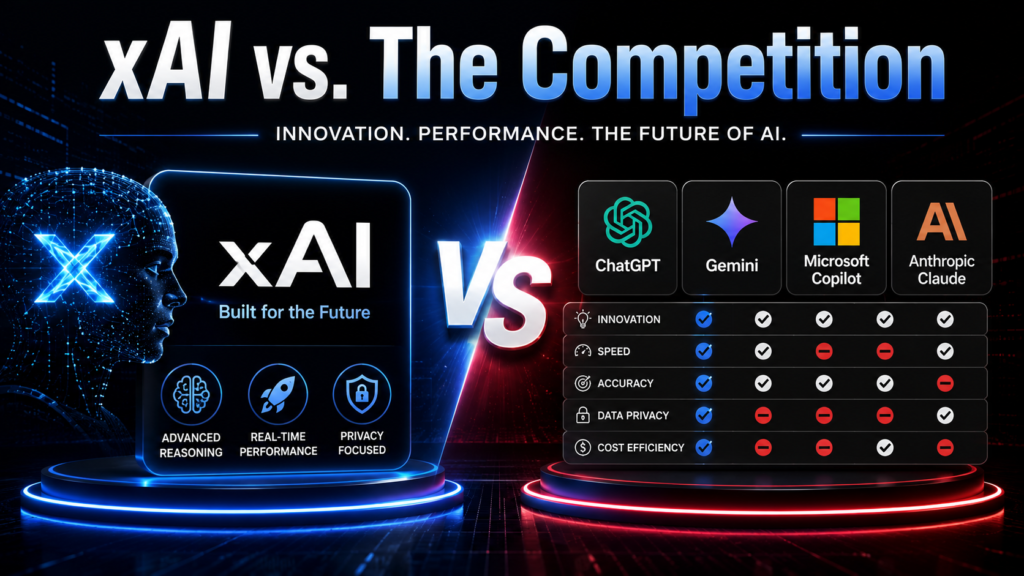
The AI landscape has shifted dramatically since xAI was founded in 2023. Here’s where things stand as of mid-2026:
| Company | Valuation | Key Metric | Status |
|---|---|---|---|
| Anthropic | ~$965 billion | On track for first profit ($559M) | Private |
| OpenAI | ~$840 billion | Record $110B financing round | Private |
| xAI (now SpaceXAI) | Part of ~$1.77T SpaceX | Losing $2.47B/quarter | Public via SPCX |
| Google (Gemini) | ~$2T+ | — | Public |
Technical performance: As of March 2026, Anthropic, xAI, Google, and OpenAI all occupy the top tier of Arena Elo ratings. The models are functionally equivalent—the competitive advantage is now about cost, reliability, and infrastructure.
The Talent Exodus Problem
By May 2026, all 11 of xAI’s original co-founders had departed the company. The last holdout, Ross Nordeen, walked in March 2026.
When the founding team abandons a company, it’s worth asking why.
AI pioneer Yann LeCun declared xAI a “failure”. LinkedIn co-founder Reid Hoffman called it “a complete train wreck”.
I’m not saying these critics are right—but dismissing them would be naive.
Three Scenarios for xAI (Through SpaceX)
| Scenario | Description | Probability |
|---|---|---|
| Bull Case | AI compute demand explodes. Anthropic and Google renew at higher rates. SpaceXAI achieves profitability by 2028. SpaceX hits $2.5T+ valuation. The orbital data center vision becomes reality by 2028. | 20% |
| Base Case | xAI continues burning cash but revenue growth from compute rentals keeps pace. SpaceX absorbs the losses. Slow, steady growth over 5-10 years. The space data center narrative remains aspirational. | 45% |
| Bear Case | AI bubble bursts. Compute demand collapses. Anthropic or Google terminates their rental agreements (90-day notice). xAI’s losses become unsustainable. SpaceX stock dragged down. The orbital data center plan never materializes. | 35% |
What Could Go Wrong? The Contrarian View
Most coverage of xAI and SpaceX is overwhelmingly positive. Let me give you the other side—the side that experienced investors always consider.
1. The Burn Rate Is Unsustainable
xAI’s Q1 2026 CapEx was $7.7 billion. Annualized, that’s over $30 billion. The Anthropic deal brings in $15 billion per year in revenue.
That’s still not enough to cover the burn. The company is losing billions even with this landmark deal.
2. The “Space Data Center” Narrative
Musk has talked about putting data centers in space—a “Starmind” constellation of up to one million AI satellites. SpaceX’s S-1 filing claims many hurdles have “already been solved,” with AI satellites potentially launching by 2028.
This is either visionary or fantastical. The technical, regulatory, and cost hurdles are enormous. As one analyst noted, “whether it becomes real infrastructure or remains a slide in a deck is one of the central questions for patient shareholders.”
3. The Regulatory Threat
The merger drew scrutiny from regulators and investors over governance, valuation, and conflicts of interest. SpaceX holds billions in federal contracts with NASA, the Department of Defense, and intelligence agencies—all of which have authority to review the merger for national security risks.
A shareholder group told the SEC that SpaceX left out key details about the xAI acquisition in its IPO filing, hindering investors’ ability to make fully informed decisions.
4. Competitive Pressure
OpenAI is valued at ~$840 billion. Anthropic recently surpassed OpenAI at ~$965 billion. xAI’s $250 billion pre-merger valuation looked cheap by comparison—but that’s because it was burning cash faster than both.
5. The Macro Environment
AI startups raised massive amounts of capital in 2025, with almost two-thirds of global venture capital going to AI companies. When the music stops—and it always does—the companies with the weakest unit economics get wiped out.
Portfolio Strategy: How to Play This
If you’re considering adding xAI/SpaceX exposure, here’s a framework:
Large-Cap Core (50%): Established AI players like Nvidia (NVDA), Microsoft (MSFT), and Alphabet (GOOGL). These have proven business models and can weather a downturn.
Growth Exposure (30%): SpaceX (SPCX) for direct xAI exposure, plus names like Palantir (PLTR) that benefit from AI infrastructure.
Speculative (20%): Smaller semiconductor plays or AI-adjacent names with higher risk/reward profiles.
Frequently Asked Questions
Is xAI on the stock market?
No. xAI was acquired by SpaceX on February 2, 2026, and is now a division within SpaceX. SpaceX trades on the Nasdaq under SPCX.
Can you purchase xAI stock?
Not anymore. All xAI shares converted to SpaceX shares at a 0.1433 ratio during the February 2026 acquisition. Secondary markets like Hiive and Forge have stopped trading xAI.
What is the xAI stock ticker symbol?
xAI never had a public ticker symbol. The company was private until its acquisition by SpaceX. If you see “xAI” on crypto platforms, it’s a tokenized derivative, not actual stock.
What is the xAI stock price today?
There is no standalone xAI stock price. SpaceX (SPCX) trades on the Nasdaq. Tokenized versions trade on crypto exchanges but are not equivalent to equity.
What are the top 3 AI stocks to buy in 2026?
Based on fundamentals and growth prospects: Nvidia (NVDA) for AI hardware, Microsoft (MSFT) for AI integration, and SpaceX (SPCX) for AI infrastructure exposure. Each offers different risk-reward profiles.
How can I invest in xAI through SpaceX?
Buy SpaceX stock (SPCX) on the Nasdaq. xAI is now a division within SpaceX, so you get indirect exposure. The minimum investment is whatever your broker requires for a share of SPCX.
What is the xAI stock price prediction for 2026?
Analysts are divided. SpaceX IPOed at a $1.77 trillion valuation. Long-term projections depend on whether xAI’s compute rentals can outrun its $30B+ annual burn rate.
Why did SpaceX acquire xAI?
The merger unifies Musk’s AI and space ambitions, combining SpaceX’s satellite and rocket infrastructure with xAI’s AI capabilities. The strategic goal is to build orbital data centers for AI computing.
Key Takeaways
- xAI is gone as an independent company. It was acquired by SpaceX on February 2, 2026, in a $1.25 trillion all-stock deal.
- You cannot buy xAI stock directly. Only SpaceX (SPCX) offers exposure.
- The financials are troubling. xAI lost $6.4 billion in 2025 and $2.47 billion in Q1 2026 alone.
- The bull case is real. Anthropic is paying $1.25 billion per month for xAI’s compute capacity.
- The risks are substantial. Burn rate, talent exodus (all 11 co-founders gone), competitive pressure, and the space data center narrative all carry significant downside.
- The regulatory environment is uncertain. SpaceX faces scrutiny from the SEC, NASA, and the Department of Defense over the merger.
Disclosure: This article is for informational purposes only and does not constitute financial advice. Always conduct your own research before making investment decisions.
Inter Links:
- Amazon Stock (AMZN) Analysis 2026: AI Spending, AWS Growth, Valuation & Price Target
- Microsoft Stock Analysis 2026 (MSFT): The $2.86 Trillion AI Investment Question Wall Street Isn’t Asking
- Apple Stock (AAPL) 2026: Valuation, Forecast, Risks & Buy or Sell Analysis
- Alphabet Inc. Class A Common Stock (GOOGL): Complete 2026 Analysis
- Nvidia (NVDA) Stock Analysis 2026: Buy, Sell or Hold?
- Advantages of Long-Term Stock Investment: What Markets Don’t Tell You Until It’s Too Late