
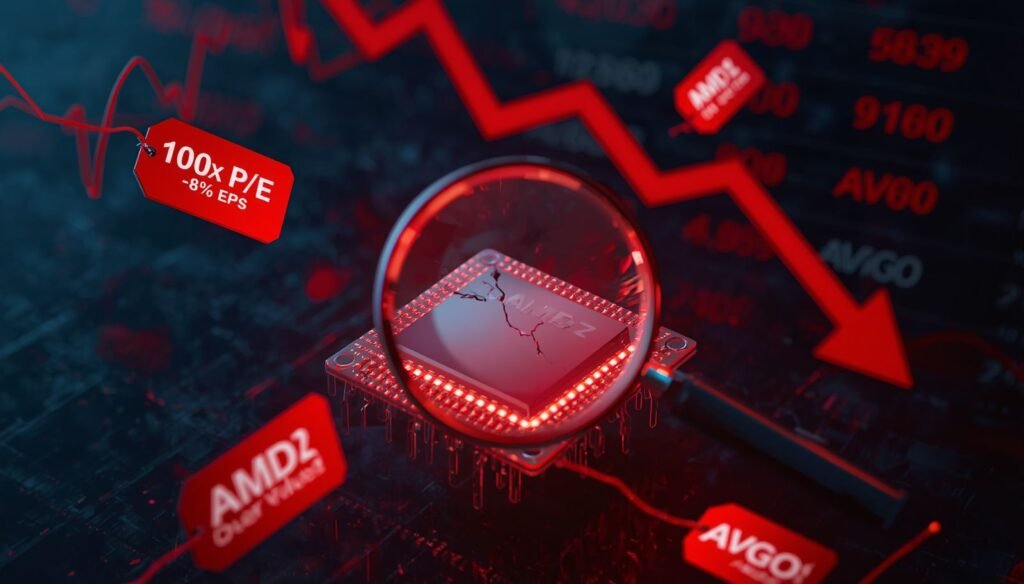
Live Market Analysis (Market Sentiment & Risk Appetite – May 2026): As of today, the Philadelphia Semiconductor Index (SOX) has surged roughly 70% since the March 30 market lows. The iShares Semiconductor ETF (SOXX) is up 54.7% year-to-date, and NVDA briefly topped a $5.5 trillion valuation. However, the last five trading sessions have seen a violent correction—MU and SNDK tanked 14% each, and INTC fell 17%—as the 10-year Treasury yield spiked to a 12-month high of 4.61%. Retail inflows into hardware stocks have hit the highest level in a year. To understand why are stocks down today, look no further than the bond market. The market’s risk appetite is euphoric but fragile. My take? The multiple-compression storm is already here.
7 Most Overvalued Semiconductor Stocks to Watch in 2026
Using a mix of GF Value™, PEG ratios, P/E expansions, and revenue growth discordance, here are the most overvalued semiconductor stocks 2026 list for US and global markets.
Note: For Indian markets, overvalued semiconductor names differ—focus on the valuation analysis below, not just the ticker.
Overvalued vs. Fair Value
| Company (Ticker) | Market Cap | Revenue Growth (TTM) | EPS Growth (TTM) | GF Value™ Overvaluation | PEG Ratio | Risk Level |
|---|---|---|---|---|---|---|
| AMD | ~$686B | 9% | -8% | 84.6% | 0.7x | Extreme |
| ON Semiconductor | ~$44B | -15% | -25% | 89.5% | N/A | Critical |
| Navitas Semi | ~$3.2B | 38% | Negative | 605% | 0.00 | Speculative |
| LRCX | ~$110B | 15% | 12% | N/A | 2.04x | High |
| ASMPT | ~$6.8B | -5% | -30% | 161% | N/A | High |
| Texas Instruments | ~$180B | -2% | -15% | N/A | N/A | Moderate |
| Broadcom | ~$1.52T | 24% | 18% | Overvalued (InvestingPro) | N/A | Elevated |
Historical Performance (3-Year & 5-Year Returns)
| Stock | 3-Year Return (annualized) | 5-Year Return (annualized) | Volatility (5Y Beta) |
|---|---|---|---|
| AMD | 48% | 52% | 1.68 |
| ON Semiconductor | 35% | 28% | 1.55 |
| Navitas Semiconductor | -12% | N/A | 2.10 |
| Lam Research (LRCX) | 42% | 38% | 1.45 |
| Texas Instruments | 12% | 15% | 1.10 |
The “Big 3” AI Traps
1. Advanced Micro Devices (AMD): The Most Overvalued Chip Stock of 2026?
Yes, by the numbers.
According to GuruFocus (May 19, 2026 data), AMD’s GF Value™ stands at $228.10, while the stock trades at roughly $420.99 — an 84.6% overvaluation.
The GF Score™ Valuation rank is 1/10, the lowest possible.
Insiders sold $106.3 million of stock in the last three months with zero purchases.
Wall Street is starting to agree. Bernstein analyst Stacy Rasgon recently said:
“Own Nvidia, Broadcom, but avoid AMD stock”
— citing the need for clearer signs of sustained customer demand beyond secondary sourcing.
My analysis: AMD is priced like it’s winning the AI data center GPU war, but NVDA still commands 80%+ market share. At 138x trailing earnings, the margin for error is zero.
For a deeper dive on a related AI hardware name, check out our ASTS stock analysis 2026: buy or sell?
2. Nvidia (NVDA): The $5.5 Trillion Gorilla
Leopold Aschenbrenner, the former OpenAI researcher now running a hedge fund, just opened massive put options betting on an NVDA crash.
Interactive Brokers’ chief strategist called the AI rally “borderline mania”.
However—and this is where I separate hype from reality—NVDA’s forward P/E is in the low 20s when adjusted for GAAP earnings, not the 126x trailing P/E of AMD.
Is NVDA overvalued? On an absolute historical basis, yes. But it’s the least overvalued of the major AI chip names.
Its PEG ratio is roughly 1.0x, which actually looks reasonable compared to AMD’s PEG of 0.7x (but remember, AMD’s growth is slower).
The real trap isn’t NVDA—it’s the second-tier AI players priced for NVDA-level growth.
For a full breakdown of the leader, see our NVDA stock price analysis & forecast 2026.
3. Broadcom (AVGO): Premium Valuation Without Premium AI Exposure
RBC Capital recently cut AVGO’s price target, noting that valuation is at a 25% premium to Nvidia despite much lower AI exposure.
Investors are pricing in Anthropic and OpenAI wins that may not materialize until late 2027.
At a $1.52 trillion market cap and a P/E above 35x, AVGO needs near-perfect execution for the next 24 months just to grow into its multiple.
If you’re curious about Anthropic’s public market prospects, read our update on Anthropic stock IPO status 2026.
Semiconductor Penny Stocks 2026: High Risk, Minimal Reward
Many retail investors chase a list of semiconductor penny stocks priced under 20, hoping to find the next 10-bagger. But that strategy demands caution, not hype. According to analysis from Futunn, two names gaining traction are Valens Semiconductor (VLN) and Peraso (PRSO), both fabless connectivity specialists. While Valens Semiconductor holds zero debt and nearly $92.6 million in cash, Peraso remains a highly speculative play with elevated risk.
On the Indian market, Moschip Technologies (202.02), MIC Electronics (41.92), and SPEL Semiconductor (139.95) are frequently mentioned among emerging semiconductor stocks. However, SPEL Semiconductor’s negative ROE of -360% signals deep operational stress — the kind of red flag retail traders often ignore during speculative rallies.
For a broader look at small-cap tech opportunities, check out 7 Semiconductor Stocks Under 50 and our guide to Best EV Stocks Under 20 for comparable high-risk, high-volatility sectors.
Future Forecast (2026–2030)
| Scenario | Description | Probability (My Estimate) |
|---|---|---|
| Bull Case | AI capex accelerates beyond 2027; HBM and custom silicon shortages persist; hyperscalers continue spending at 40%+ CAGR; NVDA hits $10 trillion market cap. | 15% |
| Base Case | Moderate multiple compression; SOXX returns 8-12% annually; AI leaders grow into valuations over 3-5 years; cyclical memory downturn in 2027. | 55% |
| Bear Case | Fed stays hawkish, 10-year yield spikes to 5.5%; AI capex slows in 2027; SOXX corrects 40%+; penny stocks wiped out. | 30% |
BNP Paribas projects the global semiconductor market to hit $1 trillion by 2027, ahead of prior expectations of 2030. But IDC notes that market growth is driven by higher ASPs, not rising unit volumes. That’s a red flag. Price-driven growth is inherently less sustainable than volume-driven growth. For a comparable growth story in another sector, see our analysis of stocks that could 10x by 2030.
What Could Go Wrong?
- Semiconductor cycles: We’re in year three of an upcycle. The industry average cycle length is 4-5 years. History says the downturn could begin as early as Q4 2026 or Q1 2027.
- Liquidity traps: Many small and mid-cap semi stocks have wide bid-ask spreads. In a panic, you may not be able to sell.
- Retail speculation: JPMorgan data shows retail inflows into hardware stocks at the highest level in a year—a classic late-cycle indicator.
- Global chip demand slowdown: Hyperscaler capex is not infinite. If AI ROI disappoints, expect a 2027-2028 capex pullback.
- Trade restrictions: China-linked revenue remains a risk for LRCX, ASML, and other equipment makers.
Why 2026 is NOT 1999 (But That Doesn’t Mean Safe)
Evercore ISI notes that while the euphoria “feels like 1999,” stock valuations today remain far below dot-com-era levels. However, Goldman Sachs strategist Peter Oppenheimer warned: “Sharp bond yield moves have coincided with negative equity returns”. With the 10-year Treasury at 4.61% and rising, the discount rate on future AI earnings is increasing. AI demand can remain strong while AI stocks fall—because the multiple investors are willing to pay shrinks as yields rise. For a case study on how high-growth stories handle rate shocks, compare with our NBIS stock analysis 2026: price target, buy or sell?
Interest Rates, AI Boom, EV Demand & Chip Shortage
- Interest Rates: The 10-year US Treasury yield jumped to a 12-month high of 4.61%. Higher yields compress tech valuations. Rate cuts are unlikely in 2026.
- AI Boom: Still the primary driver. IDC predicts memory revenue to surge from 226B(2025)to594.7B (2026). For a deeper look at the software side, read our piece on software stocks 2026: AI winners & losers.
- EV Demand: Weak, with recovery likely delayed to 2027. Analog semiconductors remain under pressure. If you’re still bullish on electric vehicles, see our Rivian stock forecast 2026 for a reality check.
- Global Chip Shortage: Shifting to a “structurally constrained” environment. This supports higher ASPs but also increases geopolitical risk.
2026 Semiconductor Portfolio Strategy
- Large-cap semis (50%): NVDA, TSM, AVGO (only at 15x forward or below)
- Mid-cap (30%): MU, MRVL, ON (but only after the 89.5% overvaluation corrects)
- Specialty AI (15%): Credo (CRDO), custom silicon plays. For more on AI infrastructure, read our AI infrastructure stocks 2026 guide.
- Penny stocks (5%): Strictly for speculation. Before you buy any, understand how to choose your first stocks and investing in stock market for beginners guide—yes, even experienced traders revisit basics.
Featured Snippets
FAQ
1. Is AMD overvalued in 2026?
Yes. According to GuruFocus (May 2026), AMD is 84.6% overvalued, trading at 420.99vs.GFValue™of228.10. P/E (TTM) is 138x, far above its 5-year median of 91.46x.
2. What is the most overvalued semiconductor stock in 2026 right now?
Based on % gap to GF Value™, Navitas Semiconductor is the most overvalued at 605.6% above its intrinsic value. Among large caps, ON Semiconductor (89.5% overvalued) and AMD (84.6% overvalued) lead the list.
3. Are semiconductor penny stocks worth buying in 2026?
Generally, no. Most semiconductor penny stocks have negative earnings (e.g., SPEL with -360% ROE) and high volatility. If you must speculate, limit exposure to 5-10% of your portfolio. For a real-time check on sentiment, see Palantir stock price today live—another volatile tech name.
4. What’s the difference between a foundry and a fabless semiconductor company?
Foundries (TSM, Intel) manufacture chips for other companies. Fabless companies (NVDA, AMD, QCOM) design chips but outsource manufacturing. Fabless stocks typically trade at higher multiples due to asset-light models. For a deep dive on a fabless AI company, read Scale AI stock price analysis.
5. How do rising interest rates affect semiconductor valuations?
Higher Treasury yields increase the discount rate on future earnings, compressing valuation multiples. This is why momentum stocks like MU and SNDK fell 14% in five days as yields spiked to 4.61%. For a broader market perspective, see tech stocks 2026.
6. Which semiconductor stock has the lowest risk in 2026?
Texas Instruments (TXN) offers lower volatility (beta 1.10) and a diversified analog portfolio, though its revenue has stagnated. For growth with reasonable risk, consider TSMC or ASML—both benefit from AI capex without the extreme multiples of pure-play AI designers. Compare with HOOD stock earnings 2026 for a fintech risk profile.
7. Where can I find a list of semiconductor penny stocks with price in India?
The list of semiconductor penny stocks with price includes Moschip Technologies (₹202.02), MIC Electronics (₹41.92), and SPEL Semiconductor (₹139.95) on the NSE. Always check debt-to-equity ratios and ROE before investing. For a comparison of hard assets versus tech, read is gold bullion a good investment in 2026? and gold vs silver.
More MoneyMint Insights
- TSLA stock analysis: buy, sell or hold 2026
- NFLX stock forecast 2026
- Software stocks 2026: AI winners & losers (referenced above)
- Why are stocks down today? (referenced above)
- Difference between trading and investing (referenced above)
- Stock market analysis for long-term investors (referenced above)
Conclusion
- The 2026 semiconductor rally is real, but valuations are stretched to dangerous levels. AMD, ON Semi, and Navitas are trading 80-600% above intrinsic value. Wait for a 30-40% correction before buying.
- Rising yields are the biggest near-term risk. The 10-year Treasury at 4.61% has already triggered a 14-17% sell-off in momentum names. If yields hit 5%, expect broader multiple compression across the sector.
- Focus on balance sheets and free cash flow, not AI narratives. The winners of 2027-2028 will be companies with low debt, positive FCF, and diversified customer bases—not the most hyped AI plays. For a genuinely undervalued list, read our undervalued semiconductor stocks 2026 analysis. And if you’re just starting out, revisit investing in stock market for beginners guide before putting a single dollar into this volatile sector.
Disclaimer: The above analysis reflects my personal investment framework and is not financial advice. Always conduct your own due diligence. Semiconductor stocks are highly volatile and may not be suitable for all investors.