
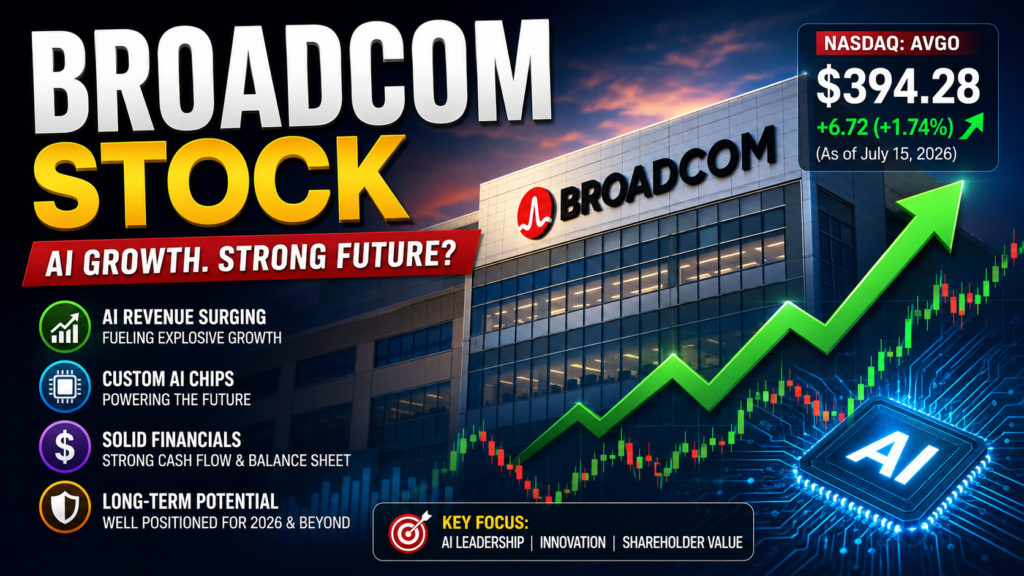
Live Market Snapshot: Broadcom Stock
Market Sentiment: Cautiously bullish with a side of anxiety. The VIX sits elevated, and semiconductor names are trading on conviction rather than valuation. AVGO is caught between AI euphoria and margin compression fears—a classic growth-at-a-premium dilemma.
Risk Appetite: Moderate. Institutions are rotating into hardware (AVGO, NVDA) and out of legacy software post-IBM’s miss. But there’s a hair-trigger quality to this market—one bad guide and stocks get cut in half.
Sector Positioning: Semiconductors are the belle of the ball, but the trade is crowded. AVGO specifically is priced for AI perfection. Any stumble and the multiple contracts.
The Cold Hard Numbers
Let’s cut through the hype.
| Metric | Value |
|---|---|
| Current Price | ~$394 (as of July 15, 2026 close) |
| 52-Week Range | $273.00 – $495.00 |
| Market Cap | ~$1.88 trillion |
| TTM P/E | ~65.6x |
| Forward P/E (FY2027) | ~23.4x |
| Beta | 1.46 (higher volatility than market) |
| Dividend Yield | 0.72% ($2.60 annual) |
The headline numbers tell one story. The forward numbers tell another. That gap between 65x trailing and 23x forward? That’s the market pricing in massive earnings growth. The question is whether that growth materializes—or whether it’s already priced in.
The Bull Case: Why You’d Buy This Stock
AI Revenue Is Not a Story—It’s a Tsunami
Broadcom reported Q2 FY2026 revenue of $22.19 billion, up 48% year-over-year. AI semiconductor revenue hit $10.8 billion, up 143%. Non-GAAP EPS of $2.44 beat estimates by 1.67%.
But here’s what the press releases don’t emphasize: Q2 AI bookings exceeded $30 billion—nearly triple what they shipped. That’s not demand. That’s a dam about to burst.
Q3 guidance: Revenue of ~$29.4 billion, up 84% year-over-year, with AI semiconductor revenue expected to grow over 200% to $16 billion.
Full-year 2026: $56 billion in AI semiconductor revenue, up ~180% from 2025.
FY2027: Management reiterated >$100 billion in AI revenue.
That’s a hockey stick. And it’s fueled by just six core customers—Google, OpenAI, Anthropic, Meta, and others.
The Apple Deal Is a Statement
Broadcom signed a $30 billion+ multi-year chip deal with Apple, supplying over 15 billion U.S.-made chips and investing $1.5 billion to expand Colorado facilities. This extends their relationship through 2031 and moves beyond traditional components into custom AI silicon.
This isn’t just revenue—it’s political capital. U.S. manufacturing footprint. National security angle. Try competing with that.
ASIC Dominance
Broadcom and Marvell control roughly 95% of the custom AI ASIC market. Broadcom alone holds 70-85% share in high-end ASICs. Custom ASICs are projected to account for 27.8% of the AI server compute market in 2026, growing 44.6% year-over-year—nearly triple the growth rate for merchant GPUs.
Translation: While everyone fights over NVIDIA GPUs, Broadcom is quietly building the other AI infrastructure. And it’s growing faster.
Analyst Love Affair
- Consensus rating: Strong Buy (37 Strong Buy, 7 Buy, 4 Hold out of 48 analysts)
- Average price target: ~$523.73—~33% upside
- Morgan Stanley (Joseph Moore): Reiterated Buy, $502 target, calls AVGO a “core AI winner”
- Bank of America & J.P. Morgan: Both reiterated Buy in July 2026
Moore’s track record matters: ranked 147th out of 12,329 analysts with a >60% success rate and 25.9% average return per rating.
The Bear Case: What Could Go Wrong
The Profitability Paradox
Here’s the dirty secret Wall Street isn’t shouting: AI chips are less profitable than the software business they’re replacing.
Gross margin contracted from 79.4% to 77.1% year-over-year in Q2. Management explicitly guided Q3 gross margin down to ~74%. The CFO admitted: as custom chips “continue to accelerate, there will be pressure overall on margins”.
Broadcom is trading higher-margin software revenue for lower-margin silicon revenue. The revenue grows. The quality of that revenue? That’s debatable.
Customer Concentration Is a Sword of Damocles
Six customers. $56 billion in 2026 AI revenue. >$100 billion in 2027. All riding on a handful of relationships.
The CEO himself acknowledged on the earnings call that he expects cloud giants will want “some diversity of sources”. That’s CEO-speak for: we know we’re going to lose some share.
MediaTek is already circling Google’s TPU business. Morgan Stanley’s Moore thinks AVGO retains ~80% share. But if that drops to 50%? The math breaks.
The Guidance Disappointment
On June 3, 2026, Broadcom reported a beat—and the stock dropped >12% the next day.
Why? Q3 AI semiconductor guidance of $16 billion missed the $17.2 billion whisper number. The market wanted more. When a stock is priced for perfection, “good” isn’t good enough.
Valuation Stretch
- Forward P/E: ~23x FY2027 estimates
- P/S ratio: 24.86x trailing, 13.23x forward
- EV/EBITDA: 45.65x
Is that expensive? For a company growing EPS at >50% CAGR, maybe not. But the PEG ratio of 0.55 suggests the market already expects that growth. Any downgrade to growth expectations and that multiple compresses—fast.
VMware Integration Risk
Broadcom faces an EU antitrust review over VMware licensing changes. European cloud groups have filed complaints alleging Broadcom drove procurement costs up by as much as tenfold. The company is also suing EU regulators over document requests.
This is a slow-burn risk. If regulators force VMware licensing changes, the high-margin software segment takes a hit—exactly when Broadcom needs those margins to offset AI chip compression.
Insider Selling
Not a screaming sell signal, but worth noting: $10.03 million in insider selling recently. When founders and executives are taking money off the table, pay attention.
Competitive Positioning
| Company | Market Cap | Forward P/E | AI Focus |
|---|---|---|---|
| Broadcom (AVGO) | $1.88T | ~23x | Custom ASICs, networking |
| NVIDIA (NVDA) | ~$3T+ | ~23x | GPUs, full-stack AI |
| AMD | ~$250B | ~30x | GPUs, CPUs |
| Marvell (MRVL) | ~$80B | ~35x | Custom ASICs (distant #2) |
Broadcom is cheaper than AMD and Marvell on a forward basis. But NVIDIA—the 800-pound gorilla—trades at a similar multiple with arguably better growth visibility.
The key differentiator: ASICs vs. GPUs. NVIDIA sells the brains. Broadcom sells the custom brains that hyperscalers build when they don’t want to pay NVIDIA’s toll. Both are winning. But ASIC growth is accelerating faster.
Three Scenarios: Where Does AVGO Go From Here?
Bull Case (Probability: 35%)
- AI revenue hits $60B+ in 2026, $120B+ in 2027
- Gross margin stabilizes at 74-75%
- Customer concentration fears prove overblown
- Stock re-rates to 30x forward earnings → $580+
Base Case (Probability: 45%)
- AI revenue hits $56B in 2026, $100B in 2027
- Margins continue sliding but operating leverage holds
- Stock trades in a range, grinding higher with earnings
- $450-525 by mid-2027
Bear Case (Probability: 20%)
- One or two hyperscalers diversify ASIC supply
- Gross margin drops below 72%
- AI spending slows (power constraints, capex moderation)
- Multiple compresses to 18x → $300-350
What Smart Money Is Doing
- Institutions own ~78.6% of shares outstanding
- BlackRock: 385.9M shares (8.11%)
- Vanguard: 308M shares (6.47%)
- Short interest: ~1.3% of float—not a crowded short
Institutional ownership is high but not extreme. The absence of a significant short position suggests the market is uniformly bullish. That’s actually a concern—when everyone’s on one side of the boat, it tips harder.
Options market implied volatility sits in the 92nd percentile of its trailing one-year range. Someone’s hedging. Hard.
Portfolio Strategy: How to Play It
| Allocation | Type | Rationale |
|---|---|---|
| 50% | Large-cap semis (AVGO, NVDA) | Core AI exposure |
| 30% | Mid-cap AI infrastructure | Upside without single-stock risk |
| 20% | Cash / hedges | Protection against AI spending slowdown |
If you own AVGO: Hold, but trim on strength. The risk/reward at $394 is okay, not great. The stock needs to grow into its multiple—and that takes time.
If you don’t own AVGO: Wait for a better entry. The $350-370 range offers a better margin of safety. Buying at $394 is buying the consensus view. And consensus views rarely make you rich.
If you’re trading: Watch the $386 level. Break below and $350 is in play. Break above $400 and momentum could carry to $430.
The $100 Billion Question
Broadcom’s AI revenue forecast for 2027 exceeds $100 billion. That’s more than NVIDIA’s entire revenue in 2024. It’s an astronomical number.
Is it achievable? Yes, if:
- AI infrastructure spending doesn’t slow
- All six hyperscalers keep buying
- No major share loss to MediaTek or others
- Power constraints don’t bite
Is it probable? That’s the debate. The CEO has visibility through 2028. Remaining Performance Obligations hit $164.6 billion. That’s contracted revenue. It’s not hopium.
But contracts can be renegotiated. Spending can be delayed. And six customers can change their minds.
What Kind of Stock Is Broadcom?
It’s a growth stock trading at a value-stock forward multiple—if the growth materializes. If it doesn’t, it’s an expensive semiconductor company with margin problems.
Broadcom isn’t NVIDIA. It’s not a pure AI play with 80% gross margins and a monopoly. It’s a custom silicon foundry for hyperscalers—a business that’s incredibly valuable but also incredibly concentrated.
Is Broadcom a Forever Stock?
No stock is a forever stock. But if forced to answer: AVGO is a 5-10 year hold if you believe AI infrastructure spending continues. It’s a sell if you think the AI capex cycle peaks in 2027-2028.
The business is real. The revenue is real. The valuation is the debate.
FAQ
1. Is Broadcom stock a good buy in 2026?
Answer: At ~$394, AVGO trades at ~23x forward earnings with 50%+ EPS growth expected. The valuation is reasonable if growth delivers. But the stock is priced for perfection—any miss and it gets punished. Buy on weakness, not strength.
2. What is the Broadcom stock price target for 2026?
Answer: Analyst consensus is ~$523.73, implying ~33% upside. Estimates range from $215.88 (bearish) to $650 (bullish).
3. Why is Broadcom stock falling?
Answer: AVGO dropped 9.1% in the past month due to Q3 guidance that missed whisper numbers and gross margin compression concerns. The market wanted more AI revenue upside and got “only” in-line guidance.
4. Is Broadcom a buy, sell, or hold?
Answer: Hold at current levels. The risk/reward is balanced—not compelling enough to buy aggressively, not worrying enough to sell. Accumulate on dips below $370.
5. What kind of stock is Broadcom?
Answer: A semiconductor and infrastructure software company transitioning from high-margin software to lower-margin AI custom silicon. It’s a growth stock with concentration risk and valuation debate.
6. Who are Broadcom’s main competitors?
Answer: NVIDIA (GPUs), AMD (GPUs/CPUs), and Marvell (custom ASICs). Broadcom dominates the ASIC market with 70-85% share.
Key Takeaways
- AI revenue is explosive—$56B in 2026, >$100B in 2027—but growth is concentrated in six customers
- Margins are compressing—from 79.4% to ~74%—as lower-margin silicon replaces software
- Valuation is reasonable on forward earnings (~23x) if growth delivers
- The stock is priced for perfection—any guidance disappointment triggers sharp selloffs
- Risk/reward is balanced at $394—better entries exist on weakness
Disclaimer: This is not financial advice. I own semiconductor stocks but not AVGO at the time of writing. Do your own research. Markets are unpredictable. Past performance does not guarantee future results.
Further Reading
- ASTS Stock Analysis 2026
- NBIS Stock Analysis 2026
- VRT Stock Analysis 2026
- HOOD Stock Earnings 2026
- Software Stocks 2026: AI Winners & Losers
- Why Are Stocks Down Today?
- Tech Stocks 2026
- What Is S&P 500? Explained
- TSLA Stock Analysis 2026
- How to Choose Your First Stocks
- Trading vs. Investing: What’s the Difference?
- Stock Market Investing for Beginners
- Stock Market Analysis for Long-Term Investors
- Rivian Stock Forecast 2026
- Netflix Stock Forecast 2026
- Anthropic Stock IPO Status 2026
- Is Gold Bullion a Good Investment in 2026?
- Gold vs. Silver
- NVDA Stock Analysis & Forecast 2026
- Palantir Stock Price Today
- 7 Semiconductor Stocks Under $50
- Best EV Stocks Under $20
- AI Infrastructure Stocks 2026
- Stocks That Could 10x by 2030
- Undervalued Semiconductor Stocks 2026
- Scale AI Stock Price Analysis
- Best Semiconductor Stocks with Highest Growth
- Most Overvalued Semiconductor Stocks 2026
- Real Estate Investment Advice
- M Stock Analysis
- VMware Stock Price
- Suzlon Energy Share Price Analysis
- MULN Stock Analysis
- IDEA Share Price
- Special Investment Region
- Advantages of Long-Term Stock Investment
- Alphabet Class A Stock
- Microsoft Stock
- Apple Stock
- Amazon Stock
- xAI Stock
- TSMC Stock Analysis
- SPCX Stock Analysis