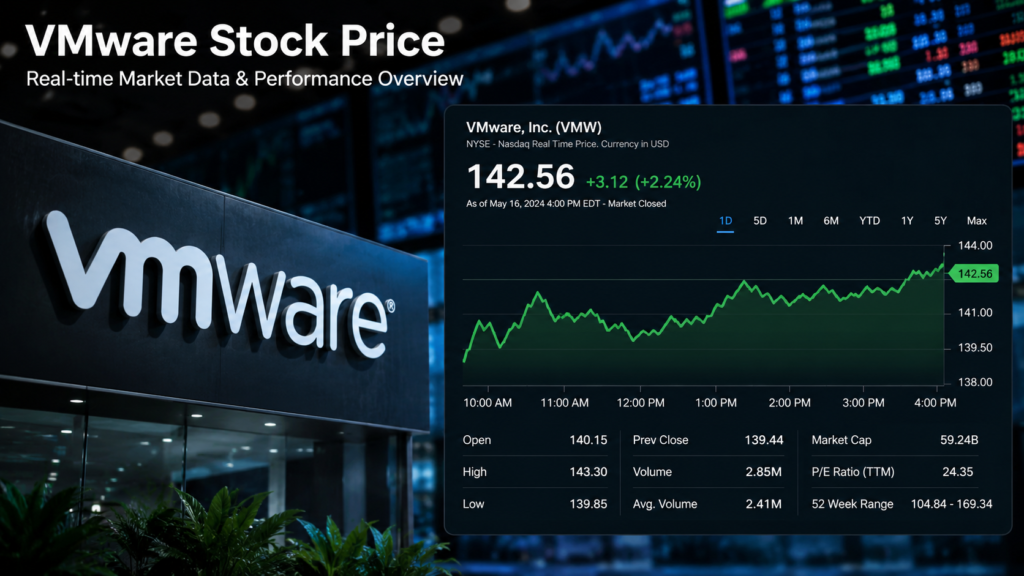
For investors searching for the VMware stock price, the first thing to understand is that VMware no longer trades publicly.
The company was acquired by Broadcom in a deal that fundamentally changed how investors gain exposure to VMware’s business. As a result, tracking VMware today means analyzing the performance of Broadcom (AVGO) rather than searching for an active VMware ticker.
Most articles stop there.
That is exactly where the real analysis should begin.
The important question is no longer “What is VMware stock trading at today?”
The better question is:
Did Broadcom create value by acquiring VMware, and does AVGO still offer attractive risk-adjusted returns in 2026?
That is where institutional investors are focused.
Live Market Snapshot
Market Sentiment
Technology investors remain heavily concentrated in AI infrastructure, cloud software, and semiconductor leaders.
Current risk appetite is strongest in:
- AI infrastructure
- Enterprise software
- Cloud computing
- Data center ecosystems
VMware sits directly in the center of this trend because its virtualization software powers a large portion of enterprise IT infrastructure globally.
What Happened to VMware Stock?
The short answer:
VMware was acquired by Broadcom in a transaction valued at approximately $69 billion.
After the acquisition closed:
- VMware stock ceased trading
- VMware shareholders received cash and stock consideration
- VMware became a Broadcom business unit
- Future value creation shifted to Broadcom shareholders
This means there is no longer an active VMware share price Nasdaq listing.
Investors seeking exposure must evaluate AVGO stock price instead.
VMware Stock Price History
Before the acquisition, VMware was widely viewed as one of the most important enterprise software companies in the world.
Its products became essential infrastructure inside corporate data centers.
Key phases of VMware stock history:
Early Growth Era
- Virtualization adoption exploded
- Enterprise IT spending expanded
- Revenue growth remained strong
Cloud Competition Era
Pressure increased from:
- Amazon Web Services
- Microsoft Azure
- Google Cloud
Investors questioned whether virtualization would remain dominant.
Acquisition Premium Phase
Broadcom’s acquisition offer dramatically repriced VMware shares as merger arbitrage investors entered the stock.
VMware Stock Chart: What Investors Should Learn
Many investors incorrectly assume a stock’s final acquisition price represents fair value.
In reality:
The final VMware stock chart reflected:
- Merger probability
- Regulatory risk
- Deal completion expectations
Not necessarily long-term intrinsic value.
This distinction matters because investors often use historical charts incorrectly when forecasting future returns.
Comparison Table
| Company | Market Cap | Revenue Growth | EPS Growth | Risk Level |
|---|---|---|---|---|
| Broadcom | Very Large | High | High | Medium |
| Microsoft | Very Large | Moderate | Moderate | Low |
| Oracle | Large | Moderate | Moderate | Medium |
| IBM | Large | Low | Moderate | Medium |
Broadcom VMware Stock Price Connection
The acquisition transformed Broadcom from primarily a semiconductor giant into a hybrid technology powerhouse.
Institutional investors increasingly view Broadcom as:
- AI infrastructure provider
- Enterprise software operator
- Cloud ecosystem beneficiary
That diversification is important.
Software revenue generally carries:
- Higher margins
- Greater predictability
- Better recurring cash flow
This is why the VMware acquisition continues to influence AVGO valuation.
Historical Performance Comparison
| Stock | 3-Year Return | 5-Year Return | Volatility |
|---|---|---|---|
| Broadcom (AVGO) | Strong | Very Strong | Moderate |
| NASDAQ 100 | Strong | Strong | Moderate |
| S&P 500 | Moderate | Strong | Lower |
VMware Share Price in India
Indian investors frequently search:
- VMware share price in India
- VMware share price NSE
There is no NSE-listed VMware stock.
Indian investors seeking exposure can:
- Invest in Broadcom through international investing platforms
- Use global technology ETFs
- Gain indirect exposure through AI and cloud infrastructure portfolios
Featured Snippet Answers
Is VMware stock still available to buy in 2026?
No. VMware is no longer publicly traded after Broadcom completed its acquisition. Investors seeking exposure must analyze Broadcom (AVGO) stock instead.
What happened to VMware stock?
VMware was acquired by Broadcom in a multi-billion-dollar transaction. Following completion, VMware shares were delisted and ceased independent trading.
What is the VMware share price NSE?
There is no VMware share price on NSE because VMware is not listed on Indian exchanges.
Does Broadcom benefit from VMware?
Yes. VMware adds recurring enterprise software revenue, helping Broadcom diversify beyond semiconductors and strengthen cash flow generation.
Is AVGO stock a better alternative?
For investors wanting exposure to VMware’s business, AVGO is effectively the replacement investment vehicle since VMware now operates within Broadcom.
Macro Factors That Matter
Interest Rates
Higher rates compress technology valuations.
Enterprise software stocks often outperform speculative growth companies during tightening cycles because cash flows are more predictable.
AI Boom
AI demand increases spending on:
- Data centers
- Networking
- Cloud infrastructure
Broadcom benefits from each category.
Enterprise IT Spending
Corporate technology budgets remain the biggest driver of VMware-related revenue.
A slowdown in enterprise spending would impact software growth.
What Could Go Wrong?
Most bullish analyses ignore risks.
That is a mistake.
Integration Risk
Large acquisitions rarely proceed perfectly.
Cultural clashes and customer dissatisfaction remain possibilities.
Valuation Risk
Even excellent businesses become poor investments if purchased at excessive valuations.
Competitive Pressure
Cloud-native technologies continue reducing dependence on traditional virtualization.
Economic Slowdown
Enterprise customers can delay upgrades and infrastructure projects.
Regulatory Risk
Large technology companies remain under increasing global scrutiny.
Future Outlook (2026–2030)
| Scenario | Description | Probability |
|---|---|---|
| Bull Case | AI infrastructure spending accelerates and software margins expand | 30% |
| Base Case | Steady growth with moderate enterprise demand | 50% |
| Bear Case | Economic slowdown reduces technology spending | 20% |
Return Calculator
Investors should focus on:
- Expected annualized returns
- Downside risk
- Portfolio concentration
- Compounding assumptions
The biggest investing mistakes usually come from unrealistic return expectations rather than poor stock selection.
Portfolio Strategy
Example allocation:
- Large-cap technology leaders: 50%
- Growth technology opportunities: 30%
- Speculative positions: 20%
Investors should adjust allocations based on risk tolerance rather than market headlines.
Related Reading
For broader technology and AI investing research, readers may find value in:
- https://moneymint.co.in/software-stocks-2026-ai-winners-losers/
- https://moneymint.co.in/tech-stocks-2026/
- https://moneymint.co.in/nvda-stock-price-analysis-forecast-2026/
- https://moneymint.co.in/palantir-stock-price-today-live/
- https://moneymint.co.in/ai-infrastructure-stocks-2026/
- https://moneymint.co.in/stocks-that-could-10x-by-2030/
- https://moneymint.co.in/undervalued-semiconductor-stocks-2026/
- https://moneymint.co.in/best-semiconductor-stocks-with-highest-growth/
- https://moneymint.co.in/most-overvalued-semiconductor-stocks-2026/
FAQ About VMware Stock Price
1. What is VMware stock price today?
Answer: VMware no longer trades publicly. Investors should follow Broadcom (AVGO) for exposure.
2. What is VMware share price Nasdaq?
Answer: There is no active Nasdaq listing because VMware was acquired and delisted.
3. Can Indians buy VMware stock?
Answer: Not directly. Exposure is available through Broadcom shares or global technology funds.
4. Why did Broadcom buy VMware?
Answer: To expand recurring software revenue and strengthen its enterprise technology ecosystem.
5. Is Broadcom now a software company?
Answer: Partly. Broadcom combines semiconductor leadership with a significant enterprise software business.
6. Is AVGO overvalued?
Answer: That depends on future AI infrastructure growth and VMware integration success.
7. What is the biggest risk for AVGO investors?
Answer: A combination of valuation compression, slowing enterprise spending, and integration challenges.
Conclusion
The story behind the VMware stock price is no longer about VMware itself.
The real investment debate has shifted to Broadcom.
Investors who continue searching for VMware’s share price may be asking the wrong question. The better question is whether Broadcom can convert VMware’s dominant enterprise software franchise into durable earnings growth over the next decade.
The bullish case rests on AI infrastructure, recurring software revenue, and operational efficiency.
The bearish case rests on valuation, integration execution, and changing cloud architectures.
For most long-term investors, the smartest approach is neither blind optimism nor excessive pessimism. It is disciplined position sizing, realistic expectations, and continuous monitoring of Broadcom’s ability to turn the VMware acquisition into lasting shareholder value.