
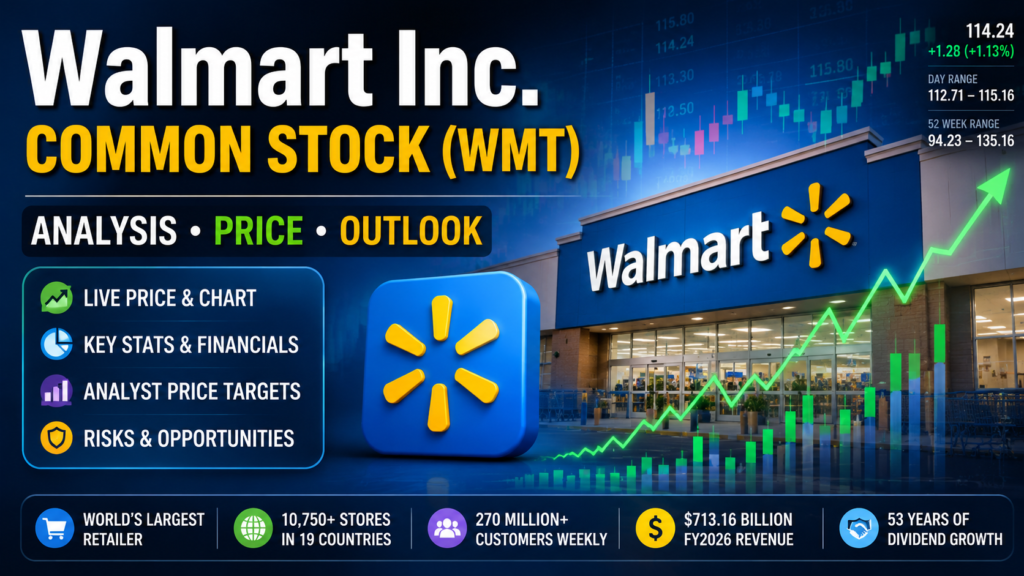
Live Market Snapshot
Market Sentiment: Cautious. The VIX remains elevated as investors digest mixed retail signals. Walmart’s 5% drop on July 1 following Cleveland Research’s slowing sales note rattled the consumer discretionary space. The stock is now trading near eight-month lows, and institutional money is rotating defensively.
Risk Appetite: Low-to-moderate. The 40x+ P/E multiple leaves zero room for error. Any miss on comparable sales or guidance could get punished severely.
Sector Positioning: Consumer Staples are traditionally defensive, but Walmart trades like a growth stock. That disconnect is the central tension here.
About Walmart Inc.
Walmart Inc. (NYSE: WMT) is the world’s largest retailer, operating through three reportable segments: Walmart U.S., Walmart International, and Sam’s Club U.S.. In fiscal year 2026 (ended January 31, 2026), the company generated $713.16 billion in revenue and employs approximately 2.1 million associates worldwide. Walmart U.S. accounts for approximately 68% of sales, followed by Walmart International at 19%, and Sam’s Club at 13%. The company is led by President and CEO John Furner, who took the helm in 2026, and Chairman Greg Penner. Walmart has raised its annual dividend for 53 consecutive years, with the current annual dividend at $0.99 per share.
The Numbers That Actually Matter
Here’s where Walmart Inc. Common Stock stands as of July 20, 2026:
| Metric | Value | Source |
|---|---|---|
| Price | $114.24 | StockAnalysis |
| Market Cap | $909.13 billion | StockAnalysis |
| P/E Ratio (TTM) | 40.22 | StockAnalysis |
| Forward P/E | ~38.33 | StockAnalysis |
| 52-Week Range | $94.23 – $135.16 | MacroTrends |
| Beta | 0.60 | StockAnalysis |
| Dividend Yield | 0.87% ($0.99 annual) | StockAnalysis |
| Next Earnings | August 20, 2026 (pre-market) | StockAnalysis |
| Ex-Dividend Date | August 21, 2026 | StockAnalysis |
The stock has lost ~20% from its May 2026 highs near $135.16. It briefly touched the $1 trillion market cap club in February—now it’s fighting to stay above $900 billion.
Here’s what the market is pricing in: A 40x P/E on a retailer that grows revenue at ~5% annually. That’s not a value play. That’s a growth premium on a business that’s transforming into something more than a grocery chain.
Walmart Inc. Common Stock Price Target: What Analysts Are Actually Saying
According to 44 analysts polled by MarketWatch, the consensus 12-month price target is $139.18—representing ~21% upside from current levels. The consensus rating remains “Buy” with a 94% Buy-side bias.
But averages hide the real story:
| Analyst | Firm | Target | Upside |
|---|---|---|---|
| Goldman Sachs | Buy | $154 | +34.8% |
| BMO Capital | Buy | $145 | +26.9% |
| Morgan Stanley | Buy | $140 | +22.6% |
| RBC Capital | Outperform | $137 | +19.9% |
| BNP Paribas | Outperform | $146 | +27.8% |
Source: MarketWatch, TipRanks, Benzinga
The lowest target is $81 (yes, really), and the highest is $155. That’s a 91% spread. When you see that kind of divergence, it suggests significant disagreement about Walmart’s digital transformation paying off.
My take: The $138-$140 range is plausible if e-commerce and advertising growth accelerate. But at $155? That implies a P/E north of 50. That’s pricing in perfection.
Why Is Walmart Stock Falling? (And Why the Answer Matters)
Three distinct sell-off catalysts in 2026:
1. The “Beat but No Raise” Sell-Off (May 2026)
Walmart reported a strong Q1 FY2027: total revenues rose 7.3% year-over-year to $177.75 billion, e-commerce up 26% globally, and global advertising up 37%. The stock fell 7% anyway.
Why? Management reaffirmed full-year guidance instead of raising it. Wall Street wanted more. They didn’t get it. So they sold.
This is the classic “buy the rumor, sell the news” dynamic—but amplified by valuation. At 40x earnings, you don’t get credit for meeting expectations. You get punished for not exceeding them.
2. The Cleveland Research Warning (July 2026)
On July 1, shares dropped 5% to an eight-month low after Cleveland Research flagged decelerating U.S. comparable sales. The firm noted Walmart appears to be cutting inventory through price reductions, using tariff refunds to offset margin pressure.
Comparable sales growth (ex-fuel) dropped to 4.1% from 4.5% a year earlier. That doesn’t sound like a disaster—but when you’re priced for perfection, deceleration is a four-letter word.
3. The $1 Trillion Hangover
Walmart hit $1 trillion market cap in February. Five months later, it’s below $900 billion. That’s >$100 billion in value wiped out—not because the business deteriorated, but because expectations were absurd.
The contrarian view: This isn’t a business problem. It’s a valuation reset. And resets may create opportunities—if you believe the underlying thesis remains intact.
What Type of Stock Is Walmart? (And Why the Classification Matters)
Walmart Inc. Common Stock (WMT) is technically a Consumer Staples stock. But that label is increasingly misleading.
The Old Walmart: Low-margin grocery retailer. Slow growth. Defensive. Dividend aristocrat.
The New Walmart:
- E-commerce: Global e-commerce sales reached $150.4 billion in FY2026, up 24%
- Advertising: Global advertising grew 37% in Q1 FY2027, with Walmart Connect U.S. up 44% (excluding VIZIO)
- Memberships: Walmart+ reached ~28.4 million members by January 2026 (Morgan Stanley estimate)
- Marketplace: U.S. marketplace sales surged nearly 50% in Q1
This is not a grocery chain anymore. This is a hybrid—part retailer, part ad-tech platform, part logistics company, part fintech.
The market is pricing WMT as a growth compounder, not a defensive staple. That’s why it trades at 40x earnings while Kroger trades at 10x.
The risk: If the market ever re-classifies Walmart back to “just a retailer,” that multiple could contract. Fast.
Who Owns 51% of Walmart? (And Why It Matters for Investors)
The Walton family—heirs of founder Sam Walton—still control roughly 45% of Walmart’s stock. Some sources peg it closer to 51% when including all family trusts and holding entities.
Why this matters:
- Insider alignment: The Waltons have ~$500 billion tied up in this stock. They’re not selling. They’re long-term compounders.
- Voting control: The family effectively controls the board. Activist campaigns? Not happening.
- Dividend discipline: The family relies on dividends for liquidity. That $0.99 annual dividend? It’s going up, not down.
Institutional holders include BlackRock (~4.44%) and Vanguard (~3.58%). Short interest is modest at ~1.05% of float—meaning nobody’s aggressively betting against WMT.
The takeaway: This is a controlled company with a long-term oriented controlling shareholder. That’s a double-edged sword—stability on one hand, but limited upside from corporate activism on the other.
Walmart Stock Chart: Technical Reality Check
| Metric | Value | Source |
|---|---|---|
| 50-Day MA | $119.64 | StockAnalysis |
| 200-Day MA | $117.57 | StockAnalysis |
| 52-Week High | $135.16 | MacroTrends |
| 52-Week Low | $94.23 | MacroTrends |
| Current | $114.24 | StockAnalysis |
| RSI | 46.42 | StockAnalysis |
The stock is trading below both key moving averages. That’s technically bearish. The 52-week range suggests support near $94—about 17% downside from current levels—and resistance at $135.
What the chart tells me: We’re in no-man’s-land. The stock needs a catalyst—either a blowout Q2 earnings report (August 20) or a macro shift that re-rates the entire consumer sector.
Walmart Inc. Common Stock Price Prediction 2026-2030: Three Scenarios
| Scenario | Description | Probability |
|---|---|---|
| Bull Case | E-commerce + advertising accelerate; Walmart+ surpasses 40M members; margins expand 200bps; P/E sustains 40x | 25% |
| Base Case | 5-6% revenue growth; e-commerce remains #2; margins stable; P/E gradually compresses to 32-35x | 55% |
| Bear Case | Consumer slows; comp sales decelerate further; tariff pressures mount; P/E contracts to 25x | 20% |
Bull Case Price Target (2027): $160-$170
Base Case Price Target (2027): $130-$140
Bear Case Price Target (2027): $90-$100
These are directional estimates, not financial advice. Do your own work.
What Could Go Wrong? (The Contrarian Section)
Everyone loves Walmart’s digital transformation. Here’s what they’re not talking about:
1. The Valuation Trap
At ~38x forward earnings, WMT trades at a premium to the industry average. The problem? Earnings growth needs to justify the multiple. Analysts project FY2027 EPS of ~$2.89. At $114, that’s ~39.5x. For the stock to hold this valuation, EPS needs to grow 15%+ annually. That’s doable—but not guaranteed.
2. The Consumer Slowdown
Cleveland Research flagged it. The company itself guided for slower sales growth. If the U.S. consumer pulls back—and all signs point to softening—Walmart’s comparable sales could dip below 3%. At that point, the growth story could weaken.
3. Tariff Exposure
Walmart is using tariff refunds to offset price cuts. That’s a temporary fix. If tariffs escalate, margins could get squeezed. Period.
4. E-Commerce Profitability
E-commerce is now profitable—but at what scale? Fulfillment costs, last-mile delivery, and returns all eat into margins. Amazon spent two decades burning cash to build its e-commerce moat. Walmart is trying to do it in five years. That’s aggressive.
5. The “Bond Proxy” Risk
Walmart and Costco are being valued like “bond-like compounders”. But bonds don’t have operational risk. If Walmart stumbles operationally, the multiple doesn’t just compress—it could collapse.
Earnings Estimates: What to Watch on August 20
| Period | Revenue Estimate | EPS Estimate | Source |
|---|---|---|---|
| Q2 FY2027 | $185.60 – $188.90 billion | $0.72 – $0.75 | Earnings Whispers, TipRanks |
| FY2027 (Full Year) | $731.12 – $748.72 billion | $2.75 – $2.89 | Walmart Guidance, Analyst Consensus |
| FY2028 | ~$752 – $760 billion | ~$3.27 | Analyst Estimates |
Walmart reiterated FY2027 guidance of adjusted EPS $2.75 to $2.85 on revenue of $731.12 billion to $738.19 billion. The current consensus EPS estimate for the full year is $2.89 on revenue of $748.72 billion.
Is Walmart Stock a Good Buy Now?
The bull case: You’re buying a high-quality business with durable competitive advantages, trading 20% off its highs, with a clear growth trajectory in e-commerce, advertising, and membership services. The Waltons aren’t selling. Analysts see 21% upside.
The bear case: You’re paying 40x earnings for a retailer growing revenue at 5%. The multiple is stretched. The consumer is slowing. The stock could easily trade down to $100 or lower if sentiment sours further.
My framework: I’d consider WMT only if:
- You have a 5+ year time horizon
- You’re comfortable with 15-20% downside risk
- You believe the digital transformation is real (I do)
- You’re not expecting a quick bounce
What I’d avoid: Buying here hoping for a V-shaped recovery to $135. That ship may have sailed. This is a slow compounder now, not a momentum play.
Portfolio Strategy: How to Think About WMT
| Investor Type | Allocation | Strategy |
|---|---|---|
| Growth-focused | 0-5% | Wait for sub-$110 or better entry |
| Income-focused | 5-10% | Dividend is small (0.87%)—not a yield play |
| Value-focused | 0% | Multiple is too rich; look elsewhere |
| Long-term core | 5-15% | Dollar-cost average into weakness |
Walmart isn’t a high-growth stock. It isn’t a value stock. It’s a quality compounder trading at a growth multiple. That’s the tension you need to resolve before buying.
Related Reads
For deeper context on the retail and tech landscape shaping Walmart’s future:
- Tech Stocks 2026: AI Winners & Losers
- What Is S&P 500?
- Stock Market Analysis for Long-Term Investors
- Difference Between Trading and Investing
- How to Choose Your First Stocks
- Investing in Stock Market: Beginners Guide
- Why Are Stocks Down Today?
Other single-stock deep dives:
- TSLA Stock Analysis
- NVDA Stock Analysis
- AMD Stock Analysis
- Palantir Stock Price Today
- Broadcom Stock Analysis
- Micron Technology Analysis
- Meta Stock Analysis
- TSMC Stock Analysis
- Alphabet Class A Stock
- Microsoft Stock
- Apple Stock
- Amazon Stock
Sector & thematic:
- 7 Semiconductor Stocks Under $50
- Best EV Stocks Under $20
- AI Infrastructure Stocks 2026
- Stocks That Could 10x by 2030
- Undervalued Semiconductor Stocks 2026
- Most Overvalued Semiconductor Stocks 2026
Comparables:
- Rivian Stock Forecast 2026
- Netflix Stock Forecast 2026
- Eli Lilly Stock Analysis
- JPMorgan Chase Analysis
- SPCX Stock Analysis
Other:
- Real Estate Investment Advice
- Gold vs Silver
- Is Gold Bullion a Good Investment in 2026?
- Advantages of Long-Term Stock Investment
Frequently Asked Questions
1. Is Walmart stock a good buy in 2026?
Answer: It depends on your time horizon and risk tolerance. At ~$114 with a 40x P/E, WMT is priced for perfection. If you believe the digital transformation (e-commerce, advertising, membership) will accelerate earnings growth, it’s a buy on weakness. If you’re a value investor, it’s too expensive. The consensus analyst target of $139.18 implies ~21% upside, but the stock has already fallen ~20% from its highs.
2. Why is Walmart stock falling?
Answer: Three reasons: (1) Post-earnings sell-off in May after management reaffirmed (not raised) guidance; (2) Cleveland Research flagged slowing U.S. comparable sales in July, triggering a 5% drop; (3) Valuation reset from the $1 trillion market cap peak in February. The business is fine—expectations were just too high.
3. Who owns 51% of Walmart?
Answer: The Walton family—heirs of founder Sam Walton—control roughly 45-51% of Walmart’s stock through family trusts and holding entities. This gives them effective voting control and aligns long-term incentives with shareholders.
4. What type of stock is Walmart?
Answer: Technically a Consumer Staples stock, but increasingly a hybrid of retail, e-commerce, advertising technology, and fintech. The market prices it like a growth compounder (40x P/E), not a defensive staple (which would trade at 15-20x).
5. What is the Walmart stock price target for 2026?
Answer: The average 12-month target among 44 analysts is $139.18, with a range of $81 to $155. Goldman Sachs ($154), BMO Capital ($145), and Morgan Stanley ($140) are among the most bullish.
6. When is Walmart’s next earnings report?
Answer: August 20, 2026, before market open. Analysts expect EPS of $0.72 to $0.75 on revenue of $185.60 to $188.90 billion. The ex-dividend date is August 21, 2026.
7. Is Walmart undervalued or overvalued?
Answer: By traditional metrics, overvalued—40x earnings on ~5% revenue growth is rich. By growth-adjusted metrics (PEG of ~4.07), also overvalued. The bull case rests on the digital transformation accelerating margins and growth, not on current earnings.
Conclusion: The Bottom Line
Walmart Inc. Common Stock is a high-quality business with a complicated valuation.
The positives are real: #1 U.S. grocer, #2 U.S. e-commerce platform with $150.4B in digital sales, a growing ad business (Walmart Connect up 44% ex-VIZIO), 28M+ Walmart+ members, and a controlling shareholder with a multi-decade horizon. The transformation from “brick-and-mortar retailer” to “omnichannel ecosystem” is underway—and it’s working.
The negatives are equally real: 40x earnings, slowing comp sales, tariff exposure, consumer uncertainty, and a stock that just shed $100B in market cap because expectations were too high.
My action plan:
- If you own it: Hold. Don’t panic-sell at $114. The business is sound. But don’t expect a quick recovery to $135.
- If you don’t own it: Wait for earnings (August 20). If the stock sells off on good results again, that may be your entry. If it rallies, let it go.
- If you’re adding: Dollar-cost average. Buy in thirds—$110, $105, $100. This is a compounder, not a trade.
The 30,000-foot view: Walmart is winning the retail war. But the stock market doesn’t reward winners—it rewards unexpected winners. Walmart’s transformation is now expected. That’s why the multiple is so high. And that’s why the downside risk is so real.
Disclosure: The author may hold positions in securities discussed. This is not financial advice. Do your own research.