
Written by: Shourya Singh
Reviewed by: MoneyMint Research Desk | Updated: July 15, 2026
Sources: SEC filings (S-1), Nasdaq, S&P Global, Bloomberg, Yahoo Finance, company reports
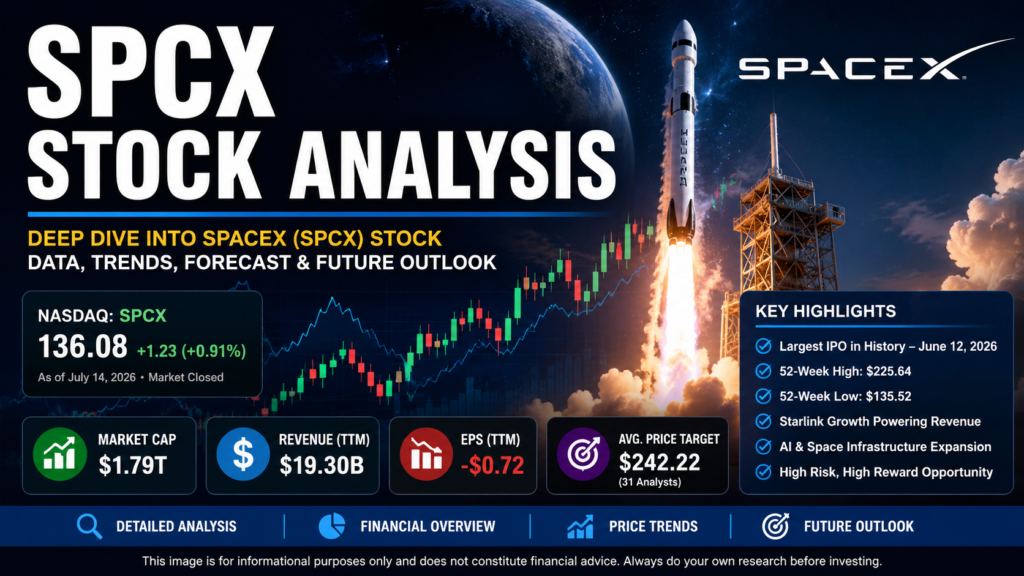
Quick Facts: SpaceX (SPCX) at a Glance
| Metric | Value | Source |
|---|---|---|
| Current Price (July 14 close) | $136.08 | CNBC, Fidelity |
| IPO Price (June 12) | $135.00 | NYT, Nasdaq |
| 52-Week High | $225.64 (June 16) | Fidelity, CNBC |
| 52-Week Low | $135.52 (July 14) | Fidelity, Morningstar |
| Market Cap | ~$1.79T | CNBC |
| Shares Outstanding | ~13.16B | CNBC, Morningstar |
| Revenue (TTM) | $19.30B | CNBC |
| EPS (TTM) | -$0.72 | CNBC |
| Analyst Consensus | Buy / Moderate Buy | S&P Global, MarketBeat |
| Avg. Price Target | $242.22 | S&P Global |
| Earnings Date | Aug 17, 2026 | StockAnalysis |
The Hook: Great Company, Great Stock — Not the Same Thing
SpaceX went public with more hype than any IPO in history. Within four days, the stock hit $225.64. Within a month, it gave back nearly all of those gains, closing at $136.08 on July 14 — just $1.08 above its $135 IPO price.
I’ve been through enough IPO cycles to recognize the pattern. The question isn’t whether SpaceX is a great company. It’s whether the stock is a great investment at this price. Those are two entirely different conversations, and most of Wall Street’s coverage conflates them.
Here’s what I actually see in the numbers.
Live Market Snapshot
Market Sentiment: Cautious. The Nasdaq-100 has been range-bound, and the VIX remains elevated. Tech stocks are under pressure as the AI trade shows signs of fatigue. SpaceX’s sell-off isn’t happening in a vacuum — it’s part of a broader rotation out of high-momentum names.
Risk Appetite: Deteriorating. New issues are being punished, not rewarded.
Sector Positioning: SpaceX sits at the intersection of aerospace, telecom, and AI — three sectors with very different valuation frameworks. That’s part of the problem. No one knows how to comp this thing.
What Actually Happened: The IPO That Broke Records and Then Broke Hearts
SpaceX priced at $135 per share on June 12, 2026, selling approximately 555.6 million shares and raising roughly $75 billion — the largest IPO in history. According to Nasdaq, the stock opened at $150 and completed “the most anticipated and largest initial public offering in Wall Street history”. The company’s implied valuation at IPO was approximately $1.77 trillion.
By June 16, it hit an intraday peak of $225.64.
Then the selling started.
Within a month, SPCX had plunged 38.5% from its peak, erasing nearly $850 billion in market value. The company’s market cap fell from nearly $3 trillion to about $1.79 trillion.
This isn’t unusual for mega-IPOs. Morningstar analyzed the dynamics and noted that pre-IPO holders could start selling later in the summer, with their selling “likely dwarf the volume of shares sold at the IPO over time”. But the speed of this reversal — and the fact that it happened despite overwhelmingly bullish analyst coverage — tells you something about the valuation that was baked in.
Why Is SpaceX Stock Falling? (The Real Reasons, Not the Headlines)
According to Barchart and Yahoo Finance, the stock is down for several reasons:
1. Valuation math stopped working. According to Barchart, SpaceX trades at “roughly 100 to 130 times sales, compared with about three times sales for the broader S&P 500”. Its price-to-book ratio sits near 55 times.
2. Profit-taking from IPO winners. Early investors who got in at $135 or bought in the first few days locked in gains and sold. That’s normal. What’s not normal is the lack of new buyers stepping in to replace them.
3. The lockup overhang. According to Nasdaq, SpaceX structured a staggered lockup plan. Insiders can sell up to 20% of their shares on the second full trading day after SpaceX releases its Q2 2026 earnings report. Smaller tranches follow through August, September, and October, with the full 180-day batch clearing in December. According to Nasdaq, about 36% of insider stock could be released by day 180. Elon Musk’s personal holding of ~6.4 billion shares becomes transferable following a strict 366-day founder lockup.
4. The “show me” phase. As Morningstar equity analyst Nicolas Owens put it, “With the launch now history, the company will have to live up to lofty expectations”.
What the Bulls Are Saying (And What They’re Not Telling You)
According to 31 analysts polled by S&P Global, SpaceX stock has a consensus rating of “Buy” and an average price target of $242.22. The lowest target is $62 (-54.44%) and the highest is $800 (+487.89%).
According to MarketBeat, 35 analysts cover the stock, with 23 buy ratings, 7 holds, 4 strong buys, and 1 sell. The average 12-month target is $239.12.
Recent analyst actions (according to MarketBeat and StockAnalysis):
| Analyst | Rating | Price Target | Date |
|---|---|---|---|
| Evercore ISI | Buy (Initiate) | $230 | Jul 14, 2026 |
| Bank of America | Buy (Maintain) | $235 | Jul 14, 2026 |
| Deutsche Bank | Buy (Maintain) | $255 | Jul 13, 2026 |
| J.P. Morgan | Buy (Initiate) | $225 | Jul 10, 2026 |
| Morgan Stanley | Overweight (Initiate) | $300 | Jul 7, 2026 |
| Goldman Sachs | Buy (Initiate) | $205 | Jul 7, 2026 |
| Moffett Nathanson | Neutral (Initiate) | $131 | Jul 7, 2026 |
Here’s what the bullish consensus isn’t telling you:
- The $242 average target is heavily skewed by a few extreme outliers.
- Even Evercore, despite its Outperform rating, acknowledges that “one can debate the feasibility of certain ambitions and timelines”.
- Morningstar equity research pegs SpaceX’s fair value at $780 billion, or just $63 per share — implying the stock is overvalued by more than 100% even after the selloff.
The Bear Case: What Could Go Wrong
This is where most coverage stops. Let’s go further.
Semiconductor and AI cycles. According to SpaceX’s S-1 filing with the SEC, the AI segment posted an operating loss of $2.469 billion in Q1 2026 on just $818 million in revenue. The February acquisition of xAI accounted for 76% of SpaceX’s $10.1 billion in capital expenditure during the quarter. If the AI trade cools, that segment becomes a liability, not a catalyst.
Valuation at any price. Even at $136, SPCX trades at extreme multiples. According to Barchart, enterprise value to EBITDA approaches 488 times. Morningstar puts fair value at $63.
Liquidity traps. According to Barchart and Yahoo Finance, roughly 17% of the public float is sold short. Ortex data has shown short interest climbing to as high as 31% of the free float at certain points.
Retail speculation. According to ThisIsMoney, up to 30% of the offering was earmarked for retail investors, with the deal reportedly over two times subscribed. Retail sentiment can turn quickly.
Global demand slowdown. SpaceX’s revenue growth is impressive — $18.67 billion in 2025, up 43% year-over-year — but the company is still burning cash. According to ThisIsMoney, free cash flow was “deeply, structurally negative” as the company plows capital into growth.
The Numbers That Actually Matter (With Sources)
| Metric | Value | Source |
|---|---|---|
| Current Price (July 14 close) | $136.08 | CNBC |
| IPO Price | $135.00 | NYT, Nasdaq |
| 52-Week High | $225.64 | Fidelity |
| 52-Week Low | $135.52 | Fidelity |
| Market Cap | $1.79T | CNBC |
| Revenue (TTM) | $19.30B | CNBC |
| Revenue (FY2025) | $18.67B | SEC S-1 filing |
| Net Income (FY2025) | -$4.94B | StockAnalysis |
| EPS (TTM) | -$0.72 | CNBC |
| Shares Outstanding | 13.16B | CNBC |
| Starlink Revenue (Q1 2026) | $3.257B | SEC S-1 filing |
| Starlink Operating Profit (Q1 2026) | $1.188B | SEC S-1 filing |
| AI Revenue (Q1 2026) | $818M | SEC S-1 filing |
| AI Operating Loss (Q1 2026) | -$2.469B | SEC S-1 filing |
| Capex (FY2025) | $20.7B | ThisIsMoney |
| Short Interest (% of float) | ~17% | Barchart |
| Analyst Consensus | Buy | S&P Global |
| Average Price Target | $242.22 | S&P Global |
Three Scenarios for SPCX (2026–2030)
| Scenario | Description | Probability |
|---|---|---|
| Bull Case | Starship achieves operational reusability. Starlink hits 10M+ subscribers. AI segment reaches breakeven by 2027. Revenue hits $72B+ by FY2027. Stock re-rates toward $250+. | 25% |
| Base Case | Starship progresses but faces delays. Starlink grows steadily at 30-40%. AI remains a cost center. Stock trades in $140-200 range for 12-18 months. | 45% |
| Bear Case | Starship setbacks. Starlink competition intensifies (Amazon’s Project Kuiper). Insider lockup selling pressures price below $100. Morningstar’s $63 fair value starts looking reasonable. | 30% |
The probability distribution here matters more than the average target. A 30% chance of a bear case means this is not a “set it and forget it” position.
Portfolio Strategy: How to Think About SPCX
If you’re considering adding SpaceX to your portfolio, here’s how I’d frame it:
- Large-cap core (50%): Established tech names with proven profitability. Think AAPL, MSFT, GOOGL.
- Growth allocation (30%): High-conviction names with clear paths to profitability. This is where SPCX could fit — but only if you have high risk tolerance.
- Speculative (20%): Pure optionality plays. SPCX arguably belongs here, not in the growth bucket, given its negative earnings and uncertain timeline to profitability.
The key insight: SpaceX is not a “buy and forget” stock. It’s a position you need to actively monitor — because the gap between the bull case and the bear case is wider than almost any other mega-cap name.
The Contrarian Take: What Everyone Is Missing
Most analysts are treating SpaceX as a growth stock with a long runway. That’s the consensus view. Here’s where I disagree.
SpaceX is a capital-intensive infrastructure company masquerading as a tech growth stock. According to ThisIsMoney, the company spent roughly $20.7 billion of capex against just $18.7 billion of revenue. According to TheBlockBeats, overall free cash flow is about -$14 billion. According to S&P, negative free cash flow is expected to continue until at least 2030.
That’s not a software company with 80% gross margins. That’s a heavy industrial business with all the cyclicality that entails.
The Starlink business is the anchor, not the rocket. According to SpaceX’s S-1 filing, Starlink generated $3.257 billion in Q1 2026 revenue — about 69% of total sales — and produced $1.188 billion in operating profit. That’s the cash cow funding everything else. If Starlink growth slows, the entire thesis breaks.
The AI business is a wild card, not a sure thing. According to the S-1 filing, the AI unit posted an operating loss of $2.469 billion in Q1 2026. That’s not a business — it’s a bet. And it’s a bet that requires massive ongoing investment before seeing any return.
Key Events Timeline
| Date | Event | Source |
|---|---|---|
| June 12, 2026 | IPO at $135, opens at $150 | NYT, Nasdaq |
| June 16, 2026 | 52-week high: $225.64 | Fidelity |
| July 7, 2026 | Nasdaq-100 inclusion | |
| July 14, 2026 | 52-week low: $135.52 | Fidelity |
| July 16, 2026 | Starship Flight 13 (scheduled) | |
| Late July 2026 | First lockup release (~20% of insider shares) | Nasdaq |
| Aug 17, 2026 | First quarterly earnings | StockAnalysis |
| Dec 8, 2026 | 180-day lockup fully expires | |
| June 2027 | Musk’s 366-day founder lockup expires |
Featured Snippets
❓ Is SpaceX a good stock to buy in 2026?
It depends on your time horizon and risk tolerance. The company has extraordinary assets — reusable rockets, a growing satellite broadband business, and AI infrastructure — but the stock trades at extreme valuations even after the selloff. For long-term investors who can stomach 50%+ drawdowns, it’s worth considering as a small allocation. For short-term traders, the volatility is treacherous.
❓ Why is SpaceX stock falling?
According to Barchart, a combination of post-IPO profit-taking, valuation concerns, upcoming insider lockup expirations, and broader weakness in technology stocks. The company hasn’t released negative news — the selloff is mostly about sentiment and supply-demand dynamics.
❓ What will SpaceX IPO be per share?
The IPO price was $135 per share. The stock opened at $150 on June 12, 2026, and has since traded as high as $225.64 and as low as $135.52.
❓ Can I buy SpaceX stock right now?
Yes. SPCX trades on the Nasdaq under the ticker SPCX. You can buy shares through any major brokerage.
❓ What is the SPCX stock price target?
According to 31 analysts polled by S&P Global, the average price target is $242.22. Targets range from $62 to $800.
The Macro Context: Why This Matters Beyond SpaceX
SpaceX’s performance is a window into broader market dynamics.
Interest rates. The 2026 rate environment remains restrictive. High-growth, unprofitable companies are being penalized. SpaceX’s negative earnings make it vulnerable to any further tightening.
The AI boom. SpaceX’s AI ambitions are part of a broader trend. But the AI trade is showing signs of fatigue. If the AI narrative loses steam, SpaceX loses one of its key valuation pillars.
The “Musk premium.” Elon Musk’s association with Tesla (TSLA) creates a halo effect — and a vulnerability. Tesla’s own stock performance affects sentiment around all Musk-linked companies.
Global chip demand. SpaceX’s AI compute infrastructure depends on semiconductor supply. Any disruption in the chip market affects the AI segment’s viability.
What I’m Actually Watching
Forget the daily price action. Here’s what matters:
- Starship Flight 13 — scheduled for July 16. A successful test could be a catalyst. A failure could push the stock below $135.
- First quarterly earnings — due August 17. The market needs to see Starlink growth accelerate and losses narrow.
- Lockup expirations — starting after the first earnings report. Insider selling could create persistent downward pressure.
- Nasdaq-100 inclusion — already happened on July 7. The passive buying from index funds is now behind us.
- S&P 500 inclusion — SpaceX can’t join until it meets the one-year seasoning and profitability requirements.
FAQ
1. Is SPCX a buy, sell, or hold?
Answer: Hold if you already own it and have a long-term horizon. Wait if you’re considering a new position — there’s no rush. The lockup expirations and first earnings report will provide more clarity.
2. What’s the difference between SPCX and private SpaceX shares?
Answer: SPCX is the publicly traded Class A common stock. According to the S-1 filing, Class B shares carry 10 votes each while Class A shares carry a single vote. Elon Musk controls 85.1% of combined voting power.
3. How does SpaceX compare to other space stocks?
Answer: There’s no direct comparable. SpaceX combines launch (similar to Rocket Lab), satellite broadband (similar to Viasat), and AI infrastructure (similar to Palantir). The sum of the parts is greater than any single comp.
4. What happens if SPCX falls below $135?
Answer: Breaking the IPO price is psychologically significant. It would suggest the market believes the IPO was overpriced. Historically, stocks that break IPO price within the first year tend to underperform.
5. Could SPCX go to zero?
Answer: Extremely unlikely. SpaceX has real revenue ($19.3B TTM), a growing Starlink business, and government contracts. But a 50%+ drawdown from current levels is entirely possible.
Final Take: The Actionable Strategy
Here’s my bottom line, after looking at the numbers, the sentiment, and the macro picture.
For existing holders: This is a test of conviction. If you believed in the long-term thesis at $225, you should believe in it more at $136 — provided your thesis hasn’t changed. But don’t average down blindly. Wait for the first earnings report and the lockup expiration to play out.
For new buyers: There’s no rush. The stock is testing its IPO price, and there’s significant insider supply coming. A better entry may emerge in the $100-120 range. If you must buy, start with a small position and plan to add on weakness.
For traders: This is a high-volatility name with a wide range of outcomes. The $800 target from Raymond James and the $62 fair value from Morningstar represent the same stock. That tells you everything you need to know about the uncertainty.
The most important thing I’ve learned from years in this business: great companies don’t always make great stocks, and great stocks don’t always come from great companies. SpaceX is a great company. Whether SPCX is a great stock depends entirely on the price you pay and the time you’re willing to hold.
This article is for informational purposes only and does not constitute financial advice. Always do your own research before making investment decisions. Sources include SEC filings, Nasdaq, S&P Global, Bloomberg, Yahoo Finance, and company reports.
Related Reading:
- ASTS Stock Analysis 2026: Buy or Sell?
- NBIS Stock Analysis 2026: Price Target, Buy or Sell?
- VRT Stock Analysis 2026: Price Target, Buy or Wait?
- HOOD Stock Earnings 2026
- Software Stocks 2026: AI Winners & Losers
- Why Are Stocks Down Today?
- Tech Stocks 2026
- What Is SP Stock? S&P 500 Explained
- TSLA Stock Analysis: Buy, Sell, or Hold 2026
- Rivian Stock Forecast 2026
- NFLX Stock Forecast 2026
- Anthropic Stock IPO Status 2026
- NVDA Stock Price Analysis & Forecast 2026
- Palantir Stock Price Today Live
- 7 Semiconductor Stocks Under $50
- Best EV Stocks Under $20
- AI Infrastructure Stocks 2026
- Stocks That Could 10x by 2030
- Undervalued Semiconductor Stocks 2026
- Scale AI Stock Price Analysis
- Best Semiconductor Stocks with Highest Growth
- Most Overvalued Semiconductor Stocks 2026
- Real Estate Investment Advice
- M Stock
- VMware Stock Price
- Suzlon Energy Share Price Analysis
- MULN Stock Analysis
- IDEA Share Price
- Special Investment Region
- Advantages of Long-Term Stock Investment
- Alphabet Class A Stock
- Microsoft Stock
- Apple Stock
- Amazon Stock
- xAI Stock
- TSMC Stock Analysis