
Let’s cut through the noise.
If you Google “Ratan Tata net worth,” you’ll get eight different numbers across the first page. ₹3,800 crore. ₹7,900 crore. ₹16,448 crore. $1 billion. $6 million. $30 billion.
Some of these are wrong. Some are misleading. And one of them — the $30 billion figure — is outright fantasy.
Here’s what actually happened. And more importantly, why the confusion exists in the first place.
What Was Ratan Tata’s Actual Net Worth?
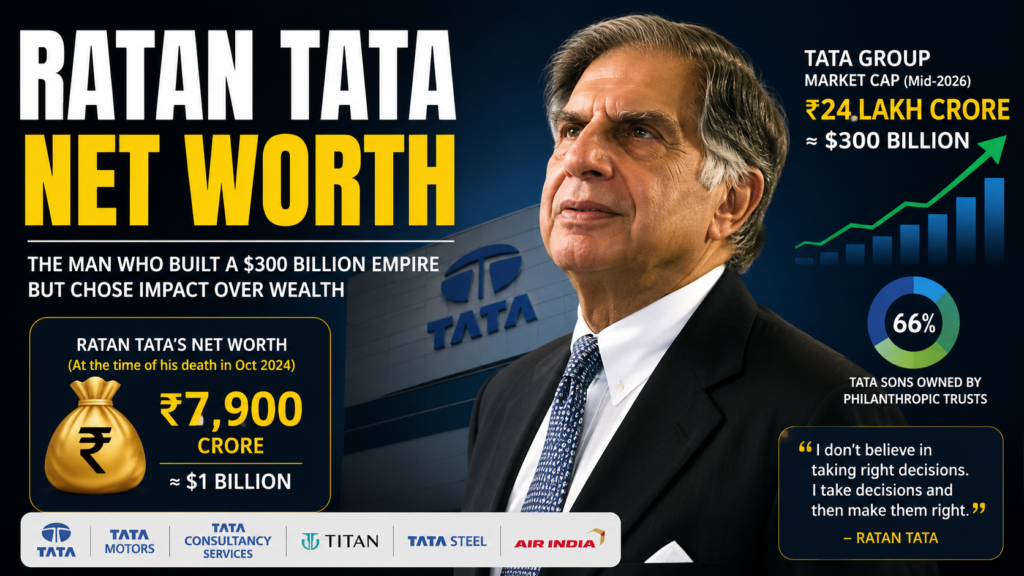
The most credible figure comes from the Hurun India Rich List 2024, released in August 2024 — about two months before his death. It pegged Ratan Tata’s net worth at ₹7,900 crore, which is approximately $1 billion at the then-prevailing exchange rate.
He held a 0.83% stake in Tata Sons, the holding company of the Tata Group. That stake alone was worth roughly ₹6,500–7,000 crore at the time. The rest came from his personal investments, real estate (a Colaba residence and an Alibaug beach house), and his stake in RNT Associates, his personal investment vehicle.
But here’s where it gets interesting.
The Hurun figure isn’t the only number floating around. Fortune India-Waterfield research estimated his personal wealth at ₹16,448 crore — more than double. The Economic Times reported ₹3,800 crore. GuruFocus, tracking only his U.S.-listed stock holdings, showed just $6 million.
So which one is right?
They all are — for different things.
- ₹7,900 crore = Hurun’s estimate of his total net worth at death
- ₹3,800 crore = the value of his will, which excluded certain assets already held in trusts or jointly owned
- $6 million = only his publicly disclosed U.S. stock holdings, not his Tata Sons stake
- ₹16,448 crore = a different valuation methodology that included unrealized gains from his stakes in other Tata Group companies like TCS, Tata Motors, and Titan
The takeaway: Ratan Tata’s net worth was somewhere between $1 billion and $2 billion — a fraction of what you’d expect for a man who ran a $300 billion conglomerate.
The Tata Group vs. Ratan Tata: A Critical Distinction
This is where most articles get it wrong.
The Tata Group’s combined market capitalization stood at approximately ₹24 lakh crore (roughly $300 billion) in mid-2026. Its revenue in FY2023-24 was $165 billion. It employs over a million people.
Ratan Tata personally owned 0.83% of the holding company — just 3,368 shares.
That’s the entire story in one number.
Compare that to Mukesh Ambani, who owns roughly 42% of Reliance Industries. Ambani’s net worth in 2026 is around $90–100 billion. Tata’s was $1 billion.
That’s a 100x difference — not because Tata was less successful, but because the ownership structure was fundamentally different.
The Tata Trusts — the Sir Dorabji Tata Trust and the Sir Ratan Tata Trust — collectively hold 66% of Tata Sons. The profits flow to philanthropy, not to the family’s bank accounts.
This isn’t a bug. It’s a feature. It’s the Tata model.
What His Will Revealed — And Why It Matters
Ratan Tata signed his will on February 23, 2022, with four codicils (legal amendments).
The will allocated the majority of his ₹3,800 crore estate to two charitable foundations:
- Ratan Tata Endowment Foundation (RTEF)
- Ratan Tata Endowment Trust (RTET)
His 0.83% Tata Sons stake — worth the bulk of his wealth — was bequeathed to these foundations in a 70:30 ratio.
Other beneficiaries included:
- Mohini Mohan Dutta, a close associate, received one-third of the residual estate — approximately ₹588 crore
- His half-sisters, Shireen and Deanna Jejeebhoy, received assets worth ₹800 crore
- His brother Jimmy received their shared family property in Juhu, Mumbai (worth ₹16 crore) and jewellery
- His German Shepherd, Tito, was provided for with lifelong care provisions
- Household staff and former employees were also remembered
The no-contest clause
The will includes a no-contest clause — anyone who challenges it risks losing their entire inheritance. It also restricts the sale of his Tata Sons shares except to existing shareholders.
This is not a typical billionaire’s will. Most wealth managers would structure things very differently. Tata chose to lock his wealth into philanthropy permanently.
Ratan Tata vs. Mukesh Ambani: The Real Comparison
| Metric | Ratan Tata | Mukesh Ambani |
|---|---|---|
| Personal Net Worth | ~$1B (₹7,900 Cr) | ~$90-100B |
| Ownership in Group | 0.83% | ~42% |
| Group Market Cap | ~$300B | ~$250B |
| Philanthropy Model | 66% of holding co owned by trusts | Personal foundation |
| Annual Donations | ~$1.2B+ lifetime | ~$100M+ annually |
The punchline: Ratan Tata’s personal net worth is less than 1% of Mukesh Ambani’s.
But here’s the contrarian take: That’s not a weakness. It’s a deliberate choice.
Ambani built Reliance into a powerhouse and kept the equity. Tata built the Tata Group into a global force and gave the equity away. Different models. Both valid. But only one gets you on the billionaire list.
Why the “Ratan Tata Net Worth Without Donation” Question Is Misleading
You’ll see this search query everywhere: “Ratan Tata net worth without donation.”
The implication is that Tata would be a billionaire if he hadn’t given so much away.
That’s not how it works.
Tata’s wealth wasn’t reduced by donations. He never owned the wealth in the first place. The Tata Trusts have held the majority stake in Tata Sons since long before Ratan took over. He wasn’t giving away his money — he was not taking money that could have been his.
Some analysts argue that a founder-style ownership structure could theoretically have created billionaire-level personal wealth, but the Tata ownership model was designed differently from the start. If he had structured Tata Sons like Reliance — with a 42% personal stake — his net worth would have been orders of magnitude higher. He chose not to.
This is a crucial distinction that most coverage misses.
Macro Take: What This Tells Us About Indian Business
The Tata model is structurally different from the Ambani/Adani model.
- Ambani/Adani: Founder/family retains controlling equity. Wealth accumulates personally. Philanthropy is a separate activity.
- Tata: The holding company is owned by charitable trusts. Wealth is socialized at the ownership level. The family acts as stewards, not owners.
Neither is inherently better. But the Tata model has one underappreciated advantage: succession is smoother.
When Ratan Tata died in October 2024, there was no family battle over the company. Noel Tata stepped in as Tata Trusts chairman. The ownership structure didn’t change. The business continued.
Compare that to the succession dramas at Reliance or the Adani Group — where the founder’s death or incapacitation would trigger massive ownership and control questions.
The Tata model is built for perpetuity. The Ambani/Adani model is built for wealth creation. Different goals. Different outcomes.
What Investors Should Actually Learn From This
If you’re an investor — and you should be thinking like one — here’s the actionable takeaway:
1. Ownership structure matters more than headline net worth.
A CEO with 0.83% ownership and a CEO with 42% ownership have completely different incentives. One is a professional manager with a stewardship mindset. The other is an owner-operator. Both can work. But you need to know which you’re betting on.
2. The Tata Group is not Ratan Tata.
His death didn’t change the group’s fundamentals. The Trusts still own 66%. The management team is still in place. The business still generates $165B in revenue.
3. Philanthropy as a business model is underrated.
The Tata Trusts’ 66% stake means the group’s profits flow back to social causes — education, health, livelihood generation, art, and culture. That creates a different kind of brand equity. In India, that matters. A lot.
4. Don’t confuse control with ownership.
Ratan Tata controlled one of India’s largest conglomerates. He owned almost none of it. That’s rare. And it’s worth understanding why.
Featured Snippet Answers
What was Ratan Tata’s net worth?
Ratan Tata’s net worth was approximately ₹7,900 crore ($1 billion) at the time of his death in October 2024, according to the Hurun India Rich List. He held a 0.83% stake in Tata Sons, with the majority of Tata Sons owned by philanthropic trusts.
Why wasn’t Ratan Tata a billionaire?
Ratan Tata wasn’t a billionaire because the Tata Trusts — not the Tata family — own 66% of Tata Sons. He personally owned less than 1% of the holding company, unlike Mukesh Ambani who owns around 42% of Reliance.
How much did Ratan Tata leave in his will?
Ratan Tata’s will was valued at approximately ₹3,800 crore. The majority went to the Ratan Tata Endowment Foundation and Trust, with portions allocated to family, close associates, staff, and his dog Tito.
Who is richer, Tata or Ambani?
Mukesh Ambani is significantly richer, with a net worth of approximately $90-100 billion compared to Ratan Tata’s around $1 billion. Ambani owns about 42% of Reliance Industries, while Tata owned only 0.83% of Tata Sons.
What is the total net worth of the Tata Group?
The Tata Group’s combined market capitalization was approximately ₹24 lakh crore ($300 billion) in mid-2026, with TCS contributing about ₹7.7 lakh crore of that total.
FAQ
1. Is Ratan Tata giving 1 crore?
Answer: This refers to rumors about Tata donating ₹1 crore to various causes. While Tata made numerous philanthropic contributions through the Tata Trusts, there is no single “₹1 crore” donation program associated with his name. His will allocated the bulk of his ₹3,800 crore estate to the Ratan Tata Endowment Foundation and Trust.
2. What was Ratan Tata’s date of death?
Answer: Ratan Tata died on October 9, 2024, at Breach Candy Hospital in Mumbai at the age of 86.
3. How much was Ratan Tata’s net worth in rupees?
Answer: ₹7,900 crore according to the Hurun India Rich List 2024. Other estimates ranged from ₹3,800 crore to ₹16,448 crore depending on methodology.
4. How much was Ratan Tata’s net worth in dollars?
Answer: Approximately $1 billion at the time of his death, based on the ₹7,900 crore figure.
5. Did Ratan Tata own Tata Sons?
Answer: Yes, he owned a 0.83% stake in Tata Sons, the holding company of the Tata Group.
6. What did Ratan Tata’s will say?
Answer: His will allocated the majority of his ₹3,800 crore estate to the Ratan Tata Endowment Foundation and Trust, with portions for family, close associates, staff, and his dog. It includes a no-contest clause and restricts the sale of his Tata Sons shares.
7. Who inherited Ratan Tata’s wealth?
Answer: The primary beneficiaries are the Ratan Tata Endowment Foundation and Trust. Other beneficiaries include his half-sisters (₹800 crore), Mohini Mohan Dutta (one-third of residual estate), his brother Jimmy, and various staff members.
Conclusion
Ratan Tata’s net worth was ₹7,900 crore — roughly $1 billion. He was never a billionaire by global standards, and he never wanted to be.
Three takeaways:
1. The numbers are complicated because the structure is complicated. Different methodologies produce different figures. The Hurun estimate is the most reliable.
2. He chose stewardship over ownership. The Tata Trusts own two-thirds of Tata Sons. Ratan Tata owned less than 1%. That wasn’t an accident — it was the Tata model.
3. His legacy isn’t measured in dollars. The Tata Group employs a million people, generates $165 billion in revenue, and has a market cap of $300 billion. Ratan Tata’s personal wealth was a rounding error compared to what he built.
For investors: Pay attention to ownership structure. It tells you more about a company’s future than any CEO’s net worth ever will.
For everyone else: Ratan Tata’s story is a reminder that wealth and impact are not the same thing. He had one. He chose the other.
About the Author
This article was written by a business and financial writer covering Indian companies, billionaire wealth structures, ownership models, and market trends. The analysis combines financial data, legal filings, and corporate governance research to provide clarity on complex ownership structures.
This article is for informational purposes only and does not constitute financial advice. Always do your own research before making investment decisions.
Internal Linking Strategy
To strengthen topical authority and improve site structure, add natural internal links to: