
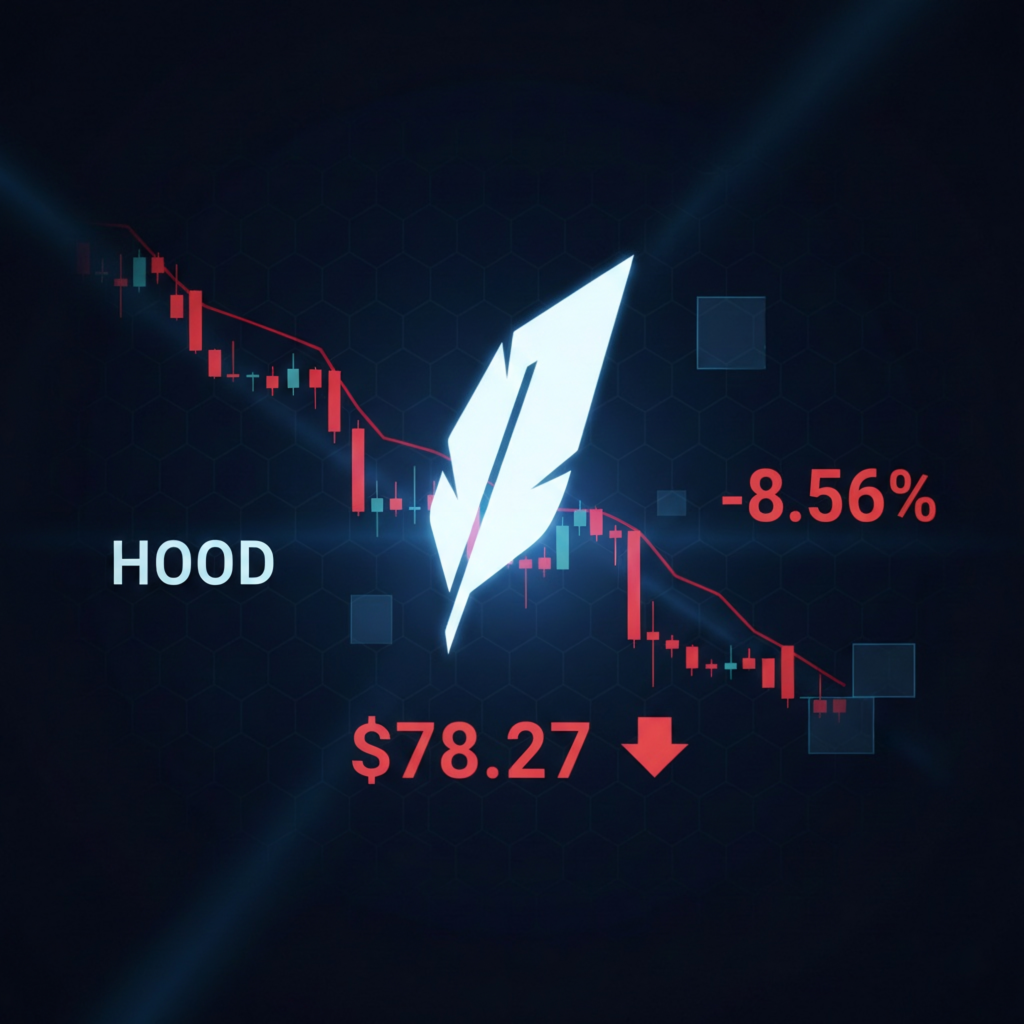
HOOD Stock Today: Live Snapshot (February 11, 2026)
Last Updated: February 11, 2026 at 9:00 AM EST
| Metric | Value |
|---|---|
| Current Price | $85.60 (close) / $78.27 (overnight) |
| Market Cap | $76.97 billion |
| 52-Week Range | $29.66 – $153.86 |
| P/E Ratio (TTM) | 35.67 |
| 1-Year Return | +52.12% |
| Daily Volume | 40.82M (vs 27M avg) |
| Beta (5Y) | 2.44 |
| Analyst Consensus | Buy (Strong Buy/Buy majority) |
| Average Price Target | $146.34 (87% upside) |
Data as of market close February 10, 2026; overnight trading at $78.27 (-8.56%)
Volume Alert: Daily volume of 40.8M vs 27M average signals heightened institutional activity following earnings—a key indicator of positioning changes by large funds.
This section is updated as new earnings guidance and price action develops.
What’s Happening With HOOD Stock Right Now?
Robinhood Markets (NASDAQ: HOOD) plunged 8.56% in overnight trading Tuesday following a Q4 2025 earnings miss that shook investor confidence. The stock closed regular trading at $85.60, then crashed to $78.27 in extended hours as revenue came in at $1.28 billion versus Wall Street’s $1.34 billion expectation.
Here’s the tension: earnings beat at $0.66 per share versus $0.63 expected, but crypto revenue collapsed 38% year-over-year. So is this post-earnings selloff a buying opportunity—or a warning that HOOD stock’s 2024 rally is over?
The answer depends on whether you believe prediction markets, international expansion, and the Robinhood Chain blockchain can offset persistent crypto weakness. Wall Street remains bullish with a $146.34 average price target, suggesting 87% upside from overnight levels. But retail sentiment on Stocktwits hit “extremely bullish” even as institutions sold—a classic divergence that signals volatility ahead.
HOOD Stock At a Glance
Best For: Aggressive growth investors with 3–5 year time horizons
Risk Level: High (Beta: 2.46 — more volatile than S&P 500)
Dividend: None
Volatility: Elevated — stock trades at 2.5x market volatility
Investment Horizon: Long-term hold (3–5+ years minimum)
Like other sentiment-driven names, including those in our recent TSLA stock analysis, HOOD can move fast in both directions.
What Does HOOD Stock Do? Understanding Robinhood’s Business Model
Robinhood Markets isn’t just another trading app anymore—it’s evolved into what CEO Vlad Tenev calls a “Financial SuperApp.”
The revenue engine runs on multiple cylinders now:
Transaction-Based Revenue generates income from equities, options, and crypto trading through payment for order flow (PFOF). Options revenue alone jumped 41% year-over-year in Q4 2025.
Net Interest Income comes from uninvested cash held in customer accounts and margin lending. This segment grew 39% YoY to $411 million in Q4.
Robinhood Gold is the company’s premium subscription service. At $5 per month, it offers higher margin rates, bigger instant deposits, and exclusive research. The subscriber base hit 4.2 million—up 58% year-over-year.
Prediction Markets represent the fastest-growing business line in company history. Launched in partnership with Kalshi, these event contracts drove over $12 billion in volume during 2025’s first full year of operation.
Crypto Trading still matters, but it’s shrinking as a revenue percentage. While crypto generated $221 million in Q4, that represented just 17% of total revenue—down from previous quarters when it dominated the mix.
Here’s what matters: Robinhood now has 11 separate business lines each generating over $100 million in annual recurring revenue. That’s diversification that didn’t exist three years ago.
Technical Levels to Watch for HOOD Stock Today
Immediate Resistance: $85-88 (current close level acting as new support/resistance)
Major Resistance: $90-95 (breakout zone if crypto stabilizes)
Psychological Support: $75 (round number attracting buyers)
Strong Support: $70-72 (200-day moving average zone)
RSI Status: Cooling from overbought levels above 70, now entering neutral zone
Volume Trend: Spike to 40.8M (vs 27M avg) confirms institutional repositioning
The overnight drop to $78.27 tests psychological support—if it holds above $75, technical buyers may step in. A break below $70 would signal deeper correction ahead.
5 Key Reasons HOOD Stock Dropped After Earnings
- Revenue Miss Disappointed Premium Valuations — At 45x earnings pre-drop, HOOD priced in perfection. Missing revenue by 4% triggered profit-taking from momentum traders.
- Crypto Revenue Collapsed 38% YoY — Bitcoin’s October 2025 crash hammered trading volumes through year-end, even as crypto represents just 18% of total revenue now.
- Coinbase Contagion Spread Across Crypto Stocks — Citi slashed its COIN price target by $100, signaling broader concerns about crypto-linked equities regardless of business diversification.
- Options Revenue Underwhelmed — $314 million came in short of $331 million estimates, suggesting even non-crypto segments faced headwinds.
- Institutional Profit-Taking at Technical Resistance — HOOD had tripled in 2024; institutions used the earnings miss as an excuse to lock in gains after the stock hit $153.86 in October 2025.
Latest Hood Earnings Breakdown: The Numbers Behind the Selloff
Let’s cut through the noise and examine what actually happened in Q4 2025.
The Top Line: Revenue came in at $1.28 billion, missing the $1.34 billion consensus by roughly 4%. That’s a 27% year-over-year increase, but Wall Street doesn’t reward you for missing estimates—even when you’re growing.
The Bottom Line: EPS of $0.66 beat expectations of $0.63. Net income reached $605 million, though that’s down 34% from the prior year quarter.
The Crypto Problem: Crypto revenue collapsed 38% YoY to $221 million. The October 2025 market downturn hammered trading volumes, and the pain extended through year-end.
The Bright Spots:
- Transaction-based revenues: $776 million (up 15.5% YoY)
- Net interest revenues: $411 million (up 38.9% YoY)
- “Other revenues” including prediction markets: jumped 108.7% to $96 million
- Robinhood Gold subscribers: record 4.2 million
Full Year 2025: Annual revenue grew 52% to $4.5 billion. Net income jumped 35% to $1.9 billion. Platform assets surged 68% to $324 billion.
Balance Sheet Strength: The company ended Q4 with $19.4 billion in total cash, providing ample runway for international expansion, blockchain development, and strategic acquisitions without needing to raise capital.
The miss wasn’t catastrophic—crypto-specific weakness in a quarter when Bitcoin got hammered. But when HOOD traded at premium valuations, any miss triggers selling.
Why Is HOOD Stock Moving? Decoding the Market Reaction
The 8% after-hours drop tells you everything about market psychology in early 2026.
Valuation Pressure: HOOD had tripled in 2024, hitting an all-time high of $148.67 in October 2025 before SEC filings showed the company benefiting from the crypto bull run. At those levels, the stock priced in perfection. Missing revenue by 4% when trading at 45x earnings invites profit-taking.
What HOOD Stock Today Faces: The current overnight price of $78.27 represents a 49% decline from October highs, resetting valuations to more reasonable levels. However, crypto sensitivity remains a near-term overhang.
Crypto Sentiment: Bitcoin’s price fell 2.8% to around $67,700 in the 24 hours following earnings. The broader crypto market dropped 2.6%. When crypto weakness persists, NASDAQ-listed HOOD feels it disproportionately—even though crypto now represents less than 20% of revenue.
Analyst Reactions: Citi cut its Coinbase price target by nearly $100, signaling broader concerns about crypto-linked equities trading on major exchanges. Autonomous Research’s Christian Bolu called the top-line miss “not helpful at all” given high expectations.
Retail Sentiment: Interestingly, Stocktwits data showed retail sentiment climbing to “extremely bullish” despite the price drop. Message volume spiked 257% in 24 hours. Retail traders saw a buying opportunity where institutions saw a warning sign.
That’s why HOOD stock today trades more on sentiment than fundamentals in the short term—the disconnect between institutional caution and retail optimism creates the volatility that defines this name.
Fed Rate Environment Impact: With interest rates remaining elevated, fintech stocks face headwinds from compressed net interest margins and reduced speculative trading activity. HOOD’s net interest revenue grew 39% YoY, but future quarters face tougher comparisons if the Federal Reserve maintains its restrictive stance.
The disconnect? Institutions focus on quarterly execution. Retail focuses on long-term potential from prediction markets, international expansion, and the upcoming Robinhood Chain blockchain.
Bull Case vs Bear Case: The Complete Risk-Reward Analysis
Let’s lay out both scenarios without the hype.
Bull Case: Why HOOD Could Surge
Revenue Diversification Works: Crypto now represents just 18% of revenue, down from over 40% historically. When crypto crashes, the business doesn’t crater anymore. Options, subscriptions, and prediction markets provide stability.
Prediction Markets Momentum: The $12 billion in 2025 volume was just year one. Management projects this could become a “super cycle” driving trillions in annual volume. Early 2026 saw $4 billion in contracts traded.
Robinhood Gold Flywheel: At 4.2 million subscribers generating $250+ million in annual recurring revenue, Gold creates predictable income Wall Street loves. Each subscriber brings higher engagement and trading volume.
International Expansion: The Indonesian market entry targets 275 million people with surging retail investor participation. Indonesia’s retail base jumped from 3.8 million to over 19 million in five years.
Robinhood Chain Catalyst: The Layer-2 blockchain on Arbitrum launches in 2026 with Chainlink as oracle provider. It targets tokenized real-world assets—bringing stocks and bonds onto on-chain settlement infrastructure, enabling 24/7 trading of traditional securities. If successful, Robinhood Chain could eliminate clearing delays and enable fractional ownership of high-value assets.
S&P 500 Inclusion Benefits: Index membership (added 2024) forces passive fund purchases under SEC oversight, creating baseline demand.
Bear Case: Why HOOD Could Struggle
Crypto Sensitivity Remains: Despite diversification, a prolonged crypto bear market still hurts. If Bitcoin trends toward $50,000, trading volumes collapse.
Regulatory Risk: Payment for order flow faces ongoing scrutiny. Regulatory changes could pressure margins.
Competition Intensifies: Traditional brokers now offer commission-free trading. Schwab, Fidelity, and Public.com compete for the same users.
Valuation Multiples Contract: At 35x earnings, HOOD trades at premium to most financial services companies. If growth rates slow, that multiple could compress toward 15-20x industry averages.
Revenue Concentration: Despite 11 business lines, options and interest income dominate. A market downturn reducing trading activity and interest rates simultaneously would hit both.
Execution Risk: International expansion, blockchain development, and new products require flawless execution. Missteps delay the growth story.
Competitive Landscape: How HOOD Stacks Up
| Company | Revenue Growth (YoY) | Business Focus | Risk Level | 2026 Outlook |
|---|---|---|---|---|
| HOOD | +27% (Q4) | Multi-product fintech platform | Medium-High | Bullish if crypto stabilizes |
| COIN | Varies with crypto | Pure-play crypto exchange | Very High | Highly crypto-dependent |
| MSTR | Corporate treasury | Bitcoin treasury company | Extreme | Leveraged Bitcoin proxy |
Robinhood’s Advantage: Product diversification and subscription revenue create stability pure crypto plays lack. When Bitcoin crashed 50%+ in previous cycles, Coinbase revenue fell 70%+. Robinhood’s 38% crypto revenue decline was painful but not existential.
Coinbase’s Edge: COIN dominates institutional crypto services and staking, capturing higher-value customers.
MicroStrategy’s Position: MSTR operates as leveraged Bitcoin proxy with continuous purchasing creating volatility but massive upside if Bitcoin trends toward $100,000+.
The difference: Robinhood builds for the next decade of retail finance. Coinbase and MSTR live and die by crypto cycles.
HOOD Stock Price Prediction: 2026-2030 Outlook
Let’s get realistic about where Robinhood stock could trade. Price predictions vary wildly because fintech valuations hinge on growth rates, market conditions, and sentiment shifts.
Wall Street Consensus on HOOD Stock (12-Month Targets)
Average Price Target: $146.34
Range: $90.00 to $180.00
Current Level: $78.27 (overnight)
The wide spread reflects uncertainty about crypto markets and prediction market adoption rates. Bulls see $180+ if crypto rebounds and prediction markets scale. Bears set floor around $90 if crypto enters multi-year winter.
HOOD Stock Scenario Analysis: 2026 Year-End
| Scenario | Price Target | Key Assumptions |
|---|---|---|
| Bear Case | $70-85 | Prolonged crypto bear market, slowing user growth, regulatory headwinds |
| Base Case | $120-145 | Modest crypto recovery, prediction markets grow 50%+, stable Gold subs |
| Bull Case | $165-180 | Crypto bull run resumes, prediction markets explode, successful international launch |
Long-Term View: 2030 Projections
Conservative Estimate: $140-160
If Robinhood maintains 15-20% annual revenue growth with stable margins, the stock could compound toward $140-160 by 2030. This assumes fintech multiples contract from current levels but the business executes well.
Moderate Estimate: $200-250
If prediction markets become a multi-billion dollar revenue driver and international expansion succeeds, HOOD could justify valuations in this range. Requires Gold subscribers reaching 8-10 million and crypto stabilizing.
Optimistic Estimate: $300+
The bull scenario requires multiple tailwinds: crypto super cycle, prediction markets generating $1+ billion annually, successful blockchain adoption, and sustained 25%+ revenue growth. This outcome demands near-perfect execution.
Critical Macro Context: Long-term fintech valuations historically compress during rising rate cycles. If the Federal Reserve maintains elevated interest rates above 4% through 2027–2028, fintech multiples could face sustained pressure regardless of operational excellence. Conversely, rate cuts that reignite risk appetite could drive HOOD toward bull-case targets faster than fundamentals alone would suggest.
Reality Check: Any forecast beyond 18 months is speculative. Fintech valuations swing wildly based on interest rates, market conditions, and regulatory changes. Use these as directional guides, not precise predictions.
Compared to other top tech stocks in 2026, HOOD trades more like a high-beta growth play.
Who Owns the Most HOOD Stock? Understanding the Shareholder Base
Ownership structure reveals who believes in Robinhood’s future.
Institutional Ownership: Approximately 65% of shares are held by institutional investors. This high institutional ownership signals Wall Street confidence, though it also means the stock moves on institutional flows.
Top Institutional Holders:
- The Vanguard Group: ~11% ownership (largest holder)
- BlackRock: ~6.6% ownership
- Index Ventures VI Jersey LP: ~9.76% ownership
Vanguard and BlackRock’s positions largely reflect index fund holdings. Robinhood’s inclusion in the S&P 500 mandated purchases by passive funds tracking the benchmark.
Insider Ownership: About 1-2% of shares are held by company insiders. CEO Vlad Tenev and other executives maintain positions, though recent insider selling in early January 2026 raised questions. The CEO completed a sale exceeding prior patterns by over 2x in both size and value—though this could represent planned diversification rather than lack of confidence.
Retail Ownership: Individual investors hold a meaningful but smaller percentage than institutions. Robinhood’s retail following remains passionate, with Stocktwits sentiment frequently in “extremely bullish” territory.
What This Means: High institutional ownership provides stability but creates volatility when funds rebalance. The Index Ventures position suggests venture capital still believes in long-term upside. Modest insider ownership is common for fintech companies where founders prioritized capital raises over control.
HOOD’s 1-year return crushed the S&P 500 benchmark, highlighting its volatility premium.
Is HOOD Stock a Good Buy? The Verdict for Different Investors
There’s no universal answer for NASDAQ: HOOD—it depends entirely on your profile.
For Aggressive Growth Investors: Consider Buying
If you can stomach 30-40% drawdowns and hold for 3-5 years, Robinhood stock offers compelling upside. The prediction markets opportunity alone could justify current valuations if it scales as management projects. Add international expansion and blockchain initiatives, and you have multiple shots on goal.
Entry Strategy: Dollar-cost average on weakness rather than chasing rallies. HOOD stock dropped 49% from October 2025 highs of $153.86 to current overnight levels around $78—volatility creates opportunities for patient buyers.
For Income Investors: Pass
Robinhood shares pay no dividend and won’t for the foreseeable future. Management prioritizes growth over distributions. If you need income, look elsewhere.
For Value Investors: Be Cautious
Even at roughly 35-40x trailing earnings, HOOD doesn’t scream “value.” The stock trades on growth expectations, not current fundamentals. Traditional value metrics suggest overvaluation unless the company compounds at 20%+ annually.
For Crypto Enthusiasts: Partial Allocation
HOOD offers crypto exposure with less volatility than pure-play crypto stocks or tokens. If you believe crypto adoption continues but want diversification into traditional finance products, HOOD makes sense as 10-20% of a crypto-adjacent portfolio.
Risk Tolerance Check for HOOD Stock
You should avoid HOOD stock if:
- You can’t handle 40%+ drawdowns
- You need your money within 12 months
- You’re uncomfortable with crypto market volatility
- You prefer established dividend-paying companies
You might consider Robinhood stock if:
- You have a 3+ year investment horizon
- You believe retail trading and prediction markets grow
- You want fintech exposure without pure crypto risk
- You can average into positions during volatility
The Bottom Line: HOOD Stock Price Today vs Future Potential
The Q4 earnings miss hurt, but it doesn’t invalidate the thesis. Robinhood is building a legitimate financial services platform that extends far beyond its commission-free trading origins.
Crypto’s 38% revenue decline dominated headlines, but that segment now represents just 18% of total revenue. Options revenue jumped 41%. Prediction markets exceeded $12 billion in volume. Gold subscribers hit record levels.
Wall Street’s “Buy” consensus with a $146.34 average price target suggests analysts see significant value after the selloff, though the $90-180 range reflects legitimate uncertainty—this isn’t a stable utility stock.
For investors who understand the risks and can hold through volatility, HOOD stock offers asymmetric upside if prediction markets scale, international expansion succeeds, or crypto rebounds. For conservative investors seeking stability, this isn’t your play.
Robinhood Markets trades where technology meets finance, growth meets volatility, and opportunity meets risk. Position size accordingly.
Current HOOD Stock Price: $85.60 (close) / $78.27 (overnight)
Market Cap: $76.97 billion
Analyst Rating: Buy (majority Strong Buy/Buy ratings)
Price Target Range: $90 – $180 (avg $146.34)
If you’re still building your foundation, review our stock market beginner’s guide before allocating capital.
Frequently Asked Questions About HOOD Stock
Is HOOD stock a good buy right now?
HOOD stock could be attractive for growth investors after the post-earnings selloff brought valuations down 49% from October 2025 highs. Analyst price targets average $146.34 and overnight trading near $78 creates potential opportunity—but crypto sensitivity and execution risk remain concerns. It depends on your risk tolerance and time horizon.
What is HOOD stock price prediction for 2030?
Conservative estimates suggest $140-160 by 2030, assuming steady 15-20% annual growth. Optimistic scenarios reach $200-300 if prediction markets scale dramatically and international expansion succeeds. However, long-term fintech valuations historically compress during rising rate cycles, so these are directional estimates rather than guarantees.
Why did HOOD stock drop after earnings?
Robinhood stock dropped 8.56% in overnight trading because Q4 revenue missed estimates by 4% ($1.28 billion vs. $1.34 billion expected). Crypto revenue declined 38% year-over-year, and the stock had tripled in 2024, creating profit-taking pressure when results disappointed premium valuations.
Who owns the most HOOD stock?
The Vanguard Group owns approximately 11% of Robinhood shares, making it the largest institutional holder. BlackRock holds about 6.6%, and Index Ventures VI Jersey LP owns roughly 9.76%. About 65% of HOOD shares are institutionally owned.
Does Robinhood stock pay dividends?
No, HOOD stock does not pay dividends. The company reinvests all profits into growth initiatives like international expansion, product development, and the Robinhood Chain blockchain. Dividend payments are unlikely in the near future.
What does HOOD stock do?
Robinhood Markets (NASDAQ: HOOD) operates a fintech platform generating revenue through payment for order flow on trades, net interest income from customer cash and margin lending, subscription fees from Robinhood Gold ($5/month), prediction market fees, and cryptocurrency trading. The company now has 11 business lines each generating $100+ million annually.
Disclaimer: This analysis is for informational purposes only and should not be considered financial advice. Cryptocurrency-linked stocks like HOOD carry substantial risk. Always conduct your own research and consider consulting a financial advisor before making investment decisions. Past performance does not guarantee future results.