

The AI narrative is getting loud—almost too loud. Every SaaS tool suddenly has a “Copilot,” every startup claims “AI inside,” and suddenly everyone’s a genius.
But let’s cut through the noise.
Software is the show.
Semiconductors? That’s the battlefield.
And if you’ve been around long enough—or at least studied the ghosts of markets past—you’ve seen this pattern play out before. During the dot‑com era, people chased flashy front‑end companies. Meanwhile, the real money quietly flowed into infrastructure—companies like Cisco and Intel.
Different decade. Same script.
What Are the Best Semiconductor Stocks With Highest Growth in 2026?
If you want the straight answer—no fluff, no hype—the top players dominating this cycle are:
- NVIDIA – undisputed AI king
- ASML Holding – monopoly‑level moat
- Taiwan Semiconductor Manufacturing Company – global backbone
- Broadcom – custom silicon powerhouse
- Advanced Micro Devices – aggressive challenger
These aren’t just companies—they’re choke points in the AI supply chain.
And markets love choke points.
Live Market Snapshot
The NASDAQ Composite looks stable on the surface. Big tech is holding the line. But underneath? Rotation is happening.
- Software = shaky
- Semiconductors = selective strength
- Equipment makers = quietly heating up
Semiconductor Sector Performance Snapshot
| Segment | Recent Trend | Key Drivers |
|---|---|---|
| AI Chips (GPUs) | Cooling after massive rally | Consolidation ahead of new architectures |
| Equipment (Lithography) | Gaining momentum | Foundry capacity build-out |
| Memory (HBM) | Entering supercycle | AI demand for high-bandwidth memory |
| Custom Silicon (ASICs) | Exploding demand | Hyperscaler in-house chip projects |
Why Semiconductor Stocks Are Running the Show
1. The Data Center Arms Race
Companies like Microsoft, Amazon, and Google aren’t “investing” in AI.
They’re going to war.
They need chips. Not just any chips—fast, efficient, power‑hungry monsters backed by high‑bandwidth memory.
And guess what?
Supply can’t keep up.
2. The Illusion of “NVIDIA Replacement”
Everyone wants to dethrone NVIDIA.
But here’s the reality check:
It’s not just about hardware. It’s about ecosystem.
CUDA isn’t just software—it’s gravity. Developers orbit around it. And breaking that orbit? Not easy.
Yes, Advanced Micro Devices is catching up.
But catching up isn’t the same as winning.
3. Supply Is the Real Moat
Unlike software, you can’t scale semiconductors overnight.
Building a fab costs billions. Takes years. Requires political stability (good luck with that).
Which is why companies like ASML Holding and Taiwan Semiconductor Manufacturing Company are basically toll booths on a global highway.
You don’t go around them.
You pay them.
Top Semiconductor Stocks With Highest Growth (Breakdown)
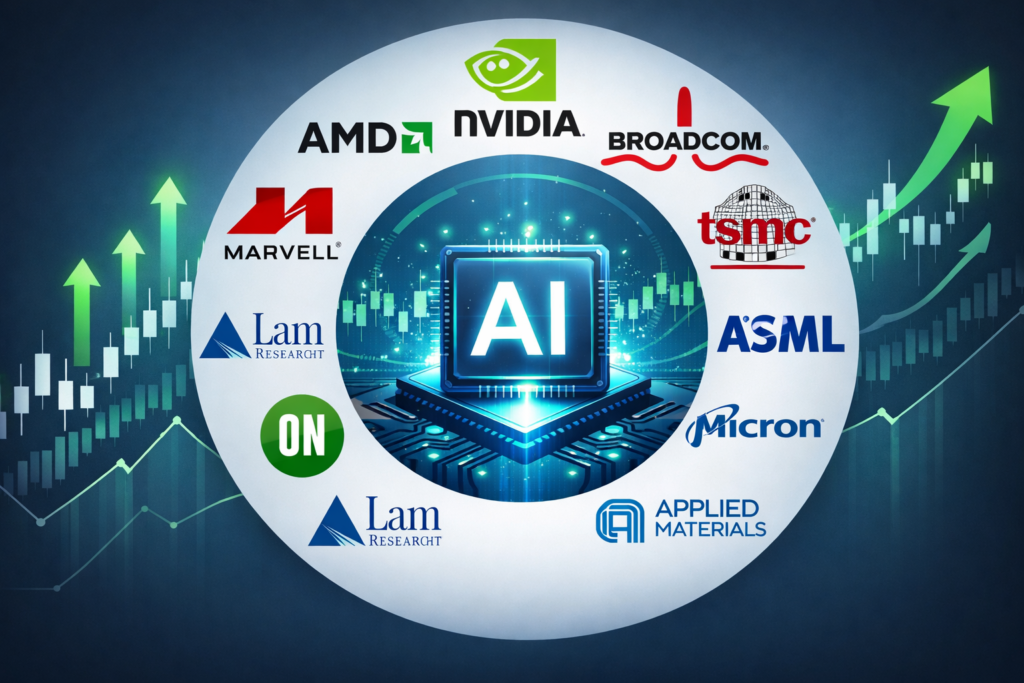
Don’t skim this list—the order and context matter more than the names themselves.
Here are the best semiconductor growth stocks to watch in 2026.
1. NVIDIA
Edge: CUDA ecosystem + insane margins
Risk: Overcrowded trade
Reality: Great company, not always a great price
2. Advanced Micro Devices
Edge: Strong AI chips (MI300)
Risk: Software lag
Play: Buy when sentiment dips
3. Broadcom
Edge: Custom chips for hyperscalers
Risk: Client concentration
Vibe: Not flashy—but prints money
4. Taiwan Semiconductor Manufacturing Company
Edge: Manufactures everyone’s chips
Risk: Geopolitics
Truth: If AI wins, they win
5. ASML Holding
Edge: Only supplier of EUV machines
Risk: Long cycles
Moat: Basically untouchable
6. Micron Technology
Edge: HBM demand
Risk: Cyclicality
Twist: This cycle might be different
7. Marvell Technology
Edge: Custom data center chips
Risk: Execution speed
Potential: Sneaky upside
8. Lam Research
Edge: Fab expansion demand
Risk: Lumpy revenue cycles
9. ON Semiconductor
Edge: Power chips for electric future
Risk: Auto cycle volatility
10. Applied Materials
Edge: Benefits from every new fab
Risk: Downcycle sensitivity
Valuation Snapshot (AI Semiconductor Leaders)
| Company | Market Cap | P/E (Fwd) | Revenue Growth (YoY) | EPS Growth (Fwd) | Key Risk |
|---|---|---|---|---|---|
| NVIDIA | $2.2T | 35x | 90% | 45% | Valuation / crowded trade |
| AMD | $250B | 45x | 15% | 25% | Software moat gap |
| Broadcom | $600B | 25x | 35% | 20% | Client concentration |
| TSM | $700B | 20x | 20% | 18% | Geopolitics (Taiwan) |
| ASML | $350B | 40x | 25% | 22% | Supply chain complexity |
| Micron | $120B | 12x | 50% | 120% | Cyclicality of memory |
| Marvell | $60B | 35x | 20% | 25% | Execution risk |
Historical Performance (1Y–5Y Returns)
| Company | 1Y Return | 3Y Return | 5Y Return |
|---|---|---|---|
| NVIDIA | 180% | 450% | 1,500% |
| AMD | 45% | 60% | 400% |
| Broadcom | 80% | 150% | 250% |
| TSM | 40% | 50% | 120% |
| ASML | 35% | 70% | 200% |
| Micron | 60% | 40% | 80% |
| Marvell | 70% | 100% | 150% |
Future Scenario Forecast (2026–2030)
| Scenario | Industry Growth (CAGR) | Expected Returns (CAGR) | Probability |
|---|---|---|---|
| Goldilocks (AI delivers) | 15–20% | 20–25% | 40% |
| Supply Constrained | 10–15% | 15–20% | 35% |
| Cyclical Downturn | 0–5% | –10% to 0% | 20% |
| Geopolitical Shock | Negative | –30% to –50% | 5% |
Risk vs. Reward
| Stock | Upside Potential | Downside Risk | Cycle Position | Verdict |
|---|---|---|---|---|
| NVIDIA | Very High | High | Late-cycle leader | Hold / Accumulate |
| AMD | High | Medium | Catch-up phase | Buy on dips |
| TSM | Moderate | Medium | Core infrastructure | Long-term hold |
| ASML | High | Low | Early-cycle beneficiary | Strong buy |
| Micron | Very High | Very High | Cyclical upswing | Tactical |
| Broadcom | High | Medium | Mature AI leader | Core holding |
| Marvell | High | Medium | Emerging ASIC player | Speculative add |
Where Smart Money Is Actually Going
Retail chases headlines.
Institutions? They zoom out.
They’re quietly stacking positions in:
- ASML Holding – tools
- Taiwan Semiconductor Manufacturing Company – manufacturing
- Micron Technology – memory leverage
Because the real game isn’t just chips.
It’s control.
The Part Nobody Likes to Hear
Let’s be real for a second.
If a stock feels “obvious,” it’s probably already priced in.
Everyone knows NVIDIA.
Everyone trusts ASML Holding.
So where’s the edge?
Usually in the boring stuff:
- second‑tier suppliers
- forgotten equipment players
- early‑stage memory cycles
Not sexy.
But markets don’t pay for sexy—they pay for mispriced.
Risks Most Investors Ignore
Overvaluation
We’re pricing perfection. Markets don’t do perfection.
Cycles
Semiconductors always boom… and always bust.
AI Bubble?
Could be 1995. Could be 1999. No one rings a bell at the top.
Geopolitics
Taiwan isn’t just a location—it’s a global risk switch.
The market appears to be underpricing that risk.
Most investors will get this cycle wrong—not because they picked bad companies, but because they couldn’t handle the volatility.
Smart Allocation Strategy
The “all‑in‑on‑NVIDIA” trade worked for 2023–2025. It won’t work for the next five years.
The “Semiconductor Core” Model Portfolio:
- 50% Large Cap Core (NVIDIA, Taiwan Semiconductor Manufacturing Company, Broadcom): Anchors. Hold through the cycle.
- 30% Mid Cap Growth (Marvell Technology, Micron Technology, Advanced Micro Devices): Beta plays. Trade around earnings.
- 20% High‑Risk / Small Cap (Ambarella, SiTime, Wolfspeed): Venture capital sleeve. Willing to lose it.
If you’re building a portfolio today, the semiconductor sector isn’t optional—it’s foundational. The only question is how much risk you’re willing to carry.
If you’re new to markets, start with our beginner’s guide to investing in the stock market before diving into high‑growth sectors like semiconductors.
Growth Compounding Calculator
\Use the calculator above to see the power of compounding. A 15–20% annual return (realistic for top semiconductor growth stocks) turns $10,000 into over $40,000 in a decade. The key is avoiding the blow‑up years where you panic sell.
Where Smart Investors Go Next
- For a deeper dive on the king of the space, read our detailed NVIDIA stock price analysis and forecast for 2026.
- The AI boom isn’t just about chips; it’s about the infrastructure. See our piece on AI infrastructure stocks shaping the boom.
- Looking for lower entry points? Check out our list of semiconductor stocks under $50.
- Some names have been beaten down. Are they value traps? See our undervalued semiconductor stocks 2026.
- For the risk‑takers, we cover stocks that could 10x by 2030.
- Want broader exposure? Read our analysis of top tech stocks to watch in 2026.
FAQ
Q: Are semiconductor stocks a buy in 2026?
A: Yes, but selectively. Focus on companies with strong moats and pricing power rather than chasing hype‑driven momentum.
Q: What are the best semiconductor stocks for the long term?
A: For a 5–10 year horizon, Taiwan Semiconductor Manufacturing Company and ASML Holding are arguably the safest bets. Both own critical bottlenecks in the supply chain.
Q: Which semiconductor stocks pay dividends while growing?
A: Broadcom stands out with a 1.5%+ yield and double‑digit growth. Intel offers a high yield but carries execution risk.
Q: Are semiconductor stocks overvalued in 2026?
A: Some are. Leaders like NVIDIA trade at premium valuations, but memory and equipment names still offer reasonable entry points.
Q: How does the AI boom affect semiconductor stocks?
A: AI is the single largest catalyst since the microprocessor. It drives demand for GPUs, custom ASICs, and HBM.
Q: What are the biggest risks right now?
A: Overvaluation, cyclical downturn, AI bubble, and Taiwan‑related geopolitical tensions.
Conclusion
Zoom out.
The AI boom isn’t about apps. Never was.
It’s about infrastructure. Control. Bottlenecks.
And the companies that own those bottlenecks—like NVIDIA, ASML Holding, and Taiwan Semiconductor Manufacturing Company—they’re not just participating in the cycle.
They are the cycle.
But don’t get comfortable.
Easy money? That phase is over.
Now it’s a thinking game. A positioning game. A patience game.
Because in every gold rush…
…the real winners aren’t the ones digging.
They’re the ones selling the tools.
Disclaimer: This content is for informational purposes only and does not constitute financial advice. Always do your own research before investing.