
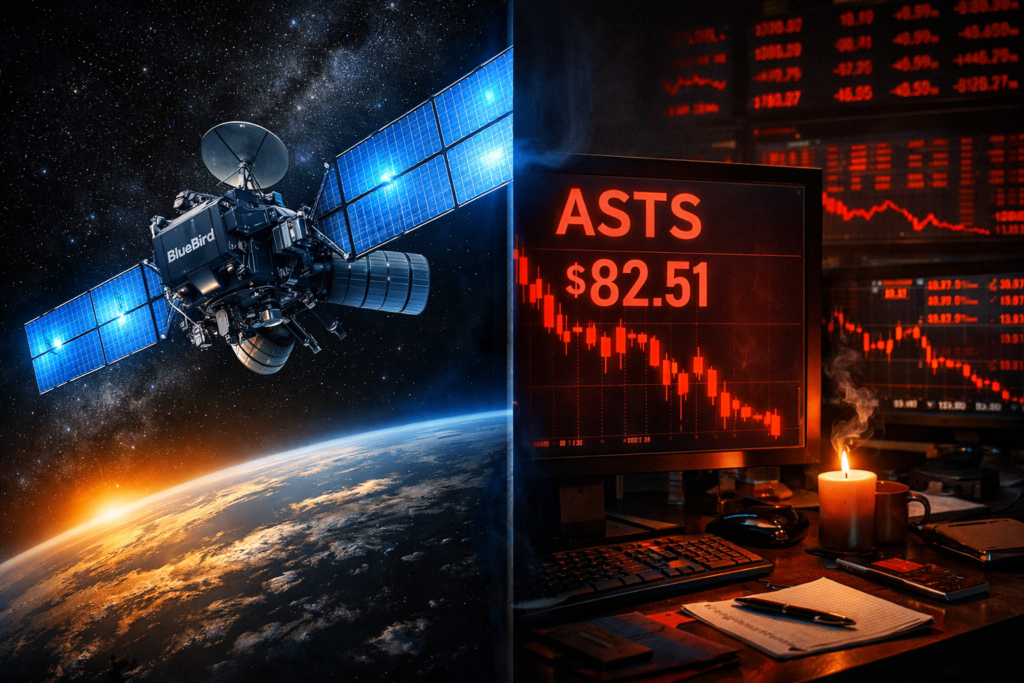
If you’ve been watching AST SpaceMobile (NASDAQ:ASTS) this week, you’re experiencing the full spectrum of pre-revenue infrastructure investing.
On February 11, the company announced it had successfully unfolded BlueBird 6—the largest commercial communications array ever deployed in low Earth orbit. Engineering triumph. Technical validation. The kind of news that confirms the direct-to-device vision is actually viable.
On February 12, ASTS announced a $1.0 billion convertible senior notes offering due 2036.
The stock dropped 19% in two days. From $101.79 to $82.51.
This is what happens when a $30 billion market cap company with $18.5 million in trailing revenue attempts to fund a capital-intensive build-out. The market celebrates the technology. It punishes the financing. And investors are left wondering whether this pullback represents opportunity or warning.
ASTS Stock News Today: What Happened?
The market often treats corporate finance events as sentiment Rorschach tests. Bullish investors see strategic positioning. Bearish investors see dilution. The truth requires understanding both.
The Technical Milestone
On February 11, AST SpaceMobile confirmed that BlueBird 6 successfully deployed its 2,400-square-foot antenna array in orbit. Deploying a structure that size in space is extraordinarily difficult. Doing it successfully means the Block 2 satellite design works, unlocking higher bandwidth (targeting 120 Mbps) and greater network capacity.
This materially reduces technical risk. The company has now demonstrated it can build and deploy its next-generation hardware.
The Financing Event
On February 12, ASTS announced a $1.0 billion offering of 2.250% convertible senior notes due 2036. Net proceeds: approximately $983.7 million. Simultaneously, the company priced repurchases of up to $300 million of its existing 2032 convertibles—targeting higher-cost debt.
Here’s what that means in practical terms:
- ASTS is raising $1B in new debt at a favorable 2.25% rate
- It’s retiring $300M in older, higher-cost debt (4.25% and 2.375% notes)
- To fund those buybacks, it’s issuing new shares
- The convertible structure gives note holders the right to convert to equity later
The market’s reaction was swift and negative. Pre-market selling intensified. Reddit sentiment scores plunged to 32 (bearish) before stabilizing. By Thursday morning, ASTS stock overnight trading showed continued pressure.
But here’s what matters: when institutions participate in large convertible offerings, they often hedge by shorting the underlying stock. Those hedge-related flows create selling pressure independent of fundamentals. Some of this week’s move is mechanical, not judgmental.
ASTS Stock Valuation in 2026
Let’s look at where ASTS stock stands today, because context matters more than price targets.
| Metric | ASTS | Industry Benchmark / Context |
|---|---|---|
| Revenue (TTM) | $18.53M | $2.1B (company 2028 projection) |
| Cash Position (Sept 2025) | $1.204B | ~12-18 months runway pre-raise |
| Pro Forma Cash (Post-Feb 2026) | ~$2.2B | Extended through critical deployment |
| Total Debt | $706.6M | $1.7B pro forma post-convertible |
| Market Cap | $30.28B | 1,634x trailing revenue |
| Forward Revenue Multiple (2028 @ $2.1B) | ~14x | If market cap stays constant |
| Risk Level | Speculative | High |
| Beta | 2.70 | 1.0 (market average) |
A few observations.
First, the valuation disconnect. A $30 billion market cap on $18.5 million in revenue requires extraordinary assumptions about future growth. The company’s own narrative projects $2.1 billion in revenue by 2028—which implies 385.7% annual revenue growth from current levels.
Second, the normalization bridge. If ASTS hits its projected $2.1 billion in revenue by 2028 and the market cap remains at $30 billion, the forward revenue multiple would compress to approximately 14x—well within range of mature infrastructure software and early-stage communications infrastructure plays. For context, high-growth infrastructure names typically trade between 10x and 20x forward revenue during their commercial scaling phase. The entire investment thesis rests on closing that gap through execution, not valuation contraction.
Third, the cash runway. With $1.2 billion in cash as of September 2025 and quarterly operating burn around $94 million, ASTS had liquidity. The new $1 billion raise extends that runway significantly but adds complexity to the capital structure.
Fourth, the beta of 2.70. This stock moves. It moves a lot. When broader markets sell off, ASTS stock tends to sell off more. Our analysis of why are stocks down today provides context on how high-beta names behave during market stress.
Is ASTS Stock Overvalued?
The valuation debate isn’t about cheap versus expensive. It’s about execution confidence and timeline.
At $82.51, ASTS stock embeds several assumptions:
- Successful deployment of 45-60 satellites by end-2026
- Carrier partnerships convert to meaningful revenue in 2026-2027
- No catastrophic technical failures
- Limited competitive interference from Starlink or others
If these assumptions hold, current prices may prove reasonable. If any break, the valuation resets quickly.
This is why ASTS stock valuation discussions inevitably become timeline discussions. The company isn’t priced like a telecom infrastructure provider. It’s priced like a biotech awaiting Phase III results—except the trial lasts five years and requires continuous capital infusions.
Institutional Behavior: Who’s Buying, Who’s Selling
The institutional picture reveals disagreement, which is exactly what you’d expect at a valuation crossroads.
Recent Institutional Buying:
- Norges Bank added 2.73 million shares in Q4 2025 (~$198M)
- Marex Group PLC increased position by 126.7%
- Clear Street Group added 1.6 million shares (+87.6%)
- Vanguard Group added 1.57 million shares
- Morgan Stanley added 1.43 million shares (+44.0%)
- BlackRock added 1.27 million shares
Recent Institutional Selling:
- D. E. Shaw removed 2.6 million shares (-44.1%) in Q3 2025
- American Tower sold 2.29 million shares in December 2025 ($159.7M)
- Multiple smaller institutions trimmed positions
The takeaway? Large, long-only institutions are adding. Some hedge funds are taking profits. And a major strategic shareholder reduced its stake significantly.
That last one matters. When a 10% owner sells $160 million worth of shares, it’s worth understanding why. Strategic holders sometimes trim when valuations disconnect from near-term fundamentals—not because the thesis is broken, but because portfolio discipline requires it. Still, it’s a signal worth noting.
Float dynamics matter here too. With approximately 376.57 million shares outstanding and significant insider and strategic holdings, the tradable float is smaller than the market cap suggests. This amplifies volatility in both directions.
Short interest remains modest relative to float, but could build if execution stumbles. The stock’s volatility profile makes it attractive for short-term traders on both sides.
ASTS vs Other High-Beta Tech Stocks
For investors comparing across the speculative tech landscape, ASTS shares characteristics with other high-conviction, pre-revenue plays.
| Characteristic | ASTS | Typical High-Beta Tech |
|---|---|---|
| Revenue Visibility | Low (contractual commitments) | Low to Medium |
| Capital Intensity | Very High | Variable |
| Primary Risk Factor | Launch cadence | Adoption / Competition |
| Catalyst Timeline | 2026-2028 | 12-24 months |
| Competitive Moat | Spectrum agreements | Varies |
| Retail Ownership | Significant | Significant |
Unlike software stocks in 2026 , ASTS requires physical infrastructure deployment. There’s no over-the-air update to fix launch delays. No cloud migration to accelerate adoption. The capital intensity is real and unavoidable.
This also distinguishes it from other infrastructure plays like VRT stock , where data center build-out follows clear demand signals. ASTS is building capacity ahead of demand, which creates financing risk.
The comparison to TSLA stock in its early years is tempting but imperfect. Tesla had pre-orders and visible demand. ASTS has carrier agreements that still need to convert to usage.
ASTS Stock Long-Term Potential Through 2030
The long-term thesis for ASTS stock rests on three variables.
1. Constellation Density
The company targets 45-60 satellites by end-2026. Full global coverage requires hundreds. Each launch brings the network closer to continuous service, which is when revenue accelerates. The gap between intermittent and continuous coverage is where most execution risk resides.
2. Commercial Adoption
ASTS has announced partnerships with major carriers including Verizon, AT&T, and Vodafone. But partnership announcements and revenue-sharing agreements are different things. The market needs visibility into how revenue splits work, whether carriers actively market the service, and what usage patterns look like.
3. Capital Efficiency
The February 2026 financing provides runway, but the company will eventually need to generate cash flow or raise again. The cost of capital matters. At 2.25%, the new convertibles are attractive. But each future raise comes at an unknown price and unknown terms.
What breaks the thesis:
- Launch delays pushing continuous coverage to 2028 or beyond
- Carrier adoption slower than expected
- Competitive pressure compressing margins
What accelerates the thesis:
- Faster deployment (60+ satellites by end-2026)
- Government contracts providing early, high-margin revenue
- Clear line of sight to cash flow positive operations by 2028
The long-term potential is real. But it’s not guaranteed. For investors building positions, understanding how to evaluate these stories matters. Our guide on how to choose your first stocks provides foundational principles for this type of analysis.
ASTS Stock Price Prediction 2026–2030
Any forecast requires explicit assumptions. Here’s our scenario-based framework.
| Scenario | Revenue Assumption | Valuation Multiple | Price Target 2026 | Price Target 2030 | Thesis Breaker |
|---|---|---|---|---|---|
| Bear Case | Delays push revenue to 2028+ | 10x 2028 revenue | $35–$75 | $15–$55 | Launch failures or dilutive rescue financing |
| Base Case | 45-60 satellites by 2026, initial revenue 2027 | 15x 2028 revenue | $65–$110 | $170–$320 | Execution stays on track, carrier adoption steady |
| Bull Case | 60+ satellites, strong carrier uptake, gov contracts | 20x 2028 revenue | $95–$150 | $320–$520 | Faster deployment, minimal competition, margin expansion |
Bear case breaks if: Launch delays force additional dilutive raises. Competitive pressure from Starlink accelerates. Carrier integration proves slower than expected. The company needs capital when markets are closed to speculative names.
Base case assumes: Deployment stays on track. Commercial agreements convert to revenue in 2027. The macro environment supports high-beta names.
Bull case requires: Faster deployment, minimal in-orbit failures, stronger-than-expected carrier marketing, and durable government revenue. Competition remains a narrative risk, not a revenue risk.
These ranges are intentionally broad. ASTS stock remains in transition from build to commercialization. The primary valuation driver is expected timeline to scaled recurring revenue, not short-term quarterly results.
Is ASTS Stock a Good Buy Right Now?
This depends entirely on your investment profile and time horizon.
Who should consider buying ASTS:
- Investors with 5+ year time horizons who can ignore volatility
- Those comfortable with 40-50% drawdowns as operating expenses continue
- Investors who understand pre-revenue infrastructure dynamics
- Those who can hold through multiple financing events without emotional selling
- Investors who believe satellite-to-phone is winner-take-most
Who should avoid ASTS:
- Short-term traders without strong risk management (beta 2.70 is unforgiving)
- Retirees or those needing capital preservation
- Investors uncomfortable with continuous dilution risk
- Those requiring near-term earnings or cash flow visibility
- Value investors focused on current fundamentals
The difference between trading and investing matters enormously here. Traders got caught in the February financing move. Long-term investors view the pullback as a potential entry point, assuming they believe the execution story holds.
For those new to this type of analysis, our beginners guide to investing provides foundational context for evaluating speculative positions and position sizing appropriately.
Can ASTS Reach $100?
Yes. It was at $101 before the recent pullback.
The question isn’t whether ASTS stock can reach $100—it’s whether it can sustain those levels and build toward higher valuations. That requires:
- Visible progress on the 45-60 satellite target with regular launch updates
- Clear commercial activations in 2026 with named carrier partners
- No additional dilutive raises at lower prices that reset expectations
- Broader market cooperation (high-beta names need risk-on environments)
The stock’s correlation to broader tech sentiment means watching S&P 500 direction matters. In risk-off environments, ASTS underperforms. In risk-on periods, it outperforms. This isn’t a defensive name—it’s a pure expression of risk appetite.
ASTS Stock Overnight Movement
For traders monitoring ASTS stock overnight, volatility is the norm.
After the February 12 announcement, pre-market selling reached 9% before stabilizing. After-hours trading showed continued pressure as retail processed the news and institutional hedging flows executed.
This pattern is typical for convertible offerings. The stock often finds support once the hedging-related selling completes and investors refocus on fundamentals. The question is whether that support holds at $80 or drifts lower as the market recalibrates expectations.
For those tracking real-time moves, understanding HOOD stock earnings dynamics provides context on how retail-heavy names behave during news events and where sentiment inflection points tend to occur.
Major Downside Risks
Let’s be explicit about what could go wrong, because with ASTS stock, the risk section isn’t theoretical.
Dilution Risk
The February 2026 financing adds complexity. Convertible structures can create price ceilings and increase volatility during financing periods. If the company needs additional capital before revenue scales, dilution accelerates.
Capital Raising Cycle
ASTS operates in a 2026 macro environment where capital costs more than it did in 2021. The Fed’s rate cycle matters. Each future raise comes at an unknown price and unknown terms.
Launch Execution Risk
The company depends on manufacturing throughput, launch availability, deployment success, and in-orbit performance. Delays in any area impact timelines. Multiple delays shift the conversation from growth to survival.
Technology Adoption Uncertainty
Carriers must integrate the service into billing systems. Consumers must actually use it. Churn and usage patterns remain unknown until the service operates at scale.
Competitive Pressure
SpaceX’s Starlink is moving into direct-to-device. Established telecom players have deep pockets and regulatory influence. Competition doesn’t need to surpass ASTS to impact valuation—it only needs to reduce future margin expectations.
Regulatory Risk
The FCC’s Supplemental Coverage From Space framework helps, but approvals remain process-driven. Spectrum coordination with terrestrial licensees is technically complex. International approvals add another layer.
Market Downturn Exposure
With beta of 2.70, ASTS stock amplifies broader market moves. In a sustained downturn, the stock could significantly underperform regardless of company-specific progress.
FAQ
Is ASTS a good stock buy in 2026?
It depends on risk tolerance and time horizon. Long-term believers in satellite-to-phone may find the post-offering pullback attractive. Risk-averse investors should wait for clearer revenue visibility in 2027.
Can ASTS reach $100?
Yes—it traded above $100 before the February financing. Sustaining those levels requires visible progress on satellite deployment and commercial activations in 2026, plus supportive broader markets.
Why did ASTS stock fall?
The 19% drop followed a $1 billion convertible notes offering. Institutional hedging created mechanical selling pressure, and retail sentiment turned cautious on dilution concerns despite positive technical news.
What is ASTS long-term potential?
If deployment succeeds and carrier adoption scales, ASTS could generate billions in revenue by 2028-2030. If execution falters, the current valuation could decline rapidly.
Is ASTS overvalued?
At $30 billion market cap on $18.5 million revenue, the stock prices in significant future success. Whether it’s overvalued depends on execution, not current fundamentals.
What are the biggest risks?
Dilution, launch delays, competitive pressure, and the need for continuous capital raises. The stock’s high beta also means it underperforms in market downturns.
The Bottom Line
AST SpaceMobile is building something genuinely ambitious: a space-based cellular broadband network that works with standard smartphones. The BlueBird 6 deployment proves the technology works. The February financing proves capital intensity remains high.
Technology validation and investment returns are different things.
The February 2026 financing highlights the tension at the heart of this story. Building a global satellite constellation requires enormous capital. Raising that capital creates dilution. The market accepts dilution when it accelerates time-to-revenue. It punishes dilution when it appears to be for survival.
ASTS now has approximately $2.2 billion in cash pro forma for the new raise. That provides runway through the critical deployment phase. The next 12–24 months will determine whether this capital translates into the recurring revenue the valuation assumes.
For investors willing to accept the volatility, the risk, and the timeline, ASTS stock remains one of the more interesting stories in space infrastructure. For those needing near-term certainty or capital preservation, waiting for clearer evidence of recurring revenue makes sense.
Compare it to other high-conviction stories like TSLA stock in its infrastructure phase or infrastructure plays like VRT. Each requires different assumptions about timing, competition, and capital efficiency.
Know what you’re owning. Know why you’re owning it. And know that with ASTS stock, the only certainty is volatility. Position size accordingly.
Disclaimer: This material is for general information purposes only and is not intended as financial, investment, or other advice on which reliance should be placed. No opinion given constitutes a recommendation that any particular investment, security, transaction, or investment strategy is suitable for any specific person.