
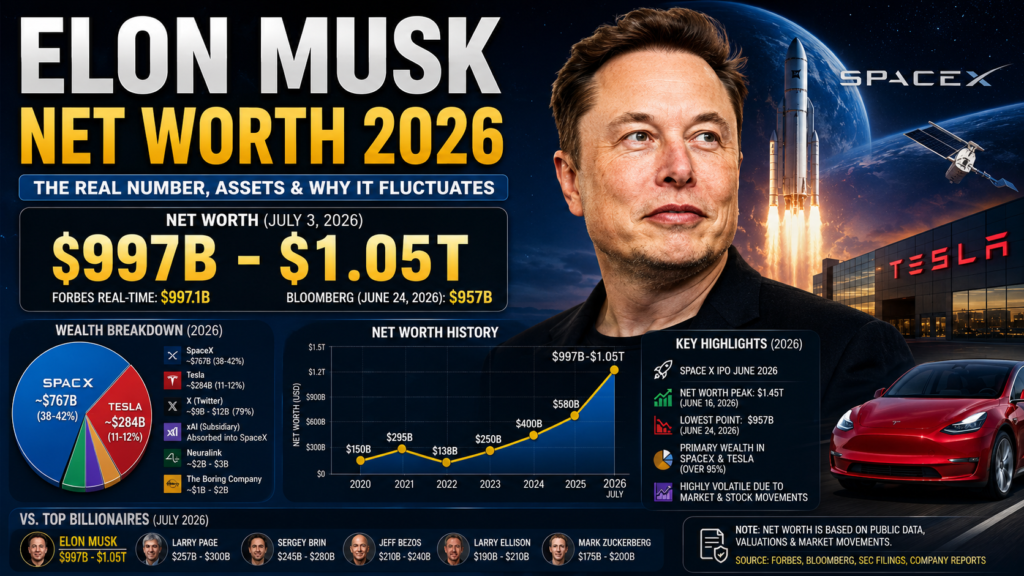
Elon Musk’s net worth in 2026 is estimated between $997 billion and $1.05 trillion, depending on the tracking methodology. As of July 3, 2026, Forbes Real-Time placed him at $997.1 billion (Forbes Real-Time Billionaires), while Bloomberg’s Billionaires Index recorded approximately $957 billion on June 24, 2026 (Bloomberg Billionaires Index).
The primary drivers of his wealth remain his controlling stakes in SpaceX (~42%) and Tesla (~11–12%), making his fortune highly sensitive to daily stock price movements. This is the baseline answer most searches seek. Below, we break down exactly where that money sits, how it moves, and the structural risks that make this trillion-dollar figure far less liquid than it appears.
Elon Musk Profile Table
| Attribute | Value |
|---|---|
| Full Name | Elon Reeve Musk |
| Age | 55 (born June 28, 1971) |
| Birth Date | June 28, 1971 |
| Nationality | South African, Canadian, American |
| Education | Bachelor of Arts in Physics and Bachelor of Science in Economics from the University of Pennsylvania (Wharton School) |
| Occupation | CTO & Chairman of SpaceX, CEO of Tesla, Owner of X |
| Net Worth (2026) | ~$997B – $1.05T |
| Children | 14 |
| Residence | Boca Chica, Texas, USA |
Elon Musk Net Worth Quick Facts (2026)
- Forbes Real-Time (July 3, 2026): $997.1 billion (Forbes)
- Forbes 2026 List (March 1 snapshot): $839 billion (Forbes 2026 Billionaires List)
- Bloomberg Billionaires Index (June 24, 2026): $957 billion (Bloomberg)
- Peak (June 16, 2026): ~$1.45 trillion (Forbes tracking during post-SpaceX IPO rally)
- Lowest point (June 24, 2026): ~$957 billion (Bloomberg)
- Primary asset concentration: SpaceX (~$767B) + Tesla (~$284B) = >95% of total wealth
How Elon Musk Makes His Money (Income Sources)
Musk does not draw a conventional salary. His wealth accumulates through equity appreciation and performance-based stock options across his private and public ventures.
- Tesla (NASDAQ: TSLA): According to Tesla’s 2026 proxy statement, Musk owns approximately 717 million shares plus performance-based restricted stock units (RSUs) tied to operational milestones. This stake represents roughly 11–12% of the company.
- SpaceX: Per the company’s IPO prospectus filed with the SEC in June 2026, Musk holds approximately 4.8 billion shares and 350 million options with an exercise price of $8.40. This translates to roughly 38–42% of outstanding shares and 84% voting control.
- xAI: Retains a significant equity position. According to SpaceX’s SEC filings, xAI became a subsidiary of SpaceX in early 2026, consolidating Musk’s AI interests under the space exploration umbrella.
- X (formerly Twitter): Owns ~79% of the social media platform, acquired for $44 billion in 2022. Fidelity Investments has marked down its X holdings multiple times since the acquisition.
- Neuralink & The Boring Company: Majority-owned private ventures, collectively valued in the low billions based on secondary market transactions.
Elon Musk Assets: What Does He Actually Own?
Beyond stock certificates, Musk’s tangible asset portfolio includes:
- Real Estate: A ~$50 million compound in Boca Chica, Texas (primary residence). He sold most of his California properties in 2020–2021.
- Private Jet: A Gulfstream G700, valued at roughly $75–80 million.
- Art & Collectibles: Estimated collection valued at $5–10 million, though notably smaller than typical ultra-high-net-worth peers.
- Private Equity & Cash Reserves: Estimated at $2–3 billion in liquid cash and short-term treasuries—less than 0.3% of his total net worth.
Elon Musk Companies & Ownership Stake
| Company | Approx. Ownership Stake | Est. Value Contribution (2026) |
|---|---|---|
| SpaceX | 38–42% (84% voting control) | ~$767 billion |
| Tesla | 11–12% (717M shares + options) | ~$284 billion |
| X (Twitter) | ~79% | ~$9–12 billion |
| xAI | Majority (subsidiary of SpaceX) | Absorbed into SpaceX |
| Neuralink | Majority | ~$2–3 billion |
| The Boring Company | Majority | ~$1–2 billion |
Elon Musk Net Worth History (Year-over-Year)
| Year | Net Worth (End of Year / Snapshot) | Key Event |
|---|---|---|
| 2020 | ~$150 billion | Tesla stock splits and S&P 500 inclusion |
| 2021 | ~$295 billion | Tesla peaks at $1.2T market cap |
| 2022 | ~$138 billion | Twitter acquisition and Tesla sell-off |
| 2023 | ~$250 billion | Tesla recovery; SpaceX valuation rises |
| 2024 | ~$400 billion (Dec) | Crosses $400B milestone |
| 2025 | ~$580 billion (Dec) | Starlink revenue accelerates |
| 2026 (March) | $839 billion (Forbes List snapshot) | Pre-IPO snapshot |
| 2026 (July) | ~$997B – $1.05T | Post-SpaceX IPO volatility |
Source: Forbes & Bloomberg historic tracking.
Elon Musk Career Timeline
- 1995: Drops out of Stanford after two days to launch Zip2 with his brother.
- 1999: Zip2 sold to Compaq for ~$307 million; Musk pockets ~$22 million.
- 2002: Sells PayPal to eBay for $1.5B in stock; Musk nets ~$175 million.
- 2004: Invests $6.35M into Tesla, becomes Chairman.
- 2016: Acquires SolarCity for $2B; founds Neuralink.
- 2022: Acquires Twitter for $44B, rebrands to “X” in 2023.
- 2025: Appointed as senior advisor to President Trump; leads DOGE.
- 2026 (June): SpaceX IPO cements temporary trillionaire status.
Elon Musk vs. The World’s Richest Billionaires
| Person | Company | Est. Net Worth (July 2026) |
|---|---|---|
| Elon Musk | SpaceX, Tesla | ~$997B – $1.05T |
| Larry Page | Alphabet (Google) | ~$257 – $300B |
| Sergey Brin | Alphabet (Google) | ~$245 – $280B |
| Jeff Bezos | Amazon, Blue Origin | ~$210 – $240B |
| Larry Ellison | Oracle | ~$190 – $210B |
| Mark Zuckerberg | Meta | ~$175 – $200B |
Comparison based on Forbes and Bloomberg data as of July 2026.
The 2026 Trillion-Dollar Rollercoaster
Here is the data that explains the dramatic peaks and troughs, with all key numbers sourced from publicly available filings and tracking services.
June 12, 2026 – SpaceX debuted on the Nasdaq at $135 per share. According to the company’s IPO prospectus filed with the SEC, Musk held approximately 4.8 billion shares and 350 million options with an exercise price of $8.40. Based on the IPO opening price, Bloomberg estimated this single stake vaulted him to roughly $1.11 trillion overnight.
June 16, 2026 – The stock hit an intraday high of $225.64, pushing Musk’s total wealth to a peak of $1.45 trillion, according to Forbes’ real-time tracking methodology.
June 22, 2026 – A broad AI-tech correction struck. SpaceX shares plunged over 16% in a single session, erasing roughly $240 billion from Musk’s paper holdings (Forbes data). Simultaneously, Forbes removed $116 billion of restricted Tesla stock from their published net worth calculation—options tied to Musk remaining CEO through January 2028. His net worth dipped to ~$957 billion (Bloomberg), losing the ‘trillionaire’ status exactly 12 days after gaining it.
June 29, 2026 – SpaceX rebounded 7.6% and Tesla 8.6%, adding roughly $62 billion, pushing him back over the $1T mark.
Key data takeaway: As of July 3, Forbes Real-Time estimates him at $997.1 billion, while Bloomberg’s last snapshot on June 24 showed ~$957 billion. This spread highlights the methodological discrepancies in how restricted stock and illiquid private holdings are valued.
Why the “Trillionaire” Label Needs Context (Institutional View)
Most coverage treats these numbers as definitive wealth. They are not. Here is the institutional nuance.
1. Illiquidity is the elephant in the room.
According to SEC lock-up provisions tied to the SpaceX IPO, insider shareholders—including Musk—are restricted from selling any shares for at least 180 days post-listing. He cannot realize that $767 billion SpaceX stake until late 2026 at the earliest.
2. The “Big Short” skepticism.
Investor Michael Burry publicly questioned SpaceX’s valuation in a June 2026 social media post, stating he found “nothing” in the S-1 filing to justify a $1–2 trillion valuation. According to SpaceX’s IPO filings, the company reported cumulative net losses exceeding $9 billion across 2025 and early 2026.
3. Performance strings attached.
A significant portion of his Tesla options—valued at over $100 billion by Forbes—are restricted. They vest only if Tesla achieves aggressive market cap and operational milestones. If Tesla stock stagnates, that paper wealth vanishes.
From an investment perspective, this resembles deferred compensation with significant execution risk, not a liquid store of value.
Risk Analysis for Investors (Macro Take)
If you are trading Tesla, holding SpaceX-adjacent funds, or simply tracking the top of the market, Musk’s net worth is a sentiment canary.
- Concentration risk is systemic. Musk’s fortune relies on two companies that together control ~65% of the global EV market (Tesla) and ~65% of active orbital satellites (Starlink). This creates a valuation singularity—when AI infrastructure fears hit, both stocks bleed simultaneously.
- The AI trade is everything. The June 2026 correction that briefly unseated him wasn’t about EV sales or rocket launches. It was about AI profitability doubts. For retail investors looking at AI infrastructure stocks in 2026, Musk’s net worth serves as a real-time barometer of speculative excess.
- What to watch: Do not anchor to the nominal number. Watch the Volatility Index (VIX) and semiconductor flows. When Musk loses $100B in a week, it usually coincides with a rotation out of growth stocks like NVDA and Palantir. This is a market structure signal, not a celebrity gossip item.
Elon Musk Net Worth in Indian Rupees (₹)
For Indian readers tracking the conversion:
- $1.05 trillion (peak) ≈ ₹104.7 lakh crore
- $997.1 billion (current) ≈ ₹95 – ₹100 lakh crore
To provide perspective: Musk’s $240 billion single-day loss on June 22 equated to roughly ₹22.8 lakh crore—a sum that exceeds the entire annual GDP of nations like Portugal or Greece. For contrast, while you might track Anil Ambani’s net worth or Virat Kohli’s net worth in crores, Musk’s daily fluctuations dwarf these figures entirely.
What This Means for Long-Term Investors
Musk’s trajectory reflects the broader shift toward narrative-driven mega-cap valuations. If you are constructing a portfolio today:
- Diversify away from concentration risk. Compare Musk’s concentrated model with the diversification strategies discussed in our real estate investment advice or gold vs. silver hedging guides.
- Look at the semiconductor supply chain. Musk’s AI ambitions hinge on chips. Our analysis of undervalued semiconductor stocks 2026 and best semiconductor stocks with highest growth provides a framework for playing the infrastructure side rather than the execution side.
- Avoid the hype. Musk’s ability to create value is undeniable, but his ability to preserve it is untested in a prolonged bear market. For every stock that could 10x by 2030, there are dozens that get crushed when liquidity dries up.
Frequently Asked Questions
What is Elon Musk’s net worth in 2026?
As of July 2026, estimates range from ~$957 billion (Bloomberg) to ~$1.05 trillion (Forbes). The primary driver is the post-IPO valuation of SpaceX combined with his Tesla holdings.
Who is the world’s No. 1 richest man?
Elon Musk has held the title since May 2024. His nearest competitor, Larry Page, is worth roughly $257–300 billion—approximately one-third of Musk’s current valuation.
Who has 1 trillion net worth?
Elon Musk is the first and only person to have crossed the $1 trillion threshold. He first achieved this on June 12, 2026, following the SpaceX IPO. He temporarily lost it on June 24 but regained it by June 29.
Who has 500 billion net worth?
Currently, no one except Elon Musk. His net worth crossed $500 billion in early 2026. The second-richest person, Larry Page, is estimated at approximately $257 billion.
Is Elon Musk richer than entire countries?
Yes. Musk’s peak net worth ($1.45T) briefly exceeded the GDP of medium-sized economies like Poland and Switzerland. However, GDP is a flow (annual income), while net worth is a stock (asset value)—they are not directly comparable.
Can Elon Musk spend $1 trillion?
No. Virtually all of his wealth is locked in equity (SpaceX and Tesla stock). He cannot liquidate most of it without crashing the stock price or facing legal lock-up restrictions. His usable cash is estimated at less than $3 billion.
Why does Elon Musk’s net worth change every day?
Because his net worth is tied to the daily trading prices of Tesla and SpaceX (post-IPO). A 10% move in SpaceX shares can add or erase over $70 billion from his net worth in a single trading session.
Key Takeaways
- The number is volatile: Elon Musk’s net worth in 2026 is not a fixed figure. It swings by tens of billions daily based on tech stock sentiment.
- Assets are concentrated: Over 95% of his wealth is in SpaceX and Tesla. This lack of diversification is a structural risk, not a strength.
- The trillionaire status is real but restrictive: Lock-up periods and performance vesting mean Musk cannot access most of this capital.
- For Indian context: His wealth in crores is almost incomprehensible, but it serves as a useful benchmark for global equity concentration.
Action Strategy: Do not treat Musk’s net worth as a financial metric. Treat it as a risk indicator for the broader AI and EV sectors. When his net worth spikes rapidly without fundamental earnings growth, it is a signal to re-evaluate exposure to growth-heavy assets. When it crashes, it often marks a temporary bottom in oversold tech names like Rivian or Palantir.
Stay disciplined. Wealth is made in the waiting, not in the watching.
About the Author
Moneymint Research Desk is the in-house analytical team at Moneymint, specializing in macroeconomics, wealth tracking, and equity market analysis. We combine institutional-grade data interpretation with a focus on actionable insights for retail investors. Our coverage emphasizes risk-awareness, transparency, and long-term value investing principles.
Last Updated: July 6, 2026