
Most retail investors misunderstand long-term investing as “buy and forget.”
Institutions don’t.
They treat long-term stock investment as a survival strategy wrapped in compounding exposure—not optimism.
And that distinction matters more than any textbook explanation of “wealth creation.”
Because in real markets:
- You don’t lose money when you buy
- You lose money when you exit badly
- And most exits happen emotionally, not rationally
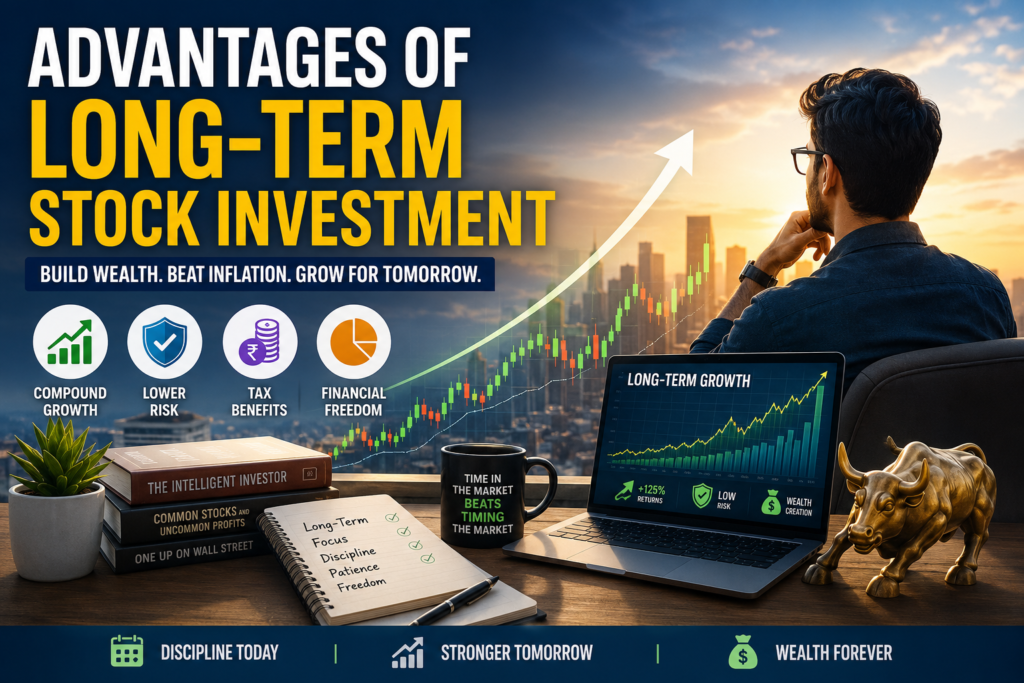
That’s the real foundation behind the Advantages of Long-Term Stock Investment.
What is Long-Term Stock Investment (Real Answer, Not Textbook)
Long-term stock investment is not holding stocks for years.
It is:
Holding businesses through multiple market cycles while ignoring short-term price noise.
A more practical definition used by institutional desks:
- 3–5 years = tactical investing
- 7–10 years = compounding zone
- 10+ years = macro wealth transfer phase
This is where concepts like
👉 “What is the 3 5 7 rule in stocks?”
start making sense—not as formulas, but as behavioral anchors.
Advantages of Long-Term Stock Investment (Operator View)
1. Compounding only works when you stop interrupting it
Compounding is not interest magic. It is non-interference over time.
Most investors kill compounding by:
- panic selling during corrections
- rotating too early into “hot stocks”
- misunderstanding volatility as risk
Institutions don’t.
They accept drawdowns because they understand:
Volatility is the price of entry, not a warning sign.
2. Market timing becomes irrelevant (and that’s the point)
A difficult truth:
Most people asking, “Is it a good time to buy stocks for the long term?” are unknowingly asking the wrong question.
Because long-term capital doesn’t depend on entry precision.
It depends on:
- survival duration
- earnings growth of underlying companies
- reinvestment discipline
Even bad entries recover if the business cycle remains intact.
Good timing without discipline still fails.
3. Tax efficiency quietly compounds returns
One overlooked advantage in India and global markets:
Holding stocks long-term reduces frictional loss.
That includes:
- lower short-term tax impact
- reduced trading costs
- fewer behavioral mistakes (which are effectively “hidden taxes”)
Related idea: How long to hold stock to avoid tax is less about rules and more about minimizing forced exits that destroy compounding structure.
4. Institutions are structurally biased toward long holding
Pension funds, insurance companies, sovereign wealth funds—they don’t trade narratives.
They accumulate exposure.
Why?
Because they are managing:
- liabilities (future payouts)
- not emotions (price charts)
This creates a structural truth:
The largest capital pools in the world are long-term by design, not ideology.
Retail traders often fight this flow without realizing it.
5. Time smooths valuation errors—but only for quality assets
This is where most investors misinterpret long-term investing.
Holding bad businesses for 10 years is not investing. It is damage extension.
Long-term advantage only applies when:
- earnings compound
- balance sheet survives cycles
- sector remains structurally relevant
Otherwise, time destroys capital, not protects it.
What Happens If I Hold Stock for 20 Years?
Direct answer:
If you hold a strong business for 20 years, your returns are primarily driven by:
- revenue expansion cycles
- reinvested earnings
- multiple economic phases (boom + recession + recovery)
But if the business is weak:
- dilution
- stagnation
- or complete capital erosion can occur
So the real variable is not time.
It is the quality of underlying cash flows over time.
Disadvantages of Long-Term Investment (Rarely Discussed Honestly)
Most blogs avoid this section. Markets don’t.
1. Opportunity cost is real
Holding slow-growth assets locks capital.
2. Structural disruption risk
Tech shifts can erase entire sectors.
3. Valuation traps
Even great companies bought at extreme valuations can underperform for years.
4. Psychological anchoring
Investors refuse to exit losing positions due to “long-term bias.”
How Long Do You Have to Hold a Stock to Avoid Day Trading?
From a regulatory standpoint:
- Day trading = intraday buy/sell
- Swing/position trading = typically 1–90 days
- Long-term investing = 1+ years (behavioral, not legal definition)
But in reality:
The market doesn’t classify you. Your behavior does.
Featured Snippets (Quick Institutional Answers)
Are long-term stocks good in 2026?
Yes—if aligned with structural growth sectors like AI infrastructure, semiconductors, and energy transition. But broad market returns will likely remain uneven, making stock selection more important than ever.
Which have the highest growth potential?
Historically, sectors with:
- technological leverage
- scalable earnings models
- global demand cycles
Such as semiconductor ecosystems, AI infrastructure, and select export-driven manufacturing themes.
Is long-term stock investment good?
Yes—but only when paired with discipline, quality selection, and tolerance for volatility. Without these, long-term investing becomes passive loss holding.
Internal Market Perspective (2026 Lens)
Long-term investing today is not the same as 20 years ago.
Markets are:
- faster in cycle rotation
- more algorithm-driven
- more narrative-sensitive
Which is why guides like:
- Difference between Trading and Investing
- Stock Market Analysis for Long-Term Investors
- How to Choose Your First Stocks
become critical for grounding expectations.
Because in modern markets:
Holding is easy. Holding the right thing is the job.
Scenario Thinking: When Long-Term Investing Works vs Fails
Works when:
- earnings compound consistently
- sector remains relevant
- management quality is stable
Fails when:
- business model gets disrupted
- valuations never normalize
- investor refuses to exit dying trends
FAQ
1. What is the biggest advantage of long-term stock investment?
Compounding returns with reduced emotional trading errors and lower transaction friction.
2. What is the biggest risk in long-term investing?
Holding structurally weak businesses under the assumption that time will fix fundamentals.
3. How long should I hold stocks for long-term gains?
Typically 5–10+ years for compounding effects, depending on business quality and sector cycle.
4. Is long-term investing better than trading?
It depends on discipline. Long-term investing suits wealth building; trading suits active risk-taking strategies.
5. Can long-term investing beat inflation?
Yes, if returns exceed inflation consistently through quality equity exposure.
6. Do long-term stocks always give profit?
No. Only fundamentally strong companies in growing sectors tend to compound wealth.
7. How to hold stocks for the long term in Groww?
By focusing on fundamentals, avoiding frequent portfolio churn, and tracking business performance—not price movements.
Conclusion: What Most Investors Miss
Long-term investing is not a strategy of patience.
It is a strategy of selective ignorance.
Ignore noise. Ignore cycles. Ignore narratives.
But never ignore:
- business quality
- earnings trajectory
- structural relevance
Because time does not create wealth.
It only amplifies what already exists.
Key Takeaways:
- Compounding is behavioral, not mathematical
- Time only rewards quality assets
- Institutions think in decades, not quarters
- Most losses come from exits, not entries