
MoneyMint Research Desk is a team of analysts covering global technology, AI markets, and long-term investment trends.
- AI infrastructure spending may exceed $700 billion in 2026, up 62% year-over-year.
- Nvidia, TSMC, and Broadcom dominate the hardware and semiconductor layer.
- Microsoft and Amazon control the cloud AI access layer with about $255B combined capex.
- Data center power and cooling companies like Vertiv are emerging winners.
- AI infrastructure ETFs like DTCR provide diversified exposure with reduced single-stock risk.
- Key risks: valuation compression, geopolitical tension (Taiwan), and spending slowdowns.
What Are AI Infrastructure Stocks?
AI infrastructure stocks are companies that provide the physical technology powering artificial intelligence systems. This includes chip manufacturers, cloud computing platforms, networking providers, and data-center equipment companies that supply the computing power required to train and run modern AI models.
Live Market Snapshot
AI Infrastructure Market Momentum
The broader technology sector is currently navigating a volatile macro environment. Recent declines in the NASDAQ and rising bond yields have pressured growth stocks. However, AI infrastructure companies continue to benefit from structural demand as hyperscalers accelerate capital spending on data centers and compute clusters.
According to Goldman Sachs Research, AI infrastructure spending is entering a “multi-year supercycle” with total capex from hyperscalers expected to exceed $1 trillion by 2027. For a deeper look at the sector, read our Tech Stocks Outlook 2026.
Global AI Infrastructure Market Size
The scale of the AI infrastructure build-out is unprecedented. According to McKinsey & Company, AI could add $4.4 trillion annually to the global economy, with infrastructure capturing a significant portion of that value.
| Metric | 2024 | 2026 (Est.) | 2030 (Est.) | Source |
|---|---|---|---|---|
| Global AI Infrastructure Spending | $240B | $625–700B | $1T+ | Goldman Sachs / IDC |
| Data Center Electricity Demand | 1% of global | 2.5% of global | 8% of global | International Energy Agency |
| AI Chip Market Size | $80B | $150B | $300B+ | Gartner |
| Hyperscaler AI Capex | $250B | $667B | $1.2T | Bloomberg Intelligence |
This massive capital deployment is creating generational opportunities across the AI infrastructure stocks list.
AI Infrastructure Stocks Screener (Live Prices)
Investors looking for a complete AI infrastructure stocks list can track real-time market data using the interactive screener below. This dashboard provides live pricing, market cap, P/E ratios, and daily changes for the leading players.
AI Infrastructure Watchlist (Curated Quotes)
For a focused view, here is a curated watchlist of the best AI infrastructure stocks with live pricing:
We are witnessing an industrial revolution built on bits and watts. Over the next twelve months, the world’s five largest hyperscalers—the tech titans building the cloud—are projected to spend north of $700 billion on artificial intelligence infrastructure. This isn’t speculative venture capital; it is hard capital expenditure (capex) going into concrete, copper, silicon, and cooling towers.
For investors searching for the best AI infrastructure stocks, understanding the picks-and-shovels of this build-out is the difference between capturing secular growth and getting lost in the hype. At MoneyMint, we look beyond the chatbot headlines. We analyze the supply chain layers—semiconductors, networking, cloud platforms, and physical infrastructure—to identify sustainable investment opportunities. Currently, the market is experiencing a healthy correction, putting many artificial intelligence infrastructure stocks on sale.
Let’s build a framework for investing in the digital foundation of the next decade.
📋 Table of Contents 15 topics
The AI Infrastructure Ecosystem: Understanding AI Infrastructure Stocks
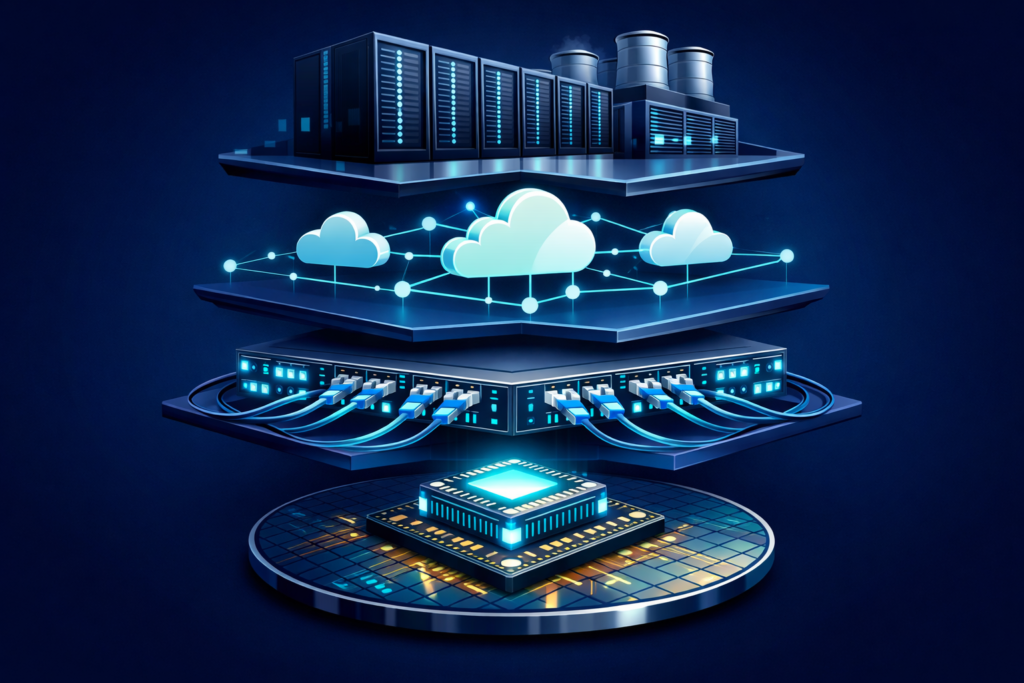
To analyze the complete AI infrastructure stocks list, one must understand the stack. The AI revolution is not a single product but a multi-layered supply chain, each with unique economic moats and risks.
- Semiconductors (The Compute Layer): This is the most concentrated and critical layer. Nvidia dominates AI GPUs with >80% market share, while TSMC controls >90% of advanced chip fabrication.
- Networking (The Connectivity Layer): As clusters grow, moving data between chips becomes paramount. Broadcom’s Ethernet solutions and Nvidia’s InfiniBand are key here.
- Cloud Platforms (The Access Layer): Cloud platforms such as Microsoft Azure, Amazon AWS, and Google Cloud provide the rental access to this hardware. They are also designing custom silicon (ASICs) to optimize cost and power.
- Physical Infrastructure (Power & Cooling): AI chips run hot. AI data center stocks like Vertiv (VRT) specializing in thermal management, and power solution providers like Eaton, are essential.
📊 Analyst InsightThe shift from AI training to AI inference is changing the economics of the AI industry. Inference workloads generate ongoing revenue for cloud providers, creating a durable demand loop for AI hardware that was largely missing in previous technology cycles.
Hyperscaler Spending Driving AI Infrastructure Stocks in 2026
According to Bloomberg Intelligence and Goldman Sachs Research, the hyperscalers are in an AI arms race. Here is the breakdown of what the tech giants are spending to build out AI infrastructure this year. This is the fuel for the entire ai infrastructure companies ecosystem
| Company | 2026 AI Capex (Est.) | Primary Focus | Source |
|---|---|---|---|
| Microsoft | $105 Billion | Azure expansion, GPU clusters | Company Guidance |
| Amazon | $150 Billion | AWS data centers, custom Trainium chips | Bloomberg |
| $80 Billion | TPU v5 deployment, data center cooling | Goldman Sachs | |
| Meta | $70 Billion | AI training clusters for Llama models | Company Filing |
| Apple | $30 Billion | Private cloud compute infrastructure | Morgan Stanley |
The International Energy Agency (IEA) notes that data centers could consume 8% of global electricity by 2030, up from 1% today, creating massive opportunities for power and cooling infrastructure providers.
AI Infrastructure Supply Chain: Companies Behind AI Infrastructure Stocks
To understand the depth of the market, here is a complete view of the AI supply chain and the key players at each layer.
| Layer | Key Companies | Primary Role |
|---|---|---|
| Semiconductors | Nvidia, AMD, TSMC, Intel | AI compute chips and advanced fabrication |
| Memory | Micron, SK Hynix, Samsung | High-bandwidth memory (HBM) for GPUs |
| Networking | Broadcom, Marvell, Arista | Data center switches and connectivity |
| Cloud Platforms | Microsoft, Amazon, Google | AI model training and inference infrastructure |
| Power & Cooling | Vertiv, Eaton, nVent | Thermal management and energy efficiency |
| Data Center Construction | Sterling, Everus, DPR | Physical building and electrical wiring |
Best AI Infrastructure Stocks to Buy in 2026 (Ranked)
Based on market position, growth outlook, and current valuations after the recent sell-off, here are our top selections ranked by market importance.
Top 10 AI Infrastructure Stocks Ranked
| Rank | Stock (Ticker) | Primary AI Role | Market Cap | Why It’s Ranked Here |
|---|---|---|---|---|
| 1 | NVIDIA (NVDA) | AI GPUs, Networking | $2.8T | Dominant >80% market share in AI chips; CUDA ecosystem moat |
| 2 | TSMC (TSM) | Chip Manufacturing | $750B | Controls >90% of advanced AI chip fabrication |
| 3 | Broadcom (AVGO) | Networking, ASICs | $650B | Critical for data center connectivity; custom AI chips |
| 4 | Microsoft (MSFT) | Cloud (Azure) | $3.0T | $105B AI capex; Copilot integration across products |
| 5 | Amazon (AMZN) | Cloud (AWS) | $1.9T | Leading cloud provider; custom Trainium chips |
| 6 | Micron (MU) | High-Bandwidth Memory | $120B | HBM memory essential for GPU performance |
| 7 | Vertiv (VRT) | Data Center Cooling | $35B | Thermal management critical for AI clusters |
| 8 | Oracle (ORCL) | Cloud Infrastructure | $450B | $100B+ RPO and strategic OpenAI partnership |
| 9 | Marvell (MRVL) | Networking, ASICs | $60B | Custom AI chip design for major hyperscalers |
| 10 | AST SpaceMobile (ASTS) | Space-Based Connectivity | $3B | Direct-to-cell satellite network enabling remote AI connectivity |
AI Infrastructure Stocks Comparison Chart
For quick reference, here is a comparison of the leading AI infrastructure stocks by growth potential and risk profile.
| Stock | AI Role | Growth Outlook | Primary Risk | Investment Style |
|---|---|---|---|---|
| Nvidia (NVDA) | GPUs | Very High | Competition / Cyclical | Growth |
| TSMC (TSM) | Chip Fabrication | High | Geopolitical (Taiwan) | Core Holding |
| Broadcom (AVGO) | Networking / ASICs | High | Valuation | Growth |
| Microsoft (MSFT) | Cloud AI | Stable | Regulatory | Core Holding |
| Amazon (AMZN) | Cloud AI | Stable | Margin Compression | Core Holding |
| Vertiv (VRT) | Cooling | High | Cyclical Demand | Aggressive Growth |
| Micron (MU) | HBM Memory | Cyclical | Memory Price Cycles | Cyclical |
| Oracle (ORCL) | Cloud Infrastructure | Moderate | Execution Risk | Value |
Individual Stock Analysis with Live Charts
NVIDIA Corporation (NVDA)
The undisputed leader. Despite its size, it trades at a forward P/E of ~22, which is historically reasonable given its 73% revenue growth. The company is transitioning to a full-stack AI provider, selling integrated server solutions rather than just chips. Learn more in our Nvidia stock forecast for 2026.
Broadcom Inc. (AVGO)
As the leader in data center networking and custom ASIC designs (for companies like Google and OpenAI), Broadcom is a critical enabler. While pricier than Nvidia (Forward P/E ~30.5), it offers diversified revenue across the AI stack.
Microsoft Corporation (MSFT)
Azure’s growth is directly tied to AI demand. With $105 billion in planned AI capex for 2026, Microsoft is building a moat that is difficult to replicate. Its enterprise software integration (Copilot) provides a sticky revenue stream. Read about the broader AI software ecosystem here.
Taiwan Semiconductor (TSM)
The silent powerhouse. Every major AI chip—Nvidia, AMD, Apple, Qualcomm—is fabricated by TSMC. With a projected 50% AI revenue growth through 2029, it’s the most critical bottleneck in the global AI supply chain.
Top Artificial Intelligence Penny Stocks (High Risk / High Reward)
For investors with a higher risk tolerance, the AI boom has lifted smaller, speculative companies. These top artificial intelligence penny stocks often trade under $5 and can be extremely volatile. Due diligence is critical.
- Rezolve AI (RZLV): A retail-tech platform using generative AI. Analyst price targets suggest significant upside, though liquidity is a concern.
- Aurora Innovation (AUR): Developing self-driving technology for trucks. It has partnerships with Continental but faces a long road to profitability.
- Similarweb (SMWB): Provides digital intelligence data, which is increasingly used to train AI models. Recent earnings missed estimates, causing a pullback.
⚠️ Risk WarningPenny stocks lack the institutional coverage and liquidity of large-cap companies. They are more vulnerable to market manipulation, extreme volatility, and binary outcomes. Only allocate capital you can afford to lose and always conduct independent research before investing.
AI Infrastructure Stocks ETF: Diversification Strategy
Given the concentration risk in individual ai chip stocks and the complexity of picking winners, Exchange Traded Funds (ETFs) offer a prudent alternative. They provide instant diversification across the AI infrastructure stocks list.
One notable option is the Global X Data Center & Digital Infrastructure ETF (DTCR) . It tracks companies generating at least 50% revenue from data centers, cellular towers, and related hardware. It has returned over 41% in the past year, offering exposure to both REITs and hardware manufacturers.
For a more global thematic play, the newly launched Boreas S&P AI Data, Power & Infrastructure UCITS ETF (AIPOWR) focuses specifically on the intersection of data centers and power grid infrastructure, holding names like Oracle, Siemens, and Eaton.
Other ETFs to consider:
- iShares Semiconductor ETF (SOXX) – Broad semiconductor exposure
- Invesco QQQ Trust (QQQ) – Tech-heavy, includes major AI players
- First Trust Cloud Computing ETF (SKYY) – Cloud infrastructure focus
Read our comprehensive guide on Best AI ETFs 2026 for detailed analysis of expense ratios, holdings, and performance.
Key Metrics Investors Should Track
To make informed decisions about AI infrastructure stocks, monitor these key metrics:
| Metric | Why It Matters | Current Trend |
|---|---|---|
| GPU Demand | Indicates AI training growth | Strong (supply constrained) |
| HBM Memory Supply | Bottleneck for AI chip performance | Tight; prices rising |
| Data Center Electricity Demand | Signals infrastructure expansion | Up 15–20% annually |
| Hyperscaler Capex | Direct driver of AI stock revenue | Up 62% YoY in 2026 |
| AI Inference Adoption | Long-term revenue driver for cloud | Early stage; accelerating |
| Custom ASIC Design Wins | Indicates share gains for Broadcom / Marvell | Multiple new projects |
| Data Center Construction Backlog | Future revenue visibility for builders | Record levels |
Valuation & Historical Context
After the recent market jitters caused by the Iran War and concerns over hyperscaler spending, valuations have compressed, presenting a potential entry point for the best AI infrastructure stocks.
Historical Performance Comparison (Approx. 5-Year Returns)
| Stock | Approx. 5-Year Return | Driver |
|---|---|---|
| Nvidia (NVDA) | +2,200% | AI GPU Dominance |
| Broadcom (AVGO) | +350% | Networking & ASICs |
| Microsoft (MSFT) | +180% | Cloud & AI Integration |
| TSMC (TSM) | +220% | Advanced Chip Manufacturing |
Valuation Comparison (Forward Metrics)
| Stock | Forward P/E (2026) | Est. EPS Growth (2026) | PEG Ratio | Analyst Sentiment |
|---|---|---|---|---|
| Nvidia | 22.0 | ~50% | 0.44 | Strong Buy |
| Broadcom | 30.5 | ~25% | 1.22 | Buy |
| Micron | 11.5 | Varies (Cyclical) | N/A | Buy |
| TSMC | 24.0 | ~25% | 0.96 | Strong Buy |
| Vertiv | 35.0 | ~30% | 1.17 | Buy |
Global AI Infrastructure Spending Forecast
| Year | Global AI Infrastructure Spending (Est.) | Source |
|---|---|---|
| 2024 | $240 Billion | IDC |
| 2026 (Current) | $625 – $700 Billion | Goldman Sachs |
| 2027 | $850 Billion | McKinsey |
| 2030 | $1 Trillion+ | Bloomberg Intelligence |
Investment Return Calculator
Market Outlook: Bull vs. Bear Case
Goldman Sachs recently noted that “concerns about AI disruption will be difficult to disprove in the near-term,” highlighting the current market anxiety. Meanwhile, McKinsey & Company projects that AI could add $4.4 trillion annually to the global economy, with infrastructure capturing a significant portion of that value. Here is our risk-adjusted outlook for artificial intelligence infrastructure stocks.
The Bull Case
- Hyperscaler Capex Momentum: Consensus forecasts point to $667 billion in spending for 2026, a 62% increase YoY. This direct funding flows to hardware suppliers.
- Inference Demand: As AI moves from training to real-world application, demand for compute becomes persistent and revenue-linked.
- Power Constraints: The International Energy Agency warns that data centers could consume 8% of global electricity by 2030. This creates pricing power for efficient infrastructure providers.
- Custom Silicon: The shift to ASICs (custom chips) benefits Broadcom, Marvell, and other design houses.
The Bear Case & Risks
- Spending Slowdown: A deceleration in quarterly growth rates is likely in late 2026. Stocks priced for perfection (like software) could be hit hard.
- Valuation Risk: Despite pullbacks, many stocks trade at premiums that leave little room for error.
- Geopolitical Risk: TSMC’s concentration in Taiwan represents a significant single point of failure for the entire supply chain.
- Interest Rates: High rates pressure the long-duration cash flows of growth stocks.
Probability-Based Outlook
| Scenario | Probability | Market Outcome |
|---|---|---|
| Bull Case (Soft Landing + AI Acceleration) | 25% | Infrastructure multiples re-rate higher. |
| Base Case (Growth Deceleration) | 50% | Stock differentiation; winners with strong earnings hold up. |
| Bear Case (Recession / Capex Cut) | 25% | Broad de-risking; cyclical hardware stocks fall hardest. |
How to Build an AI Infrastructure Portfolio
Investors do not need to pick a single winner in the AI race. A balanced approach spreads exposure across the supply chain:
- Compute leaders (Nvidia, AMD)
- Foundry manufacturers (TSMC)
- Data center infrastructure (Vertiv)
- Cloud platforms (Microsoft, Amazon)
This approach reduces single-stock risk while still capturing the structural growth of artificial intelligence infrastructure. Learn the fundamentals with our Stock Market Analysis for Long-Term Investors guide.
For those interested in specific sectors:
Strategic Portfolio Allocation (Model Suggestion)
How much of your portfolio should be in AI data center stocks and related plays? For a balanced growth investor, we suggest the following framework to manage risk while capturing upside.
| Sector | Example Stocks | Suggested Allocation |
|---|---|---|
| Core AI Chips & Foundry | NVDA, TSM, AVGO | 40% |
| Cloud & Software Giants | MSFT, ORCL, AMZN | 30% |
| AI Data Center Suppliers (Power/Cooling) | VRT, EATON, STRL | 20% |
| Speculative / AI Penny Stocks | NBIS, AUR, RZLV | 10% (High Risk) |
Learn how to build a foundation with our beginner investor guide and understand trading vs investing.
Ready to invest? Investors can purchase AI infrastructure stocks through most global brokers such as Interactive Brokers, Fidelity, or Zerodha depending on their region. Always compare brokerage fees and research tools before selecting a platform.
FAQs
What are AI infrastructure stocks?
AI infrastructure stocks represent companies that provide the physical hardware and services enabling artificial intelligence. This includes semiconductor manufacturers (like Nvidia and TSMC), data center REITs and builders, networking specialists, cooling and power management firms, and cloud platform providers.
Which are the best AI infrastructure stocks for 2026?
Based on current market dynamics, Nvidia (NVDA), Broadcom (AVGO), Microsoft (MSFT), and TSMC (TSM) lead the pack due to their irreplaceable roles in the supply chain and strong earnings visibility.
Which companies build AI infrastructur?
Key players include Nvidia (chips), TSMC (manufacturing), Broadcom (networking), Microsoft (cloud), Amazon (AWS), and specialized firms like Vertiv (cooling) and Sterling Infrastructure (data center construction).
Are AI stocks overvalued?
Following the recent sell-off, valuations have normalized. Nvidia trades at a forward P/E of 22, which is reasonable for its growth rate. However, investors should focus on the PEG ratio (Price/Earnings-to-Growth) to assess value.
What ETF tracks AI infrastructure stocks?
The Global X Data Center & Digital Infrastructure ETF (DTCR) is a popular option. For a more targeted approach, the new Boreas S&P AI Data, Power & Infrastructure UCITS ETF (AIPOWR) focuses specifically on data centers and power grids. See our Best AI ETFs 2026 guide for full analysis.
What are AI data center stocks?
AI data center stocks are companies that provide the power, cooling, networking, and physical infrastructure required to run artificial intelligence workloads. Examples include Vertiv, Eaton, and data center construction firms supporting hyperscaler expansion.
Can beginners invest in AI stocks?
Yes, but caution is advised. Beginners are better suited starting with broad-market ETFs (like an S&P 500 index fund) or a diversified AI ETF like DTCR before picking individual stocks. Read our beginner’s guide.
What is the outlook for AI infrastructure spending?
Goldman Sachs projects $625-700 billion in 2026, rising to $1 trillion+ by 2030. McKinsey estimates AI could add $4.4 trillion annually to the global economy.
How do interest rates affect AI stocks?
Higher rates compress valuations for growth stocks by discounting future cash flows more heavily. However, AI infrastructure companies with strong current earnings (like NVDA) are less sensitive than speculative pre-revenue companies.
Conclusion: The Long View on AI Infrastructure
The build-out of AI infrastructure is not a one-year event; it is a multi-trillion dollar capital cycle likely to last the rest of the decade. While volatility is inevitable—driven by macro fears, spending deceleration rates, and geopolitical tensions—the secular demand for compute is undeniable.
For investors, the strategy should be clear: identify companies with durable moats (like Nvidia’s CUDA ecosystem or TSMC’s manufacturing lead), maintain a diversified exposure across the supply chain layers, and use market pullbacks as accumulation opportunities. Avoid the hype cycle around penny stocks and focus on the ai investment opportunities that are actually receiving the $700 billion in capex today.
As we navigate 2026, remember Goldman’s warning: disruption fears are hard to disprove. But for patient capital, the foundational layer of the AI economy remains one of the most compelling growth stories in modern financial history.
Related AI & Tech Analysis
- Nvidia Stock Forecast 2026
- Vertiv Stock Analysis: Buy or Wait?
- Nebius AI Infrastructure Analysis
- Tech Stocks Outlook 2026
- 7 Semiconductor Stocks Under $50
- Anthropic IPO Status 2026
- Gold vs. Silver: Portfolio Diversification
- Rivian Stock Forecast 2026
- Netflix Stock Forecast 2026
- Tesla Stock Analysis 2026
- Best AI ETFs 2026
- Data Center REITs Guide
- Why Are Stocks Down Today?
- What is the S&P 500?
- Is Gold Bullion a Good Investment in 2026?