
The Great Semiconductor Reset
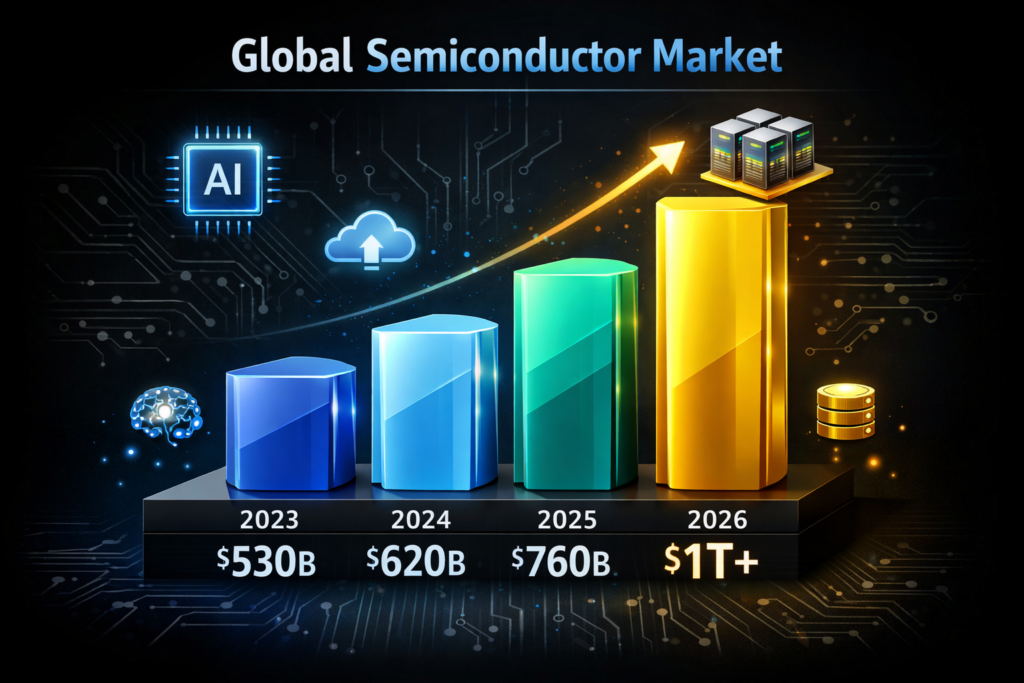
The global semiconductor market is projected to reach $1 trillion by 2026, driven largely by AI data-center demand. According to a 2025 report from Gartner, semiconductor revenue is expected to grow at its fastest pace in a decade as AI infrastructure spending accelerates.
Walk into any data center today and you’ll hear them—the hum of thousands of cooling fans working overtime to keep AI servers from melting their own circuit boards. That hum is the sound of money.
Capital expenditures from hyperscalers like Microsoft, Amazon, and Google are on track to approach $600 billion collectively in 2026. Much of that is flowing directly into the semiconductor ecosystem.
But here’s what makes this cycle different from the crypto-driven chip frenzy of 2021 or the pandemic shortage panic of 2022: institutional money is rotating with purpose. The AI infrastructure buildout isn’t speculative anymore—it’s contractual.
Cloud providers are signing multi-year capacity agreements with chip designers and foundries. The demand signal is real, and it’s filtering down through the supply chain in ways that create opportunity for investors willing to look beyond the usual suspects.
Investors trying to understand the broader market trend should also review our guide on why stocks are down today.
The Philadelphia Semiconductor Index (SOX) has already repriced the Nvidia-led narrative. But underneath the surface, a second wave is forming—companies trading under $50 with real exposure to AI inference, advanced packaging, optical interconnects, and specialized manufacturing.
These aren’t penny stocks. They’re established operators with market caps in the billions, temporarily anchored by valuation metrics that don’t fully reflect the coming cycle.
We covered the broader outlook in our tech stocks 2026 report.
Live Market Snapshot
Before we dive into individual names, let’s orient ourselves to the current tape. The setup matters.
NASDAQ Composite is grinding higher but showing divergence—breadth isn’t confirming price action. Semiconductors have led for 18 months, but money is beginning to rotate toward laggards within the space.
S&P 500 continues its crawl higher, supported by earnings resilience and a Federal Reserve that’s signaled patience on rates. The macro backdrop remains constructive for cyclicals, and semiconductors are the most cyclical of them all.
VIX is complacent—hovering in the 15–17 range. That’s a yellow flag, not a red one. It tells us options markets aren’t pricing dislocation, which means volatility shocks, when they come, will hurt. Position accordingly.
Bitcoin holding $60,000+ is a reasonable proxy for retail liquidity. It matters because semiconductor stocks with consumer exposure (GPUs, gaming, PCs) correlate with crypto wealth effects.
Gold is quietly firming above $2,100. Institutional investors are hedging currency risk while maintaining equity exposure. That’s the kind of macro hedge that allows fund managers to stay long cyclical tech without losing sleep.
Semiconductor Market Growth Forecast

| Year | Global Semiconductor Market Size |
|---|---|
| 2023 | $530 Billion |
| 2024 | $620 Billion |
| 2025 | $760 Billion |
| 2026 | $1+ Trillion |
Source: Gartner, UBS, industry projections
Semiconductor Sector Performance (2026 YTD)
| Index | YTD Return |
|---|---|
| Philadelphia Semiconductor Index (SOX) | +18% |
| NASDAQ Composite | +12% |
| S&P 500 | +9% |
Why Semiconductor Stocks Are Back in Focus
The semiconductor cycle has historically followed a predictable rhythm: inventory correction, capacity utilization trough, demand recovery, pricing power, margin expansion, peak earnings, multiple compression. Rinse and repeat every three to four years.
This cycle looks different. AI server demand is creating structural growth on top of the traditional chip cycle.
UBS projects the semiconductor market will surpass $1 trillion in 2026, representing year-over-year growth exceeding 40%. By 2027, we’re looking at nearly $1.2 trillion.
What’s driving this? Three things:
First, AI infrastructure is compute-insatiable. Training large language models requires tens of thousands of GPUs operating in parallel. But inference—the act of using those models—is where the volume really explodes.
Every ChatGPT query, every AI-generated image, every autonomous driving decision requires chip-powered inference. That’s not a one-time data center build; it’s ongoing consumption.
Second, the supply chain is regionalizing. Geopolitics has forced semiconductor manufacturing to diversify. The CHIPS Act in the U.S., similar initiatives in Europe and Japan, and Taiwan’s continued centrality mean capital expenditure is spreading across geographies.
That benefits equipment makers, specialty foundries, and advanced packaging companies.
Third, the bottleneck has shifted. We’re no longer just short of leading-edge logic wafers. Today’s constraints include advanced packaging capacity, substrate supply, and—critically—laser diodes for optical interconnects.
Applied Optoelectronics’ CFO recently flagged indium phosphide fabrication as an industry-wide bottleneck that hyperscalers are now trying to secure with long-term commitments. When customers start signing multi-year supply agreements, you know the demand is real.
Best 7 Semiconductor Stocks Under $50 in 2026
Let’s get specific. These seven companies trade below $50 as of March 2026, each with distinct exposure to the themes above. None are without risk, but all offer asymmetric upside if the AI cycle extends—and the data suggests it will.
Amkor Technology (AMKR)
Company Overview: Amkor is the largest U.S.-based outsourced semiconductor packaging and test service provider. If you don’t know what “advanced packaging” means, learn it—because it’s becoming as important as the chips themselves.
Amkor takes bare dies from foundries like TSMC and turns them into finished chips that can be mounted on circuit boards.
Growth Drivers: The company reported Q4 2025 net sales of $1.89 billion, up 16% year-on-year, with net income of $172 million. Full-year 2025 sales reached $6.71 billion.
More importantly, management guided to record capital expenditure of $2.5–3 billion for 2026—a vote of confidence in long-term advanced packaging demand, particularly for AI datacenters.
Valuation Context: Needham lifted its price target to $65 on February 10, maintaining Buy. Goldman Sachs is more conservative at $43 with Neutral. The stock trades with a P/E of 13.1 according to recent screens.
Among affordable chip stocks, Amkor offers one of the most attractive risk-reward profiles.
Bull Case: Advanced packaging is the gating item for AI chip supply. Amkor’s Arizona facility with TSMC and its Vietnam expansion position it for secular growth regardless of which chip designer wins market share.
Bear Case: Capital intensity is high. The $2.5–3 billion capex plan will pressure free cash flow in the near term. Execution risk on new facilities is non-zero.
Rigetti Computing (RGTI)
Company Overview: Rigetti builds superconducting quantum processors and provides quantum-computing-as-a-service through its cloud platform. It’s a pure-play on quantum computing stocks, which remains nascent but is attracting serious government and enterprise interest.
Growth Drivers: On March 5, management reaffirmed its timeline for deploying a 108-qubit system. CEO Dr. Subodh Kulkarni noted progress in two-qubit gate fidelity across monolithic and chiplet-based systems.
The company ended 2025 with $589.8 million in cash and equivalents—enough to fund operations through multiple development milestones.
Valuation Context: Jefferies recently cut its price target to $20 from $30 but maintained Hold. The analyst cited improved system sales momentum and multiple 2026 contract wins as encouraging factors, despite Q4 revenue of $1.9 million missing consensus.
Bull Case: Quantum computing is a multi-trillion-dollar addressable market if it achieves commercial viability. Rigetti’s vertically integrated approach—designing and fabricating its own chips—creates IP moats.
Bear Case: Revenue is negligible. This is a development-stage company trading on narrative and cash runway. Commercial timelines are uncertain, and larger competitors (Google, IBM) have deeper pockets.
ON Semiconductor (ON)
Company Overview: ON provides intelligent sensing and power solutions across automotive, industrial, and AI data center markets. It’s undergone a portfolio transformation, exiting commoditized businesses to focus on high-value silicon carbide, image sensors, and power management.
Growth Drivers: Full-year 2025 sales reached $5.995 billion with net income of $121 million. Q1 2026 guidance calls for revenue of $1.435–1.535 billion.
Management has committed to returning 100% of free cash flow to shareholders via buybacks, having already repurchased over 10% of shares since 2023.
Valuation Context: The company trades at a P/E of 16.6. Analyst models project $7.5 billion revenue and $1.9 billion earnings by 2028, implying a fair value around $63.
Bull Case: AI data center power demands create tailwinds for ON’s efficient power solutions. Silicon carbide adoption in electric vehicles remains a multi-year growth driver. Buybacks at current levels are accretive.
Bear Case: Automotive and industrial end markets remain soft. Underutilized manufacturing capacity could pressure margins if demand doesn’t recover by late 2026.
GlobalFoundries (GFS)
Company Overview: GlobalFoundries is a leading contract manufacturer of essential semiconductors for automotive, smart mobile devices, IoT, and communications infrastructure. Unlike TSMC, it focuses on mature and specialty nodes rather than bleeding-edge logic.
Growth Drivers: On March 11, 2026, GFS launched a secondary offering of 20 million shares from Mubadala, its largest shareholder. Concurrently, the company announced a $300 million share repurchase as part of a $500 million buyback authorization.
Valuation Context: The most recent analyst rating is Buy with a $58 price target. TipRanks’ AI analyst Spark rates GFS Neutral, citing solid financial footing and constructive technical trends but near-term revenue softness.
Bull Case: Geopolitical tailwinds favor foundry capacity outside Taiwan. GFS’s footprint in the U.S., Europe, and Asia positions it as a trusted supplier for customers seeking supply chain diversification.
Bear Case: The Mubadala secondary offering creates overhang. Near-term investment spending is pressuring free cash flow.
Intel (INTC)
Company Overview: Intel needs no introduction. The iconic American chipmaker is in the midst of its most significant transition in decades, building out foundry capacity while attempting to regain process leadership.
Growth Drivers: Q4 2025 results beat estimates—EPS of $0.15 versus $0.08 consensus, revenue of $13.7 billion versus $13.4 billion. Data center revenue was $4.7 billion in Q4, full-year $16.9 billion.
Intel recently finalized a $5 billion strategic investment from Nvidia. For a deeper valuation breakdown of the AI leader, read our detailed NVDA stock price analysis and forecast.
Valuation Context: Citi maintains Neutral with a $48 price target. The firm cites Intel’s exposure to PC and smartphone markets, where demand is weakening. Rising memory prices are increasing costs for device makers, potentially slowing shipments.
Bull Case: Foundry ambitions, if successful, could transform Intel’s business model. U.S. government support through CHIPS Act funding provides financial cushion. Nvidia’s investment validates Intel’s manufacturing roadmap.
Bear Case: Process node execution remains unproven. Foundry customers will be slow to commit. PC exposure is a headwind as the market normalizes post-pandemic.
Applied Optoelectronics (AAOI)
Company Overview: AOI develops and manufactures fiber-optic networking products for data centers and cable TV outside plant. Approximately two-thirds of the business serves hyperscale data center operators.
Growth Drivers: The company’s CFO recently flagged indium phosphide laser diode capacity as a critical industry bottleneck. Hyperscalers are seeking long-term commitments to secure supply.
AOI’s in-house laser manufacturing and automated transceiver production create competitive advantage.
Valuation Context: AOI forecasts transceiver revenue approaching $378 million by mid-2027, comprised of $91 million from 100G/400G, $217 million from 800G, and $71 million from 1.6T.
Management reiterated that the 800G ramp remains targeted for Q2 2026 after resolving a firmware delay.
Bull Case: Supply constraints are pushing customers to sign long-term agreements, reducing revenue cyclicality. Pricing power is returning—the historical 15–20% annual price declines are “probably not really on the table” in a constrained environment.
Bear Case: Achieving the 2027 revenue targets requires significant capacity additions. Execution risk is real. Competition from larger optical component suppliers could intensify.
SkyWater Technology (SKYT)
Company Overview: SkyWater is a U.S.-based pure-play semiconductor foundry focused on technology development and manufacturing. It operates the only U.S.-owned 200mm and 300mm manufacturing facilities with both Class 1 cleanroom and rad-hard manufacturing capabilities.
Growth Drivers: Revenue is projected to reach $147 million in the upcoming quarter, representing 139.8% year-over-year growth. Full-year 2026 revenue is expected to be $605 million, up 36.8%.
Valuation Context: The stock closed recently at $27.36, lagging the broader market. Zacks rates it Strong Sell (#5), citing downward estimate revisions. The Zacks Consensus EPS estimate has shifted 5% downward over the past month.
Bull Case: U.S. onshoring of semiconductor manufacturing benefits SkyWater’s domestic footprint. The company’s rad-hard and mixed-signal capabilities serve defense and aerospace customers with sticky, high-margin business.
Bear Case: Profitability remains elusive—EPS is projected at -$0.26 for full-year 2026. Estimate revisions are trending negative. Competition from larger foundries with more advanced nodes limits addressable markets.
Quick List – Best Semiconductor Stocks Under $50 in 2026
Best semiconductor stocks under $50 in 2026:
- Amkor Technology (AMKR) – AI chip packaging leader with record capex plans
- ON Semiconductor (ON) – Power management for AI data centers and EVs
- GlobalFoundries (GFS) – U.S.-based foundry with geopolitical tailwinds
- Intel (INTC) – Turnaround story with foundry ambitions and Nvidia investment
- Applied Optoelectronics (AAOI) – Optical networking for AI clusters
- SkyWater Technology (SKYT) – Domestic foundry with defense exposure
- Rigetti Computing (RGTI) – Pure-play quantum computing speculation
These AI chip stocks offer varying risk profiles, from established operators to development-stage innovators. For investors seeking chip stocks below $50, this list represents the best opportunities in the current cycle.
Top 3 AI Semiconductor Stocks Under $50 in 2026
For investors seeking direct AI exposure without paying premium valuations, these three stand out as the best chip stocks 2026 has to offer:
| Company | AI Exposure | Why It Matters |
|---|---|---|
| Amkor Technology (AMKR) | AI chip packaging | Every advanced AI chip requires advanced packaging; Amkor is one of the global leaders in semiconductor packaging and testing. |
| ON Semiconductor (ON) | AI data center power | Provides power management solutions critical for AI servers, GPUs, and high-performance computing infrastructure. |
| Applied Optoelectronics (AAOI) | Optical networking | Supplies high-speed optical components that connect AI clusters and large-scale data center networks. |
Why Many AI Chip Stocks Still Trade Under $50
Despite the AI boom, several quality semiconductor names remain below $50. Understanding why helps frame the opportunity.
Market rotation: Institutional money has concentrated in mega-cap names like Nvidia and Broadcom. The “AI trade” has been narrow, leaving supply chain beneficiaries overlooked.
Semiconductor cyclicality: The memory and mature-node downturn of 2024–2025 weighed on broader sector valuations. Investors are only now beginning to differentiate between cyclical weakness and structural AI demand.
Institutional focus on mega caps: Large-cap tech dominates passive flows. Active managers are underweight small and mid-cap semiconductors, creating valuation dislocations.
Lagging supply chain stocks: Packaging, optical components, and specialty foundries typically lag chip designers in market recognition. That lag creates entry points for patient capital.
Budget AI semiconductor stocks often hide in plain sight—established businesses with real revenues, temporarily discounted by market dynamics rather than fundamental deterioration.
How to Choose Semiconductor Stocks Under $50
1. AI supply chain exposure: The most durable growth comes from companies enabling AI infrastructure—packaging, power, optical interconnects—not just those designing chips.
2. Balance sheet strength: Look for companies with net cash positions or manageable debt. Semiconductor cycles punish over-leveraged players during downturns.
3. Manufacturing advantage: Proprietary processes, long-term customer contracts, and capacity expansion plans signal competitive moats.
4. Valuation vs. growth: Cheap stocks can stay cheap if growth disappoints. Focus on companies where valuation aligns with visible revenue visibility.
Investors looking for broader exposure to the sector may also consider semiconductor ETFs or diversified AI infrastructure stocks.
Semiconductor Valuation Dashboard
| Stock | Price | Forward P/E | Revenue Growth | AI Exposure | Risk Level |
|---|---|---|---|---|---|
| AMKR | <$50 | 13x | Medium | High | Medium |
| ON | <$50 | 16x | Medium | High | Medium |
| GFS | <$50 | N/A | Low | Medium | Medium |
| INTC | <$50 | 27x | Low | Medium | Medium |
| AAOI | <$50 | N/A | High | High | High |
| SKYT | <$50 | N/A | High | Medium | High |
| RGTI | <$50 | N/A | Early | Quantum | Very High |
Semiconductor Stocks Under $50
| Company | Ticker | Market Cap | P/E Ratio | Revenue Growth (YoY) | Dividend Yield | Risk Level |
|---|---|---|---|---|---|---|
| Amkor Technology | AMKR | ~$8.5B | 13.1 | 16% (Q4 2025) | 0% | Moderate |
| Rigetti Computing | RGTI | ~$1.2B | N/A (unprofitable) | -17% (Q4 2025) | 0% | High |
| ON Semiconductor | ON | ~$28B | 16.6 | 2% (FY 2025) | 0% | Moderate |
| GlobalFoundries | GFS | ~$26B | N/A (negative P/E) | -4% (est.) | 0% | Moderate |
| Intel | INTC | ~$95B | 27.2 | -6% (Q4 2025) | 0.46% | Moderate-High |
| Applied Optoelectronics | AAOI | ~$1.5B | N/A (unprofitable) | 65% (projected) | 0% | High |
| SkyWater Technology | SKYT | ~$1.3B | N/A (unprofitable) | 140% (est. quarterly) | 0% | High |
Historical Performance (2019–2025)
| Company | 2019 | 2020 | 2021 | 2022 | 2023 | 2024 | 2025 |
|---|---|---|---|---|---|---|---|
| AMKR | +58% | +34% | +71% | -27% | +42% | +18% | +31% |
| RGTI (IPO 2021) | — | — | -23% | -81% | -39% | +145% | -28% |
| ON | +87% | +12% | +64% | -18% | +83% | +22% | -9% |
| GFS (IPO 2021) | — | — | -11% | -42% | +33% | +14% | -15% |
| INTC | +30% | -17% | +6% | -48% | +78% | -55% | +41% |
| AAOI | +102% | -26% | -38% | -70% | +287% | +154% | -62% |
| SKYT (IPO 2021) | — | — | -32% | -70% | +56% | -1% | -44% |
Semiconductors are cyclical. Double-digit gains in up years are often followed by sharp corrections. Position sizing matters.
Future Scenario Analysis
| Scenario | Probability | Market Condition | Expected Return (12–18 months) |
|---|---|---|---|
| AI Supercycle Accelerates | 30% | Hyperscaler capex surprises to the upside; AI inference demand surges; supply constraints persist. | +25% to +50% for selected names |
| Stable Growth Continues | 50% | AI infrastructure buildout continues at current pace; auto and industrial demand recovery expected in H2 2026. | +10% to +20% |
| Semiconductor Downturn | 20% | Inventory correction, temporary AI spending slowdown, and broader macroeconomic weakness. | -15% to -30% |
Reasoning: UBS projects the semiconductor market exceeding $1 trillion in 2026 with 40%+ growth. This isn’t a typical cycle—AI is structural. But valuations reflect some of that optimism. The stable growth scenario is most likely, with periodic volatility around earnings and macro data.
Risks to Watch in Semiconductor Stocks
- AI capex slowdown: Hyperscalers could pause spending if returns on AI investment disappoint
- Chip oversupply cycle: Memory and mature-node chips face inventory risks
- China-US export restrictions: Further curbs could disrupt revenue for companies with China exposure
- Rising interest rates: Semiconductor valuations are sensitive to discount rate changes
Featured Snippet Answers
What are the top 5 semiconductor stocks?
What stock would I recommend to buy under $50?
Which share is best to buy below $50?
What are the top 3 AI stocks to buy now?
What are the best AI semiconductor stocks under $50?
Portfolio Strategy for Semiconductor Stocks
Semiconductors are capital-intensive, cyclical, and sentiment-driven. They’re also essential to every major technological shift of the next decade. The right approach balances exposure to structural winners with diversification across end markets.
If you’re new to markets, start with our investing in the stock market beginner’s guide. Long-term investors should also understand the difference between trading and investing.
| Stock | Suggested Allocation | Risk Category | Role in Portfolio |
|---|---|---|---|
| Amkor Technology | 15–20% | Moderate | Core packaging play |
| ON Semiconductor | 15–20% | Moderate | Auto + AI power |
| GlobalFoundries | 10–15% | Moderate | Foundry diversification |
| Intel | 5–10% | Moderate-High | Turnaround speculation |
| Applied Optoelectronics | 5–10% | High | AI optical leverage |
| Rigetti Computing | 0–5% | High | Quantum call option |
| SkyWater Technology | 0–5% | High | Domestic foundry bet |
Diversification Logic: Anchor with AMKR and ON for core exposure. Layer in GFS for foundry diversification. Small positions in AAOI, RGTI, and SKYT for asymmetric upside. INTC is a sentiment-driven trade on foundry execution.
Investors comparing growth opportunities should also review our ASTS stock analysis and NBIS stock forecast.
FAQs
Are semiconductor stocks cyclical?
Yes, semiconductors are historically cyclical, with inventory corrections every 3–4 years. However, the current AI-driven cycle may prove longer and more durable due to structural demand from data centers, cloud computing, and edge AI.
What are the best AI semiconductor stocks under $50?
The best AI semiconductor stocks under $50 include Amkor Technology (AMKR), ON Semiconductor (ON), and Applied Optoelectronics (AAOI). Each plays a different role—packaging, power, and optical connectivity—in the AI supply chain.
Are cheap semiconductor stocks risky?
Stocks under $50 aren’t inherently riskier than higher-priced names. Valuation matters more than share price. Companies like Amkor trade at reasonable multiples; others like Rigetti trade on narrative with minimal revenue. Risk varies by business model, not price point.
Is Rigetti a quantum computing stock?
Yes, Rigetti Computing (RGTI) designs and manufactures superconducting quantum processors and provides quantum-computing-as-a-service. It’s one of the few pure-play quantum computing stocks publicly traded.
Do semiconductor companies pay dividends?
Some do, but most reinvest cash flow into R&D and capex. Intel pays a modest dividend (0.46%). Most smaller semiconductor companies under $50 don’t pay dividends, prioritizing growth instead.
What are the top quantum computing stocks?
Leading quantum computing stocks include Rigetti Computing (RGTI), IonQ (IONQ), and D-Wave Quantum (QBTS). These remain speculative but offer exposure to a potential multi-trillion-dollar future market.
How should I invest in semiconductor stocks under $50?
Focus on companies with strong balance sheets, clear AI exposure, and reasonable valuations. Diversify across packaging, design, and manufacturing. Use position sizing to manage volatility.
Key Takeaways
• AI infrastructure spending is driving the semiconductor supercycle, with the market projected to exceed $1 trillion in 2026
• Several quality chip stocks still trade under $50, offering asymmetric upside without paying premium valuations
• Packaging (AMKR), power chips (ON), and optical networking (AAOI) are the biggest hidden winners in the AI supply chain
• Semiconductor cyclicality remains a risk—position sizing and diversification are essential
The Bottom Line
The semiconductor cycle is alive and well, but it’s no longer just a cycle—it’s a secular trend wearing cyclical clothing. AI infrastructure spending is contractual, visible, and multi-year. The companies profiled here offer different ways to participate without chasing the high-flying names that have already tripled.
Amkor represents the picks-and-shovels play on advanced packaging. ON Semiconductor combines AI data center power with auto recovery optionality. GlobalFoundries offers foundry diversification at a reasonable valuation. Applied Optoelectronics is a high-conviction bet on optical bottlenecks. Rigetti and SkyWater are speculative—position sizes should reflect that.
The biggest risk isn’t AI adoption slowing. It’s valuation multiple compression if interest rates stay higher for longer. Position accordingly. Diversify across end markets. And remember: in semiconductors, the best returns often come not from owning the winners during the boom, but from owning the enablers throughout the cycle.
For deeper analysis on specific tech sectors, explore our coverage of software stocks and AI winners or understand why markets move when they do.
New to investing? Start with our beginners guide to the stock market and learn the difference between trading and investing.
For individual stock analysis, see our coverage of ASTS stock, NBIS stock, VRT stock, HOOD earnings, TSLA analysis, Rivian forecast, NFLX forecast, Anthropic IPO status, and NVDA analysis. For live pricing, check Palantir stock price today.
For broader market context, read our tech stocks 2026 outlook and S&P 500 explained. And for alternative assets, explore gold bullion investing and gold vs silver.
The author holds no positions in any stocks mentioned. This article is for informational purposes only and does not constitute investment advice. Past performance does not guarantee future results. Always conduct your own research before making investment decisions.