

An S&P stock is any publicly traded company included in the S&P 500 index—a collection of 500 of the largest U.S. companies by market capitalization.
You can’t buy “an S&P stock” as a single investment. The term simply refers to any of the 500 individual companies that meet the index’s strict criteria for size, liquidity, and profitability.
The S&P 500 index itself tracks these companies’ combined performance and serves as the most widely watched benchmark of the U.S. stock market.
What Are S&P 500 Stocks? The Companies Behind the Index
The S&P 500 includes America’s corporate giants across every major industry sector. As of 2026, companies must meet specific requirements to qualify:
S&P 500 membership criteria:
- Market capitalization of at least $14.5 billion
- U.S.-based company with majority of revenue from U.S. operations
- High trading volume and public float of at least 10%
- Positive earnings over the most recent quarter and trailing four quarters
- Listed on major U.S. exchanges (NYSE, Nasdaq, or Cboe)
Meeting these criteria doesn’t guarantee inclusion. An index committee from S&P Dow Jones Indices makes final decisions based on sector balance and overall market representation.
Final inclusion decisions are made by a committee at S&P Dow Jones Indices, which manages the S&P 500 index.
Which Companies Are in the S&P 500?
The index spans all 11 Global Industry Classification Standard (GICS) sectors, though weighting shifts constantly as stock prices change.
| Sector | Approximate Weight (2026) | Top Holdings |
|---|---|---|
| Technology | ~29% | Apple, Microsoft, Nvidia, Broadcom |
| Financials | ~13% | JPMorgan Chase, Berkshire Hathaway |
| Healthcare | ~12% | UnitedHealth, Eli Lilly, Johnson & Johnson |
| Consumer Discretionary | ~10% | Amazon, Tesla, Home Depot |
| Communication Services | ~9% | Meta, Alphabet, Netflix |
| Industrials | ~8% | Caterpillar, Boeing, Honeywell |
| Consumer Staples | ~6% | Procter & Gamble, Walmart, Coca-Cola |
| Energy | ~4% | ExxonMobil, Chevron |
| Utilities | ~2% | NextEra Energy, Duke Energy |
| Real Estate | ~2% | American Tower, Prologis |
| Materials | ~2% | Linde, Air Products & Chemicals |
Source: S&P Dow Jones Indices sector weightings fluctuate with market movements
Technology’s dominance reflects the modern U.S. economy, but this concentration also means the index’s performance heavily depends on a handful of mega-cap tech companies.
How Does the S&P 500 Actually Work?
The S&P 500 is a market-capitalization-weighted index. Larger companies influence the index more than smaller ones.
Here’s what that means in practice:
If Apple represents 7% of the total index value and its stock rises 5%, that moves the entire S&P 500 up approximately 0.35% (7% × 5%). A 5% gain in a company that represents just 0.1% of the index barely registers.
This weighting method differs fundamentally from the Dow Jones Industrial Average, which weights companies by stock price rather than total market value.
S&P 500 vs Nasdaq: Key Differences
People often confuse these indexes, but they measure different market segments.
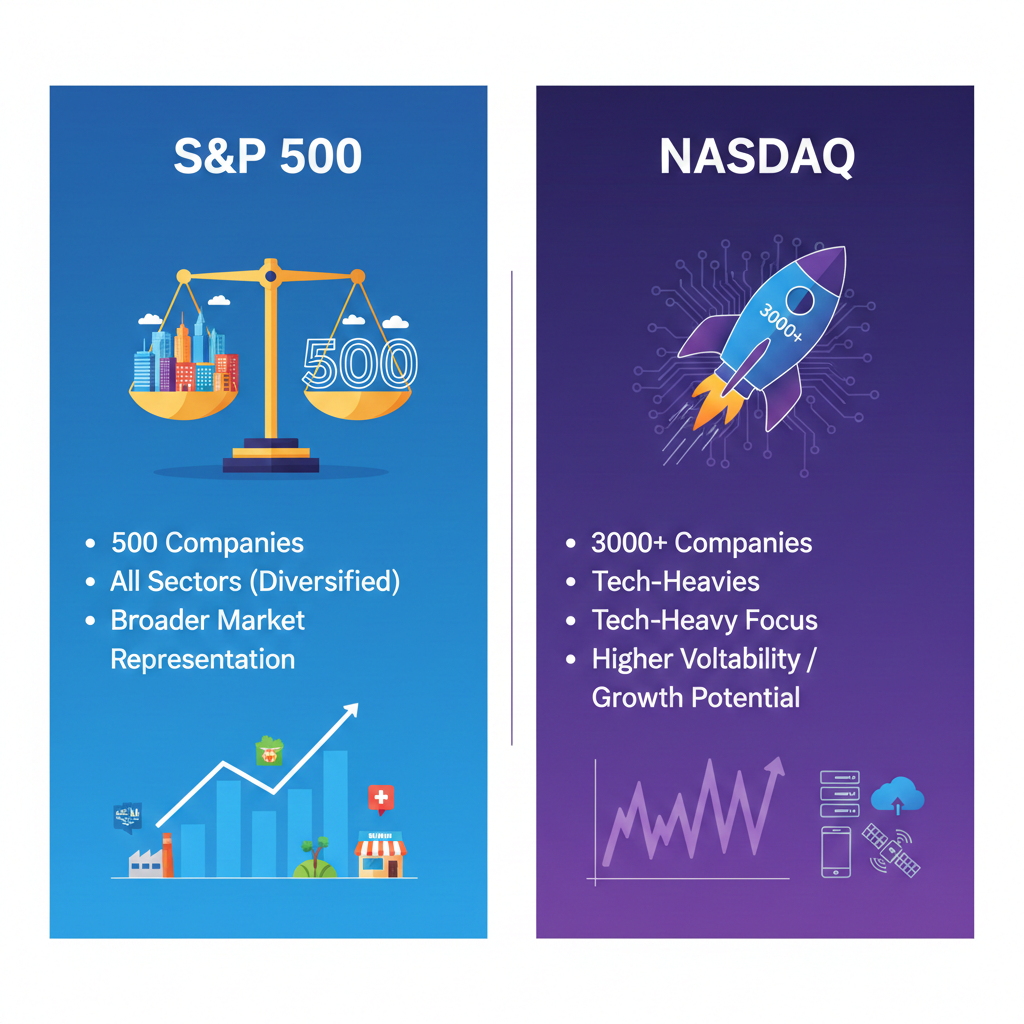
S&P 500:
- 500 large-cap stocks across all sectors
- Broader economic representation
- Selection based on multiple quality criteria
Nasdaq Composite:
- 3,000+ stocks listed on the Nasdaq exchange
- Heavy technology and growth stock concentration
- All Nasdaq-listed stocks automatically included
The Nasdaq-100 (top 100 non-financial Nasdaq stocks) provides a more comparable alternative to the S&P 500, though it remains more tech-focused and volatile.
How to Invest in S&P 500 Stocks
Most investors don’t buy all 500 individual stocks. That would require hundreds of thousands of dollars and constant rebalancing as the index composition changes.
Instead, S&P 500 index funds automatically hold all companies in the same proportions as the index.
Popular S&P 500 index fund options:
- Vanguard 500 Index Fund (VFIAX) – 0.04% expense ratio
- SPDR S&P 500 ETF Trust (SPY) – 0.0945% expense ratio, most liquid
- iShares Core S&P 500 ETF (IVV) – 0.03% expense ratio
- Fidelity 500 Index Fund (FXAIX) – 0.015% expense ratio
Exchange-traded funds (ETFs) trade throughout the day like stocks, while mutual funds price once daily after market close. The S&P 500 index fund price for ETFs fluctuates continuously during trading hours.
You can purchase these through most major brokerages including Vanguard, Fidelity, Charles Schwab, and Interactive Brokers.
If you’re new to the market, check out our stock market investing beginners guide for step-by-step help before you choose your first fund.
What If I Invested $1000 a Month in S&P 500?
The answer depends entirely on your time period and when you start investing.
Historical scenario (2016-2026): Investing $1,000 monthly over 10 years would have contributed $120,000. Based on approximate historical returns of 11-13% annually during this period, the account could have grown to roughly $200,000-$230,000.
Counterexample (2000-2010): Someone investing $1,000 monthly from 2000-2010 experienced two major bear markets (dot-com crash, 2008 financial crisis). Despite contributing $120,000, they would have barely broken even by decade’s end.
These contrasting examples highlight that starting valuations matter tremendously. High valuations at the beginning of your investment period typically mean lower subsequent returns.
Understanding the difference between trading and investing can help you avoid common pitfalls — especially when you’re committed to long-term strategies like S&P 500 indexing.
What Is the 10 Year Return on the S&P 500?
The 10-year return varies dramatically based on which decade you measure.
Recent 10-year periods:
- 2016-2026: Approximately 11-13% annualized
- 2006-2016: Approximately 6-7% annualized
- 1996-2006: Approximately 8-9% annualized
Long-term historical average (1926-present): Around 10% annualized
These are nominal returns before inflation. Real returns (adjusted for inflation) have historically averaged 7-8% annually.
The S&P 500 chart over multiple decades shows extended periods of stagnation alongside years of extraordinary gains. Historical performance includes:
- 38% gain in 1995
- 37% loss in 2008
- 27% gain in 2021
- Years of essentially flat returns (2000-2002, 2011, 2015)
Past performance does not guarantee future results. Market conditions, valuations, and economic environments constantly change.
To dig deeper into how market trends unfold over decades, see our stock market analysis for long-term investors — it explains how historical cycles shape returns.
Understanding S&P 500 Futures
S&P 500 futures are derivative contracts that allow traders to bet on the index’s future value. These contracts trade nearly 24 hours a day on the Chicago Mercantile Exchange (CME).
Financial news often references “futures pointing higher” or “futures trading lower” before U.S. markets open because futures trading continues overnight while the stock market is closed.
Key differences from S&P 500 index funds:
- Futures are leveraged instruments (you control large positions with small capital)
- You can lose more than your initial investment
- Designed for institutional investors and professional traders
- Require margin accounts and active management
Most individual investors should avoid S&P 500 futures. Index funds provide S&P 500 exposure without leverage risk or margin calls.
S&P Stock Market: Which Country?
The S&P 500 tracks U.S.-based companies, but many generate substantial revenue internationally.
For example:
- Apple manufactures primarily in Asia
- Coca-Cola operates in over 200 countries
- Pfizer sells pharmaceuticals globally
These remain “U.S. companies” by headquarters location and primary stock exchange listing, but their business operations span the globe.
According to recent data from FactSet, S&P 500 companies generate approximately 30-40% of total revenue from international markets. This gives S&P 500 investors broader global economic exposure than a purely domestic index might suggest.
Common Mistakes When Investing in S&P 500 Stocks
Assuming “large cap” means “safe” Large companies can still experience severe declines. General Electric, once the world’s most valuable company and an S&P 500 stalwart, fell from grace and was eventually removed from the Dow Jones Industrial Average in 2018.
Believing you can’t lose money long-term While 20+ year periods have historically shown positive returns, “long-term” might exceed your actual investment timeline. If you need funds in 5-10 years, the S&P 500 could absolutely be below your purchase price.
Forgetting about concentration risk As of 2026, the top 10 companies represent roughly 30% of the index’s total value. This concentration means a handful of stocks can disproportionately impact your returns—both positively and negatively.
Ignoring fees and expense ratios The difference between a 0.03% and 0.50% expense ratio seems trivial. Over 30 years on a $500,000 portfolio, that difference costs approximately $120,000 in lost returns due to compound growth.
When S&P 500 Investing Makes Sense
S&P 500 index funds work well for:
- Long-term investors (10+ year time horizon)
- Those seeking broad U.S. large-cap exposure
- Investors who prefer passive, low-cost strategies
- Building a core portfolio holding
- Tax-advantaged retirement accounts
S&P 500 index funds may not fit if:
- You need money within 5 years
- You want international diversification (consider total world index funds)
- You’re seeking higher current income (dividend funds might be better)
- You can’t tolerate 20-30% portfolio declines
- You’re trying to beat market returns through active selection
Frequently Asked Questions About S&P Stocks
What does S&P stand for in S&P 500?
Standard & Poor’s, the financial services company that created the index in 1957. The company merged with Dow Jones Indices in 2012 to form S&P Dow Jones Indices.
Can you buy S&P 500 stock directly?
No. The S&P 500 is an index, not a stock. You invest through index funds or ETFs that track the S&P 500’s performance by holding all 500 component stocks.
How often do S&P 500 companies change?
The index typically sees 20-40 changes per year as companies are added or removed based on the index committee’s decisions. There’s no fixed schedule for changes.
Do S&P 500 index funds pay dividends?
Yes. Index funds distribute dividends received from the underlying 500 companies, typically on a quarterly basis. You can reinvest these dividends or receive them as cash.
What’s the difference between S&P 500 index fund price for ETFs vs mutual funds?
ETF prices fluctuate throughout trading hours like stocks. Mutual funds calculate their net asset value (NAV) once daily after market close. The percentage returns should be nearly identical.
Are all S&P 500 stocks U.S. companies?
Yes. All S&P 500 companies are U.S.-based and primarily listed on U.S. exchanges, though many operate globally and generate significant international revenue.
Final Thoughts: What You Need to Know About S&P Stocks
An S&P stock refers to any company within the S&P 500 index—America’s 500 largest publicly traded corporations selected by market cap and quality criteria.
For most individual investors, buying an S&P 500 index fund makes more sense than purchasing individual S&P stocks. These funds provide instant diversification across all 500 companies with expense ratios as low as 0.015%.
The S&P 500 has historically delivered approximately 10% annual returns over the long term, but “long term” means weathering significant volatility. The index has experienced multiple 20%+ declines, extended periods of flat returns, and occasional spectacular gains.
If you’re investing for retirement 20-30 years away, an S&P 500 index fund likely deserves a core position in your portfolio. For shorter time horizons or if you need more conservative investments, consider mixing in bonds or other asset classes.
Start with what you can afford, invest consistently through dollar-cost averaging, and resist the temptation to sell during market downturns. The investors who build wealth with S&P 500 index funds rarely make exciting decisions—and that’s precisely the point.
Risk Disclaimer: This article provides educational information about S&P 500 stocks and investing concepts. It is not personalized financial advice. Consult a qualified financial advisor before making investment decisions. All investing involves risk, including potential loss of principal.
Author Note: This guide synthesizes publicly available information about the S&P 500 index and investment strategies. All performance data references historical averages and should not be interpreted as predictions of future results.