
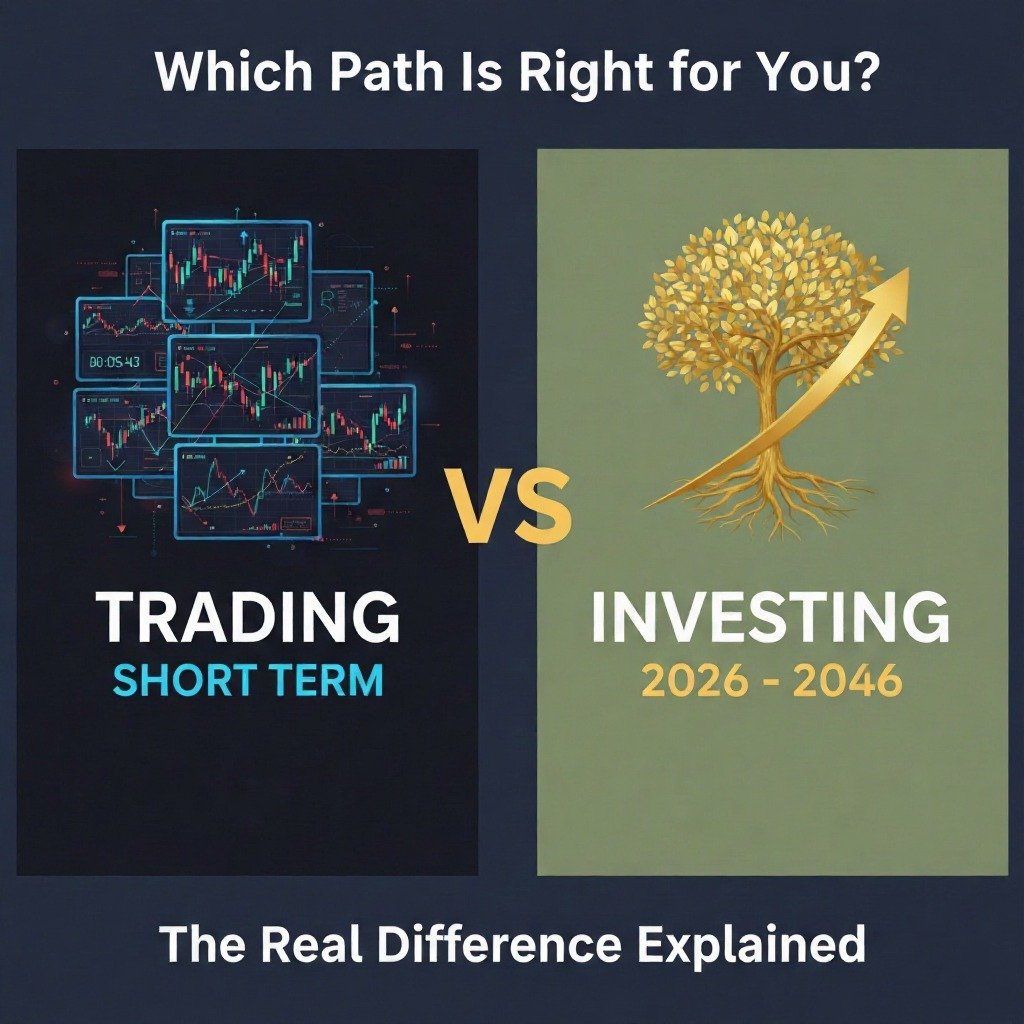
Trading and investing—two words often used interchangeably, but they represent completely opposite approaches to making money in the stock market. Get this choice wrong, and you could waste years chasing profits that never materialize. Get it right, and you’ll have a clear roadmap to building real wealth.
The difference between trading and investing goes far beyond timeframes. It’s about different mindsets, different skill sets, different risk profiles, and different lifestyles. Your personality, available time, and financial goals should determine which path you take—not what some guru on social media tells you.
This guide cuts through the confusion and gives you straight answers: Which is more profitable? Which is better for beginners? Can you do both? And most importantly—which one matches who you actually are, not who you wish you were?
What Trading Actually Means (Beyond the Basics)
Trading is about capitalizing on short-term price movements. When you trade, you’re trying to profit from the ups and downs that happen over days, weeks, or even minutes.
Think of it like flipping houses. You buy a property, improve it quickly, and sell it for a profit. You’re not interested in living there for 30 years—you want in and out with gains.
Many beginners confuse these two approaches, thinking they’re just different speeds of the same activity. That’s a costly mistake.
Here’s what makes trading unique:
- Positions are held from seconds to several months (rarely longer)
- Success depends on timing and technical analysis
- Profits come from volatility, not company growth
- You’re watching charts, patterns, and market sentiment constantly
- Emotions run high because decisions happen quickly
Day traders might make dozens of trades in a single session. Swing traders hold positions for days or weeks. The common thread? They’re all focused on price action, not the underlying business value.
What Investing Really Involves
Investing takes the opposite approach. You’re buying ownership in companies you believe will grow over time,
and you’re willing to wait years—even decades—for that growth to pay off.
Warren Buffett’s famous line captures it perfectly: “If you aren’t willing to own a stock for ten years, don’t even think about owning it for ten minutes.”
For clear definitions and basic concepts, resources like Investopedia provide foundational explanations of market terms, risk, and different financial strategies.
What defines the long-term approach:
- Positions held for years or decades
- Focus on company fundamentals and long-term potential
- Profits come from business growth and compound returns
- Less time spent monitoring daily price movements
- Emotional discipline centers on patience, not quick reactions
When you invest in a company like Microsoft or Johnson & Johnson, you’re betting on their ability to innovate, generate profits, and reward shareholders over many years. Daily price swings? Just noise in the bigger picture.
The stock market offers two distinct paths to potential wealth, but they require completely different mindsets.
The Core Difference Between Trading and Investing in the Stock Market
Both activities happen in the same market, using the same stocks. But the similarities end there.
Time horizon is the most obvious divider. Traders measure success in days or weeks. Investors think in years
and decades.
But there’s something deeper that separates these approaches: what you’re actually analyzing.
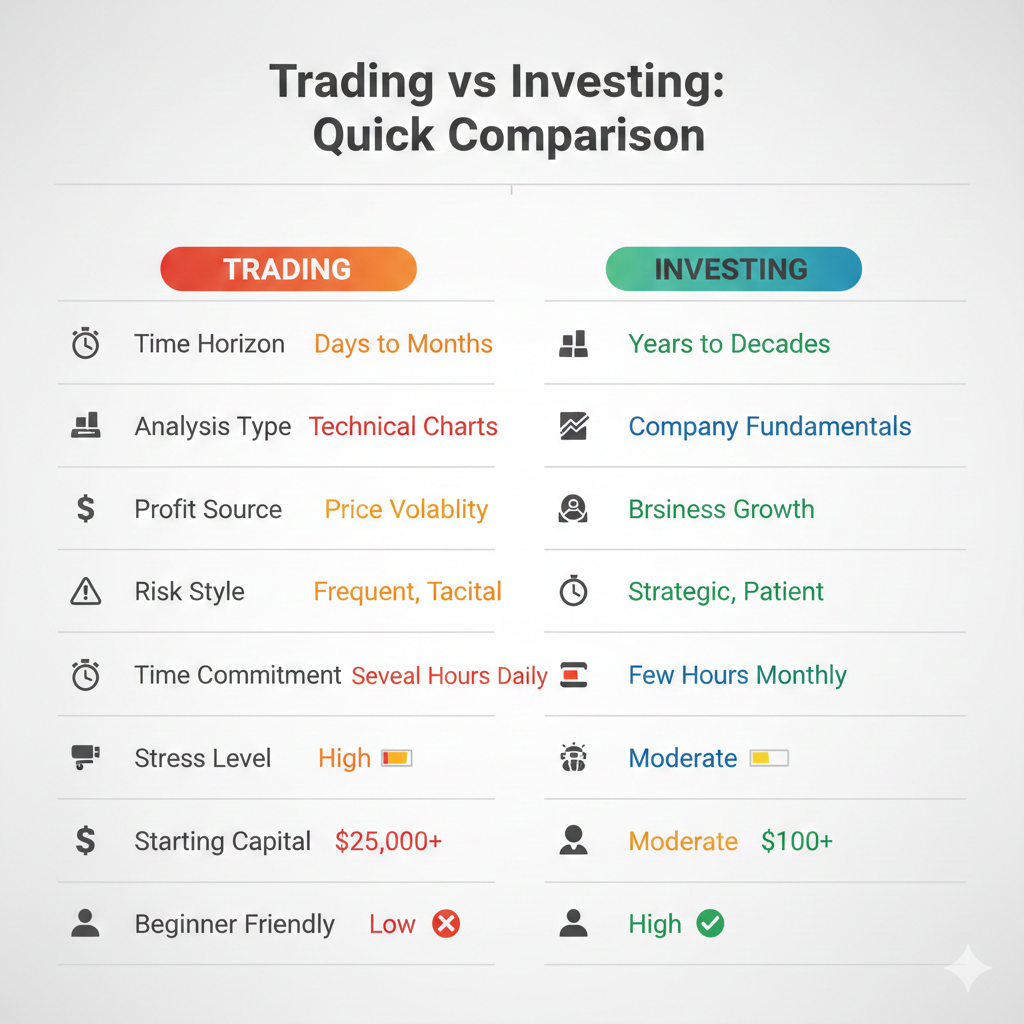
Trading vs Investing: Quick Comparison
| Aspect | Trading | Investing |
|---|---|---|
| Time Horizon | Days to months | Years to decades |
| Primary Analysis | Technical charts & patterns | Company fundamentals |
| Profit Source | Price volatility | Business growth |
| Risk Style | Frequent, tactical | Strategic, patient |
| Time Commitment | Several hours daily | Few hours monthly |
| Stress Level | High | Moderate |
| Tax Efficiency | Low (short-term rates) | High (long-term rates) |
| Beginner Friendly | Low | High |
| Capital Requirements | $25K+ for day trading | Can start with $100 |
Traders study price charts, volume patterns, support and resistance levels. They want to predict where the price is going next based on market behavior. The company’s quarterly earnings? Not really their concern unless it moves the stock price immediately.
Investors dive into financial statements, competitive advantages, industry trends, and management quality. They’re trying to determine if a company will be worth more five years from now. Short-term price drops? Often seen as buying opportunities, not warning signs.
This kind of patience-driven approach relies heavily on long-term stock market analysis—looking past daily price swings and focusing on how a business compounds value over years.
Your relationship with risk changes too. When it comes to market participation, risk management looks completely different for each strategy.
Short-term traders take many small risks frequently. You might win 60% of the time but lose 40%. That’s acceptable because your winners outweigh your losers, and you move on quickly
Long-term investors accept that portfolios will swing in value—sometimes dramatically—but believe the trajectory is upward. You’re risking short-term volatility for long-term gains.
Trading vs Investing: Which Is More Profitable?
This is where things get interesting, and the answer might surprise you.
Studies consistently show that most active traders underperform the market. According to research tracking thousands of traders, about 80-90% lose money or barely break even after accounting for fees and taxes.
The math works against you. Every trade costs money through commissions, spreads, and short-term capital gains taxes (which can eat up to 37% of your profits in the US). Make 100 trades a year, and those costs pile up fast.
Meanwhile, patient investors who buy and hold quality companies have historically earned around 10% annually on average. Not every year, of course—some years you’re up 30%, others you’re down 15%. But over decades, the numbers favor buy-and-hold strategies.
But here’s the nuance: a small percentage of skilled traders do beat the market. These are professionals who’ve developed proven systems, maintain iron discipline, and treat it like a full-time job. They exist, but they’re rare.
For the average person with a full-time career and family obligations, patient capital allocation has proven more profitable over time. You don’t need to be glued to your screen. You don’t need to outthink the market daily. You just need patience and decent company selection.
That said, active market participation can generate income if you’re among the disciplined few. Some experienced traders make consistent returns through well-defined strategies. Profitability depends heavily on your skill level, time commitment, and emotional discipline.
Trading vs Investing: Which Is Better for Beginners?
If you’re just starting out, long-term wealth building offers a much friendlier entry point.
For anyone who’s still learning the ropes, starting slow matters. A structured approach to investing in the stock market safely as a beginner helps you understand risk, fundamentals, and market behavior without the pressure of short-term decision-making.
Here’s why: patient strategies forgive mistakes. Buy a solid company at a slightly high price? Just hold it, and time often bails you out. The company grows, your purchase price becomes irrelevant, and you still profit.
Short-term market participation punishes mistakes immediately. Enter a position at the wrong time, and you’re watching real losses within hours. There’s no “wait it out” safety net because your strategy requires exiting quickly.
For beginners, long-term strategies provide:
- Time to learn without constant pressure
- Ability to start small and build gradually
- Forgiveness for imperfect timing
- Simpler analysis focused on fundamentals
- Lower stress and time commitment
Investment trading for beginners means starting with index funds or stable blue-chip stocks. Learn how markets work. Understand what makes companies valuable. Build confidence through small wins.
Once you understand market basics—and only then—you might explore active strategies. But rushing into short-term speculation as a beginner is like learning to drive in a Formula 1 car. Technically possible, but you’ll probably crash.
The choice for newcomers is clear: start with patient capital allocation, then explore active strategies only after you’ve built a solid foundation.
Trading vs Investing Risk Management: Two Different Games
Both approaches require managing risk, but the execution looks completely different.
Short-term trading risk management:
- Setting strict stop-loss orders on every position
- Never risking more than 1-2% of capital on a single trade
- Accepting small losses quickly before they become big ones
- Diversifying across multiple trades, not just sectors
- Monitoring positions constantly for exit signals
Traders live by the rule: protect your capital first, make profits second. One bad trade shouldn’t wreck your account, so you cut losses ruthlessly.
Long-term investing risk management:
- Diversifying across different companies and sectors
- Sizing positions so no single holding dominates your portfolio
- Understanding your time horizon and tolerance for downturns
- Avoiding panic selling during market crashes
- Rebalancing periodically to maintain your target allocation
Investors focus on surviving downturns without selling at the bottom. Their worst enemy isn’t a bad stock—it’s emotional decisions during volatility.
The difference? Short-term risk management is tactical and immediate. Long-term risk management is strategic and patient. Neither is “better,” but they require different skills and temperaments.
Can I Do Both Trading and Investing?
Absolutely, and many experienced market participants successfully combine both strategies in their overall portfolio.
The key is keeping the two activities separate—both mentally and practically.
Here’s a smart approach:
Set aside 80-90% of your capital for long-term wealth building. This is your buy-and-hold money. Acquire quality companies or index funds, and leave them alone for years.
Use the remaining 10-20% for active market participation if you want to engage in shorter-term opportunities. This is your “tuition money” for learning. If you lose it, your long-term wealth isn’t compromised.
Never blur these lines. Don’t suddenly decide to “trade” your long-term holdings because they’ve dropped and you want to “get out before it gets worse.” That’s how investors destroy their returns.
Think of it like your budget. Most of your money goes to essential expenses and savings (long-term holdings). A small portion might go to entertainment or hobbies (active trading). You wouldn’t gamble your rent money—don’t gamble your retirement money either.
Some people successfully run dual portfolios. Their long-term positions grow steadily while they scratch their active trading itch with a controlled amount. Combining both approaches is possible, but it requires discipline to keep them separated.
Which Approach Fits Your Personality and Lifestyle?
Your personal situation matters more than any general advice when choosing your market strategy.
Consider active trading if you:
- Genuinely enjoy analyzing charts and market patterns
- Can dedicate several hours daily to market monitoring
- Handle stress and rapid losses without emotional spiraling
- Have risk capital you can afford to lose while learning
- Thrive on quick decisions and active engagement
- Don’t need the money for years and can absorb learning losses
Lean toward long-term investing if you:
- Prefer analyzing businesses over reading price charts
- Have a full-time job or other major time commitments
- Value peace of mind over constant market action
- Need your money to grow for retirement or major goals
- Struggle with emotional decisions under pressure
- Want wealth building without becoming a market expert
Be honest with yourself here. I’ve seen too many people try to force themselves into active trading because it sounds exciting, only to discover they hate the stress and lose money in the process.
There’s no shame in being a patient investor. Some of the wealthiest people in history—Warren Buffett, Charlie Munger, Peter Lynch—built fortunes through patient capital allocation, not frantic speculation.
Your choice ultimately depends on your lifestyle, risk tolerance, and financial goals.
The Tax Implications Nobody Talks About
Here’s a reality check that catches many beginners off guard: taxes dramatically affect your real returns, especially with frequent trading.
In most countries, short-term gains (assets held less than a year) are taxed as ordinary income. In the US, that means rates up to 37% for high earners. Trade frequently, and you’re handing a huge chunk of your profits to the tax authorities.
Long-term capital gains (assets held over a year) usually get preferential rates—often 15-20% in the US. That’s a massive difference.
Quick example:
Make $10,000 from short-term trades with a 35% tax rate? You keep $6,500.
Make $10,000 from long-term holdings with a 15% tax rate? You keep $8,500.
Same profit, but the patient investor keeps $2,000 more just by holding longer.
This doesn’t mean active strategies are always worse after taxes—some traders make enough to overcome the tax hit. But beginners rarely account for this, then wonder why their “profitable” year barely moved their account balance.
Tax efficiency is one of the hidden advantages of patient wealth building over frequent market activity.
Common Mistakes That Cross Both Strategies
Whether you choose active or passive strategies, certain errors appear everywhere:
Chasing performance. Last year’s hot stock or trendy trade becomes this year’s disaster. Past results don’t guarantee future success—ever.
Ignoring fees. Transaction costs, fund expenses, and advisory fees seem small but compound over time. A 1% annual fee doesn’t sound like much until you realize it could cost you 25% of your wealth over 30 years.
Emotional decision-making. Buying high because of FOMO (fear of missing out) or selling low because of panic destroys returns in both approaches.
Lack of a plan. Jumping between strategies, changing your approach after every loss, or buying random stocks without criteria—these behaviors guarantee mediocre results.
Overleveraging. Using too much margin or borrowed money amplifies both gains and losses. Many people discover they can’t handle the downside only after it’s too late.
The difference between trading and investing might be significant, but these mistakes respect no boundaries. They’ll wreck your returns regardless of which path you choose.
Building Your Personal Strategy: A Practical Starting Point
Stop trying to figure out which approach is “better” in the abstract. Start with where you are right now.
For complete beginners:
Open a brokerage account and start with index funds or ETF investments if you’re new and still figuring out how to invest in the stock market safely as a responsibly.
Give yourself six months to a year just observing and learning. Most people skip this step and pay for it in losses.
For those with some experience:
If you’ve successfully built a portfolio and want to explore active strategies, start small. Take 5-10% of your capital and practice short-term techniques. Track every trade, including the rationale, entry, exit, and results.
After six months, review honestly. Are you actually making money after fees and taxes? Or just spinning your wheels while your long-term holdings quietly outperform?
For advanced participants:
You probably already know what works for your personality. Keep refining your systems, managing risk better, and staying disciplined. The market rewards consistency and punishes ego.
Your journey should start with education, continue with small experiments, and only scale up after you’ve proven your strategy works.
Real Talk: What the Gurus Won’t Tell You
The financial education industry loves selling courses on trading. Why? Because it sounds exciting, promises quick money, and people will pay thousands to learn “secrets.”
Here’s the truth: there are no secrets. Success requires screen time, emotional control, and probabilistic thinking. Most courses teach basic technical analysis available free online, wrapped in hype and testimonials from the few who succeeded.
Patient wealth building doesn’t sell as well because it’s “boring.” Buy good companies, hold them, ignore the noise. Not exactly clickbait material.
But boring often wins. The difference between these approaches isn’t just about time horizons or analysis methods—it’s about accepting that wealth usually builds slowly, not through finding some magic formula.
I’m not saying active strategies can’t work. I’m saying the path is harder than most imagine, and the success rate is lower than most courses admit.
Many people waste years and thousands of dollars chasing quick profits when they could have built substantial wealth through straightforward, patient strategies.
Understanding Both Approaches: The Complete Picture
Now that you understand the fundamental differences, you might be wondering how these strategies fit into your overall financial plan.
The truth is, both have merit depending on your circumstances.
These approaches aren’t enemies—they’re tools. Some people build wealth exclusively through long-term holdings. Others generate income through disciplined short-term strategies. Many successful participants use both in different parts of their portfolio.
The stock market rewards different personalities. If you’re analytical, patient, and comfortable with long time horizons, buy-and-hold probably suits you. If you’re quick-thinking, enjoy active problem-solving, and can handle frequent losses, active trading might work.
But here’s what matters most: neither approach guarantees success. Both require education, discipline, and honest self-assessment.
The key lies in knowing yourself. Recognize your strengths, acknowledge your weaknesses, and choose the path that aligns with who you are—not who the financial media says you should be.
Start where you’re comfortable. Most people find that patient investing provides the foundation for wealth building, while active trading (if pursued at all) becomes a small, controlled addition to their portfolio.
Frequently Asked Questions
What is the main difference between trading and investing?
Trading focuses on short-term price movements and typically involves holding positions for days to months, while investing emphasizes long-term company growth and involves holding assets for years or decades. Traders profit from volatility; investors profit from business success over time.
Is trading or investing more profitable for beginners?
Investing typically proves more profitable for beginners because it forgives timing mistakes, requires less time and expertise, and avoids the high costs and taxes associated with frequent trading. Most beginner traders lose money while learning, whereas beginner investors can succeed with simple index fund strategies.
Can you do both trading and investing at the same time?
Yes, many people successfully maintain both a long-term investment portfolio and a separate trading account. The key is keeping them separate—allocate most capital (80-90%) to long-term holdings and only risk a small portion (10-20%) on active trading to avoid jeopardizing wealth.
Which requires less time: trading or investing?
Investing requires significantly less time commitment. After initial research and portfolio setup, investors might spend a few hours monthly reviewing holdings. Trading demands daily attention, often several hours per day monitoring positions, analyzing charts, and executing trades.
What are the tax differences between trading and investing?
Short-term trading profits are usually taxed as ordinary income (up to 37% in the US), while long-term investment gains typically qualify for lower capital gains rates (15-20%). This tax difference can significantly impact your actual returns, often favoring patient investors.
Is day trading the same as investing?
No, day trading is a specific form of trading where positions are opened and closed within the same day. It’s the opposite of investing, which involves holding assets for years. Day trading is extremely risky, requires substantial capital and expertise, and most day traders lose money.
What is investment trading for beginners?
Investment trading for beginners typically refers to starting with long-term strategies using index funds or stable stocks before attempting any active trading. It’s about learning market fundamentals through lower-risk investments before exploring shorter-term approaches.
What is the difference between trading and investing in the stock market?
In the stock market, trading involves buying and selling securities frequently to profit from short-term price fluctuations, while investing means purchasing securities to hold long-term for gradual appreciation and income. Both use the same market but with completely different timeframes, analysis methods, and risk profiles.
The Bottom Line: Choose Your Path Wisely
The difference between trading and investing isn’t about which is objectively better—it’s about which matches your goals, personality, and life situation.
If you have decades until retirement, enjoy stability over excitement, and want proven wealth-building results, patient investing wins. Start with index funds, learn about quality companies, and let compound growth do the heavy lifting.
If you’re fascinated by market dynamics, willing to dedicate serious time to learning, and can handle the emotional rollercoaster of active strategies, then explore that path—but start small and treat your early attempts as education, not income.
For most people reading this, the honest answer is long-term wealth building. Establish your foundation there. Once you’ve got years of experience and a solid portfolio, you can always explore active trading with money you can afford to lose.
The market doesn’t care about your approach—it rewards discipline, patience, and honest self-assessment. Whether you choose one path or combine both strategies, success comes from consistency and self-awareness.
Pick the strategy that fits who you are, not who you wish you were. That’s how you actually make money in the stock market. Both approaches can build wealth, but only if you choose the path that matches your personality, resources, and commitment level.
Start learning, start small, and start building your financial future today.
Written by a long-term market observer with experience in both investing and active trading.